Microanalytical and Microstructural Analysis of Thirteenth-Century Luster Tiles Attributed to the Emamzadeh Yahya in Varamin, and a Comparison to a Nineteenth-Century Imitation ‘Luster’ Tile by ʿAli Mohammad Esfahani
Trinitat Pradell, Judit Molera, Moujan Matin, and Keelan Overton
Contents:
- Introduction to the Emamzadeh Yahya’s Luster Tilework: In Situ, On Display, and In Storage
- Why Scientific Analysis? Questions, Goals, and Building the Project
- Sampling the Tiles: Oxford and London
- Techniques of Analysis and Preparing the Samples: Barcelona
- Scientific Results: Ceramic Bodies
- Historical Context: Iranian Stonepaste between the Thirteenth and Nineteenth Centuries
- Scientific Results: Glazes
- Scientific Results: Luster Decoration of the Thirteenth-Century Emamzadeh Yahya Tiles
- Scientific Results: Imitation ‘Luster’ Decoration of the Nineteenth-Century Tile by ʿAli Mohammad Esfahani
- Conclusion
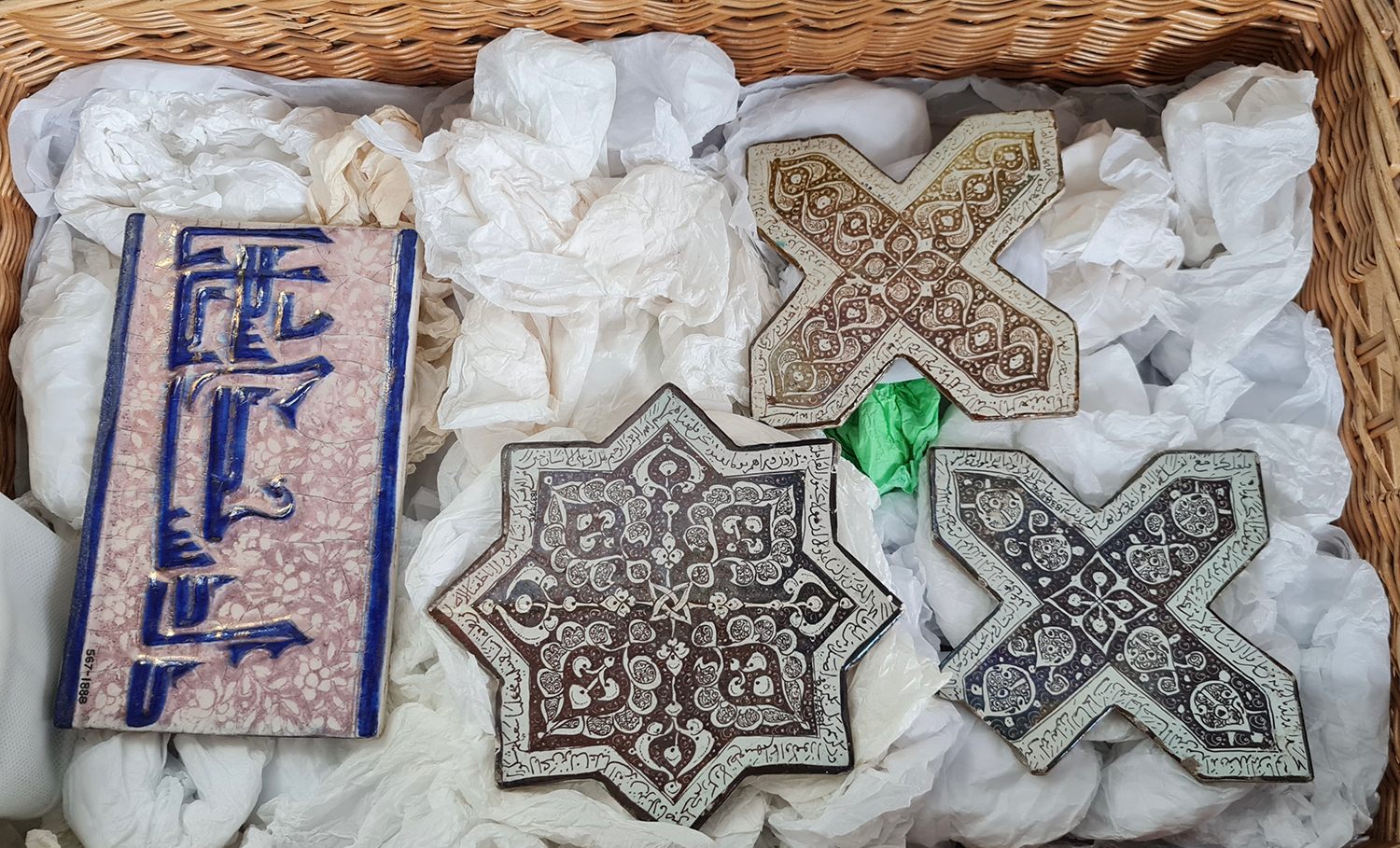
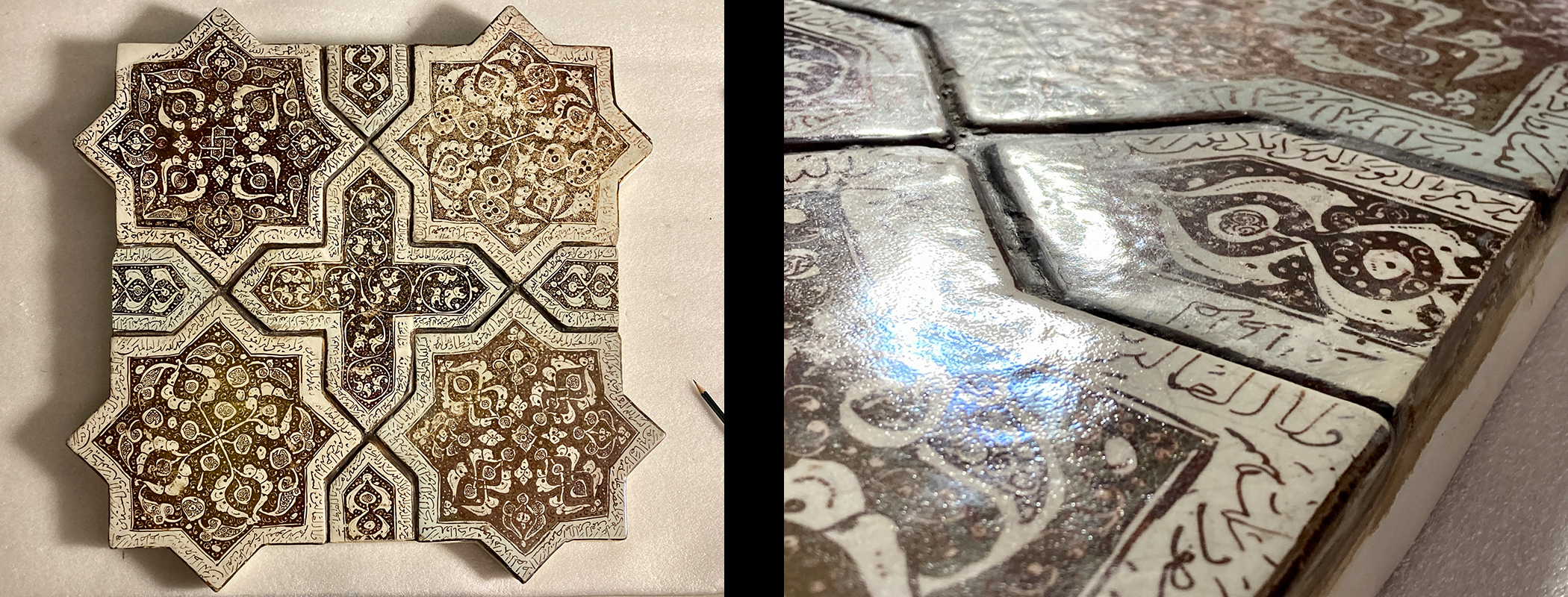
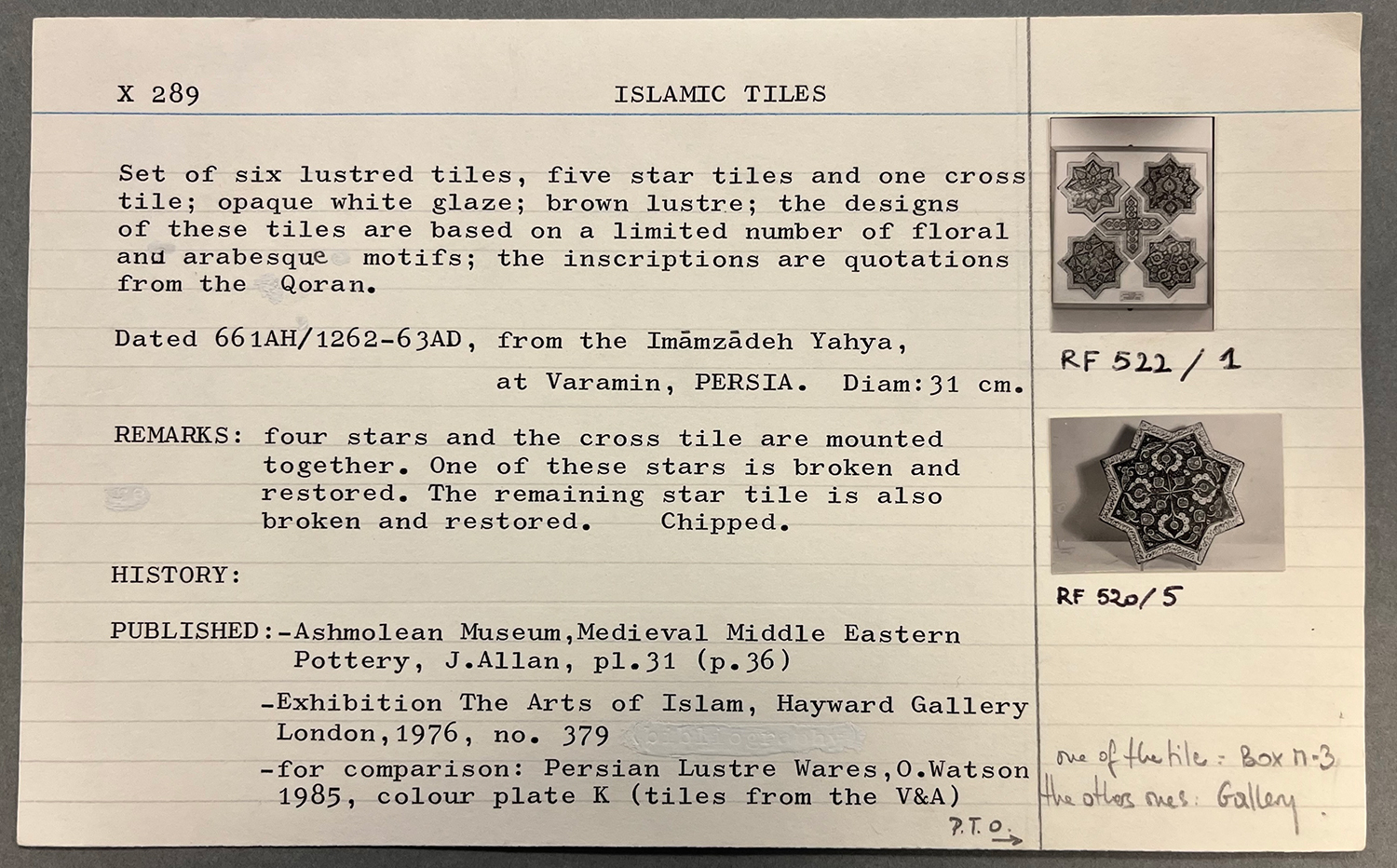
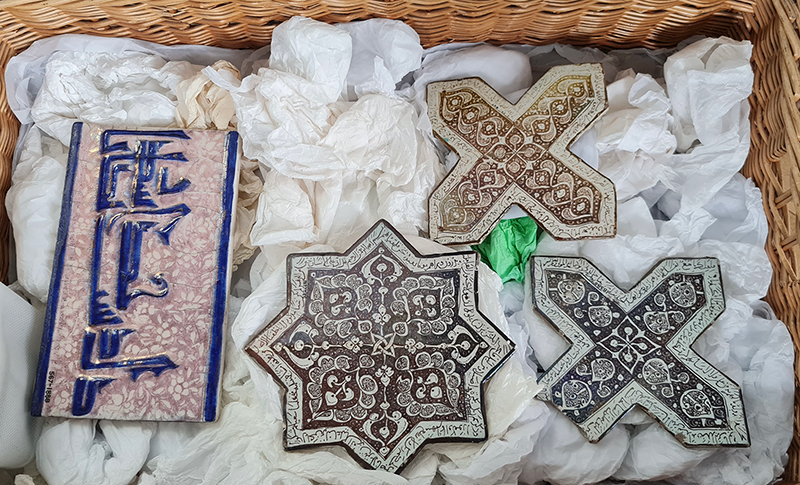
This essay presents the findings of a three-year collaborative scientific analysis project dedicated to developing a deeper understanding of the material compositions and production techniques of thirteenth-century luster (or lustre) tiles from the tomb of Emamzadeh Yahya in Varamin. The analysis of luster tilework is extremely challenging. In order to achieve precise quantitative results, invasive sampling is required, but the extreme thinness of the luster layer, coupled with the need for specialized equipment to assess it, makes the process especially difficult. Two British museums ultimately approved the sampling of tiles in their collection for inclusion in this study: the Ashmolean Museum in Oxford and Victoria and Albert Museum (V&A) in London (fig. 1). Barcelona-based physicist Trinitat Pradell and geologist Judit Molera extracted the samples in July 2024 and then analyzed them in laboratories at the Universitat Politècnica de Catalunya · BarcelonaTech (UPC) and ALBA Synchrotron.
During the selection of tiles in the V&A, the opportunity presented itself to investigate a nineteenth-century tile that has long been described as ‘luster’ (see fig. 1). This rectangular epigraphic tile was made by Tehran-based potter ʿAli Mohammad Esfahani (fl. ca. 1880–1900) and purchased by the museum in 1887, around the same time that it was acquiring luster tiles from the Emamzadeh Yahya. The decision was made to incorporate this nineteenth-century tile into our analysis, allowing room to explore where the technological evidence and comparison might lead.
This multivocal interdisciplinary essay is organized into ten sections. It begins with Keelan Overton’s introduction to the Emamzadeh Yahya’s luster tiles and overview of this project’s goals and development. Trinitat Pradell and Judit Molera’s scientific findings are presented in three categories: the ceramic body, glaze, and luster decoration. The Emamzadeh Yahya tiles are discussed first, followed by the ʿAli Mohammad Esfahani, thus facilitating a deeper comparison. Throughout the text, archaeological scientist Moujan Matin bridges the fields of material science and Persian art and architectural history. This collaborative study seeks to be useful to scientists specializing in materiality, curators and conservators of the tiles in question, readers with a general interest in Iranian luster across the centuries (thirteenth to nineteenth), and students interested in bridging science and the humanities. The inclusion of many videos and photographs taken in laboratories and museum storage aims to make both the scientific process and the tiles more tangible and accessible.
Introduction to the Emamzadeh Yahya’s Luster Tilework: In Situ, On Display, and In Storage
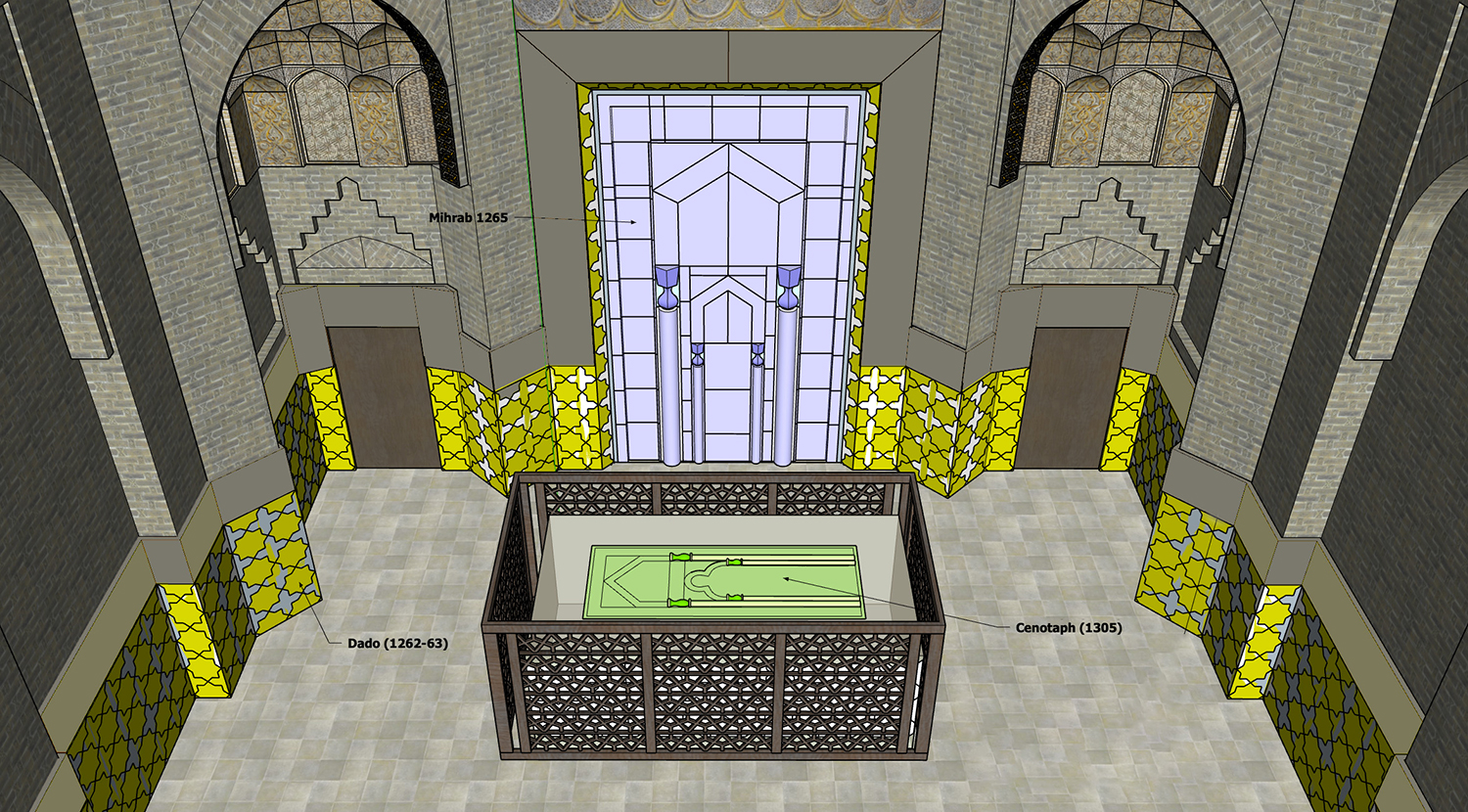
The luster tilework that once served architectural, sacred, and aesthetic functions in the tomb of Emamzadeh Yahya at Varamin is now scattered across the globe in private and public collections (fig. 2). The tomb’s mihrab is in the Shangri La Museum of Islamic Art, Culture & Design in Honolulu, previously the home of American collector Doris Duke (d. 1993). Originally composed of over sixty tiles, it is now an ensemble of fifty-four tiles, some of which are mispositioned and/or damaged. Several tiles isolated from the mihrab have been identified in other collections, and still others remain to be located.1 The four-tiled panel inscribed “Emam-e ʿalem, Yahya” (امامِ عالِم یحیی) and presumed to have sat on the upper surface of the cenotaph of Yahya b. ʿAli (d. 255–56/869–70) is in the State Hermitage Museum in St. Petersburg.2 Research remains in progress to identify the many other tiles that once clad this sizeable rectangular box.3
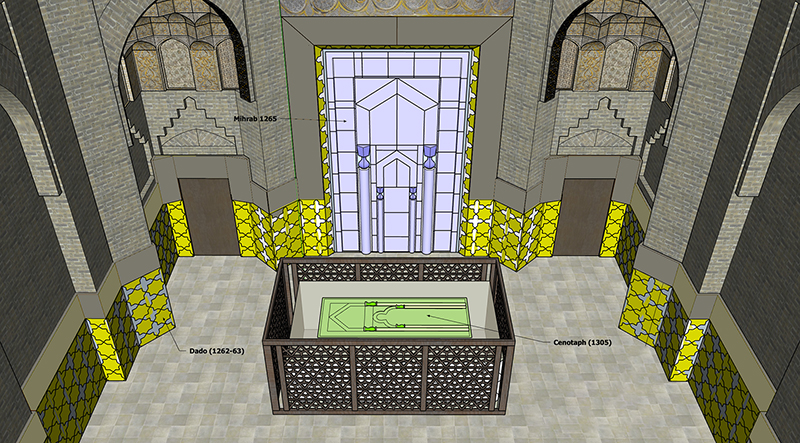
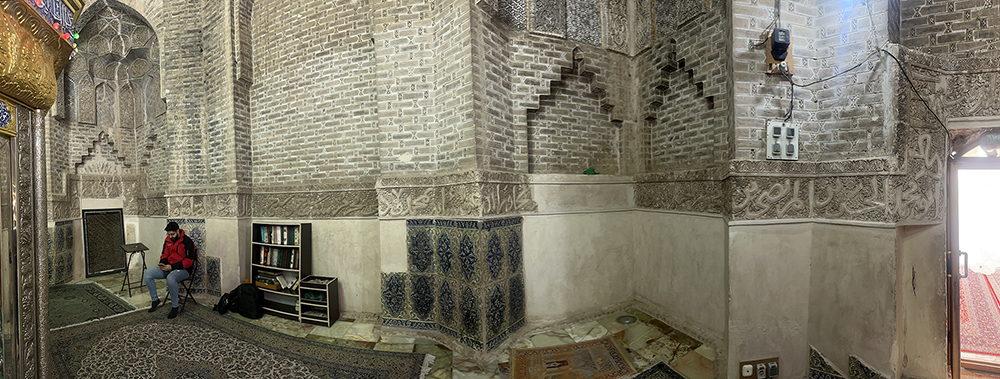
The majority of luster tiles attributed to the Emamzadeh Yahya in collections worldwide are stars and crosses presumed to have clad the tomb’s dado (lower walls) or bordered the mihrab in half versions (figs. 2–3).4 Decorated with vegetal patterns and generally framed by Qur’anic inscriptions, they are notable for their palette of white and luster alone and large size (about 30 cm).5 At present, we can estimate that these tiles are preserved in at least fifty collections worldwide, and in many cases, they are considered ‘stars’ of the collection.6
Approaches to the display and curation of the Emamzadeh Yahya’s luster star and cross tiles vary tremendously. Some museums preserve many tiles from the tomb, in complete and fragmented form, but only display a small portion or a single representative example. Examples include the State Hermitage Museum in St. Petersburg (the largest collection), Museum of Islamic Art in Doha (the closest sizeable collection to Iran), British Museum in London, and Sèvres, Musée national de Céramique (vid. 1 and jump ahead to vid. 4).7 At the Victoria and Albert Museum in London, the tiles are so relevant and malleable to different curatorial narratives that they are presented in four displays, one of which can be called ‘open storage’ (areas of permanent storage in the public galleries).8 Alongside museums, private collectors have also coveted these tiles, and some have since entered institutions open to the public (see the Checklist, nos. 17 and 18, and jump ahead to vid. 3).
Video 1. A luster star and cross tile attributed to the Emamzadeh Yahya at Varamin on display in Sèvres, Musée national de Céramique (Manufactures nationales, Sèvres & Mobilier national). This case usually displays three tiles from the tomb, but a second star tile, and several other notable luster tiles in the collection, were at the time on loan to “Gengis Khan: Comment les Mongols ont changé le monde,” an exhibition at the Château des ducs de Bretagne in Nantes (see Overton, “Introduction,” fig. 9 and vid. 2). Video by Keelan Overton, April 2024.
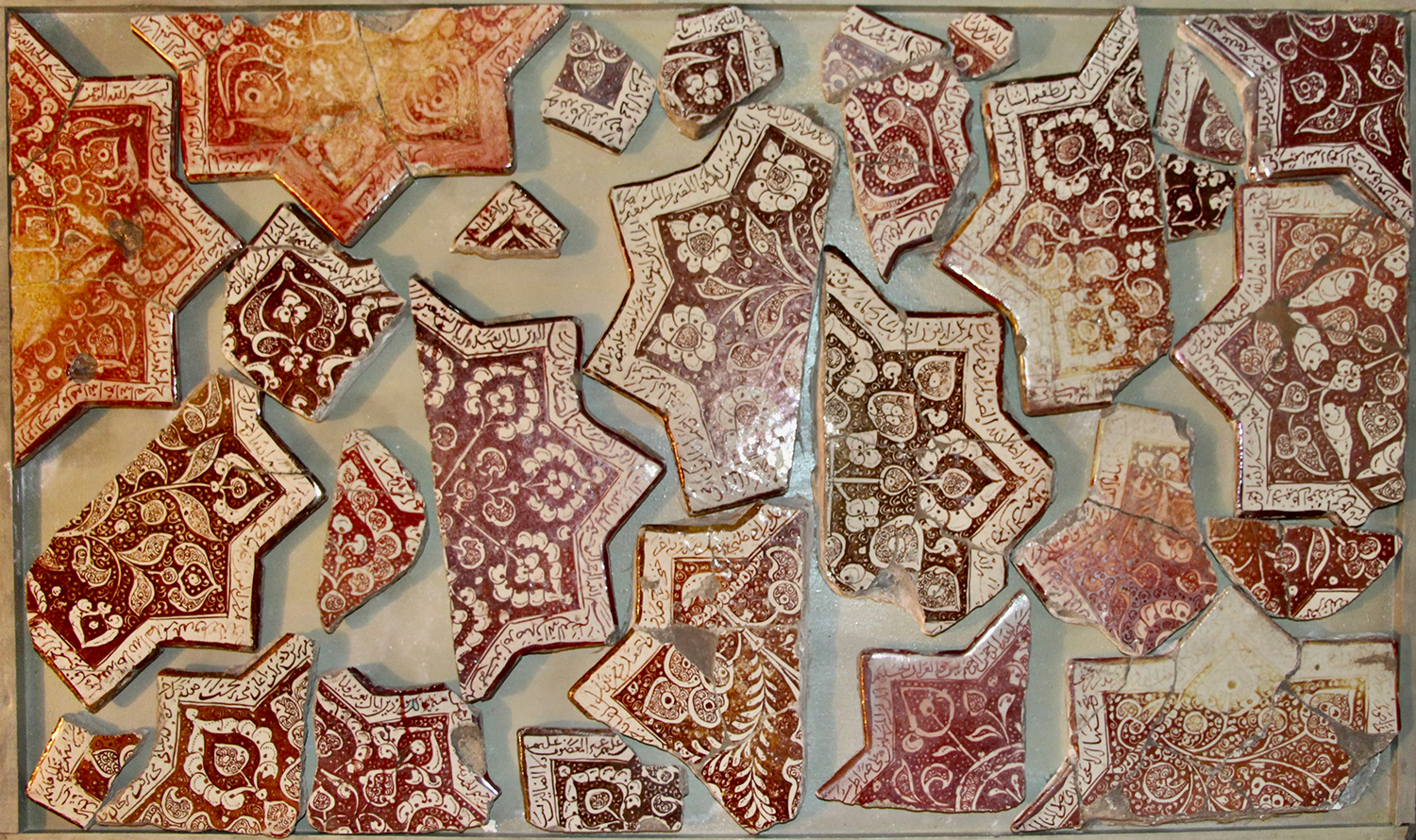
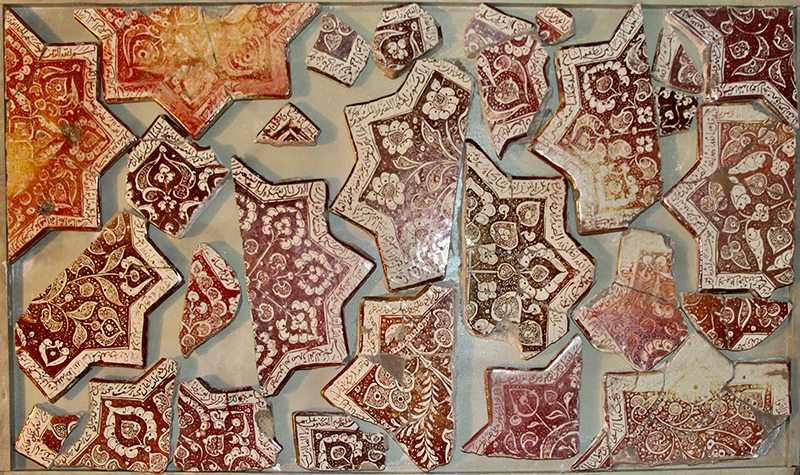
In fine art museums that prioritize exhibiting the most beautiful and pristine materials in their collection, curators tend to favor displaying Emamzadeh Yahya tiles considered to be in the best condition and lacking noticeable damage. Many tiles in ‘poor condition’ are rarely shown in the galleries and relegated to a lifetime of relative obscurity in storage. In some cases, their physical inaccessibility to the public is countered through their digital inclusion in the collections online, but in others, they have not even been photographed. The most immediate condition issue is the tile’s physical integrity. Some are broken but still recognizable as stars or crosses, while others are best described as fragments, since the surviving pieces are very small (fig. 4). Some accession numbers include letters that indicate a single tile’s breakage into pieces; for example, 16.330a-d, a half star in the Museum of Fine Arts Boston.9 Some of this breakage likely occurred when the tiles were pried from the tomb’s walls during the second half of the nineteenth century. Areas of stuccowork adjacent to the stolen tiles still preserve the marks of the vandalizer’s tools, and it is common to encounter cross tiles with a broken arm or tip, presumably caused by the pressure of the tool (consider this study’s V&A 1838B-1876).
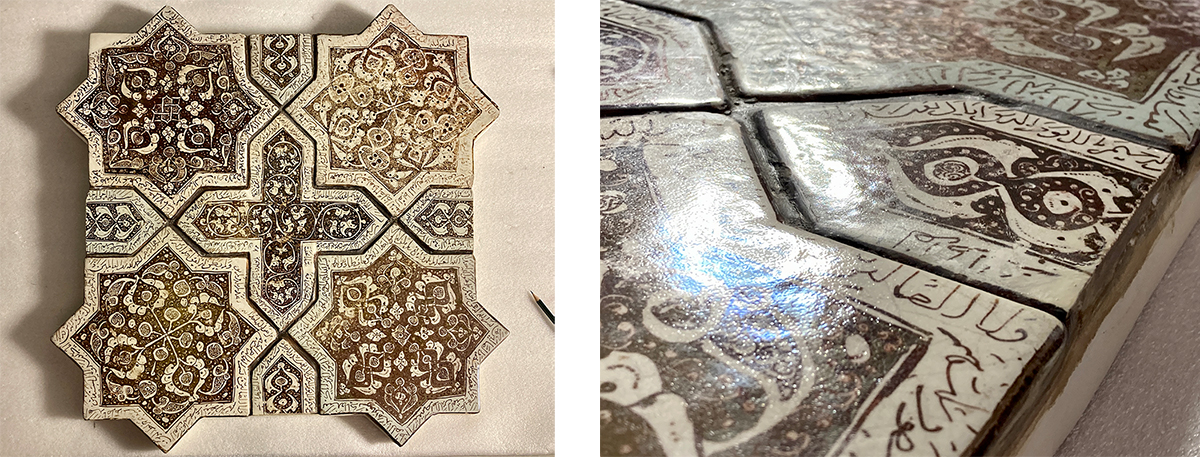
Video 2. Star tile attributed to the tomb of Emamzadeh Yahya at Varamin. Wereldmuseum, Rotterdam, WM-66085, acquired from dealer Saeed Motamed in 1977. This video focuses on the surface texture and play of light. Video by Keelan Overton, September 2022, taken in storage.
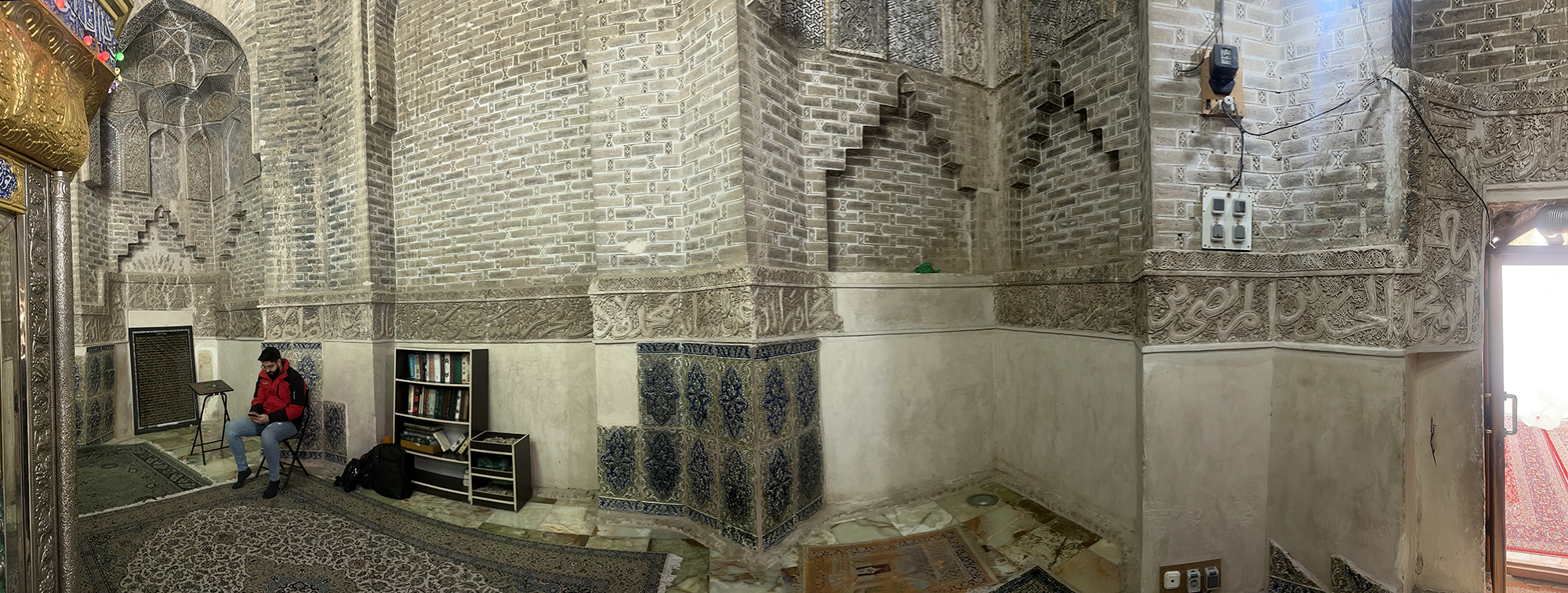
Most of the Emamzadeh Yahya star and cross tiles also exhibit areas of chipping or loss to the glaze and extremely thin luster layer. Additional disruptions to the surface can include abrasions, smearing, fading, cracking, pockmarking, and bubbling (vids. 2–3). These issues can stem from the tiles’ production in the presumed Kashan workshop (materials, techniques, the kiln), mounting in the tomb, and over six hundred years of existence on the walls of a living sacred space, where they were likely touched and rubbed during pious visitation (ziyarat). The stars and crosses in the dado were located beneath the 707/1307 stucco inscription upon which pilgrims wrote small inscriptions (yadegari) over the centuries.10
Video 3. Two broken and unrelated half star tiles attributed to the tomb of Emamzadeh Yahya at Varamin. Keramiekmuseum Princessehof, Leeuwarden; Loan Stichting van Achterbergh-Domhof, BP 01072.D and BP 01072.E. This video begins with a brief view of a broken cross tile from another site, signed by Abu Zayd al-Kashani and dated 606/1209 (BP 01072.C). Video by Keelan Overton, September 2022, taken in storage.
Still other damages can be attributed to the actions of dealers, collectors, restorers, and possibly even museum professionals. Some tiles were damaged during packing, transport, and display as isolated ‘objects.’ Others were likely cut to create new compositions, as was perhaps the case with four tips of crosses within a panel of five complete tiles (fig. 5). It was also common for half tiles to be fused together as one, as with this study’s composite star (V&A 1837H/L-1876). Such fusions sought to create a complete shape, which was considered more attractive to some, and could result in the mismatching of inscriptions and patterns (see the Checklist, no. 17). Many tiles were also heavily restored, and fills and repainting can be detected with the naked eye and technologies like UV light.
The museological description of these tiles as in ‘poor condition’ is therefore often attributable to human intervention during theft and collecting, rather than indicative of the quality of the tiles themselves or natural circumstances like age and exposure. Conversely, their presentation as in ‘excellent condition’ likewise warrants further physical and intellectual analysis. Regardless of their individual condition, all luster tiles preserved in museums, whether from the Emamzadeh Yahya or other sites, must be considered isolated parts of a much larger whole, since they originally constituted multi-tiled forms and surfaces (cenotaphs, mihrabs, dados, epigraphic friezes, borders) embedded into the architecture.11 Thus, from the architectural perspective, their current condition can hardly be considered ‘excellent’ or ‘complete.’ While museums tend to favor displaying eight-pointed stars and four-armed crosses from the Emamzadeh Yahya, the tomb’s architectural reality required a combination of full shapes, half versions, and even smaller units to completely clad its dynamic folding walls (see figs. 2 and 3).12
Why Scientific Analysis? Questions, Goals, and Building the Project
The seeds of this project were planted during research of Emamzadeh Yahya tiles in museums in France, the Netherlands, and England in 2021 and 2022. It became clear that many luster tiles attributed to the tomb were preserved in storage, and many were broken, hence unlikely to ever be displayed. These often dismissed and ignored tiles presented an excellent opportunity for scientific research, since they could potentially be approved for invasive sampling, which is preferred on materials that already exhibit some loss or damage. Scientific analysis also offered an opportunity to understand these tiles quantitatively and objectively from the inside out, versus through the sometimes murky art historical frames of attribution and provenance.
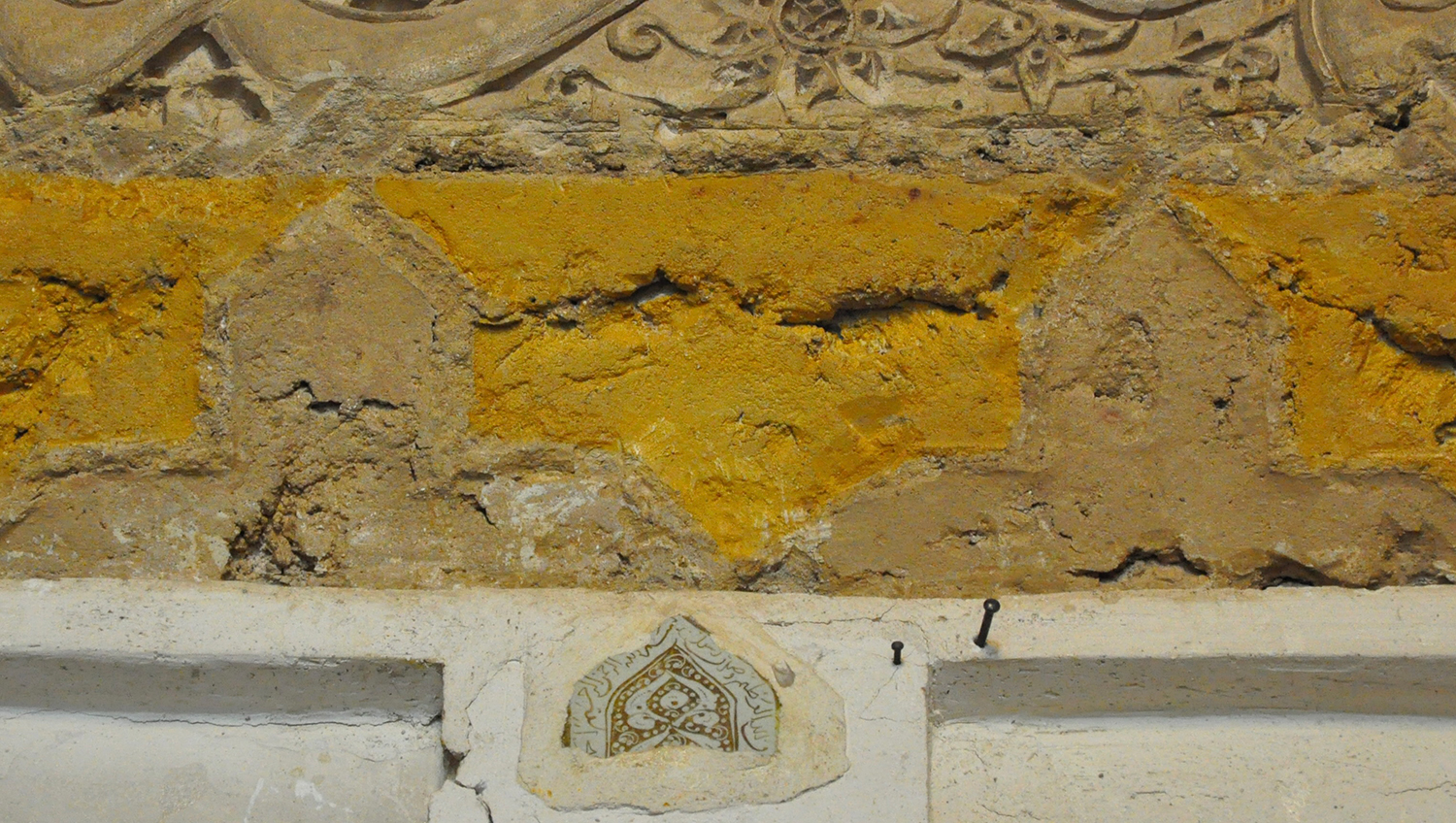
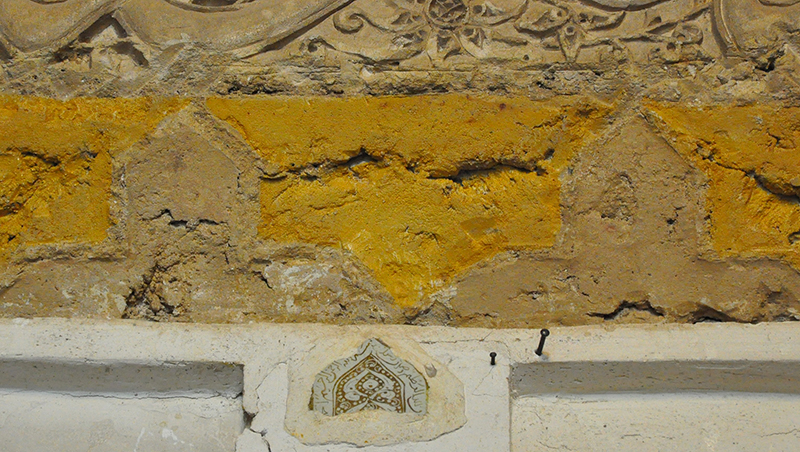
Star and cross tiles of the type that we today attribute to the Emamzadeh Yahya began entering European museums and private collections in the 1870s and 1880s. Known contemporary records describe the tiles and their origin generically as “from Verameen,” “de l’intérieur de la mosquée de Véramine (from the interior of the mosque at Varamin), and “Persian lustred wall tile.”13 While these descriptions can provide a useful starting point, the question remains: What is the concrete evidence tying these tiles to the Emamzadeh Yahya? Only one piece of luster tilework remains in the tomb: a small tip of a cross located at the top of the mihrab void, likely remounted there during the restoration of the shrine in the 1980s by the National Organization for the Preservation of Historic Monuments of Iran (fig. 6).14 The right side of the fragment ends in a prayer, the left side begins with the basmala and continues to the Qur’anic verse, and the visible trefoil echoes the triangular shape. This fragment closely resembles many crosses and cross fragments in museums, some of which are dated between 660–61/1262–63.15
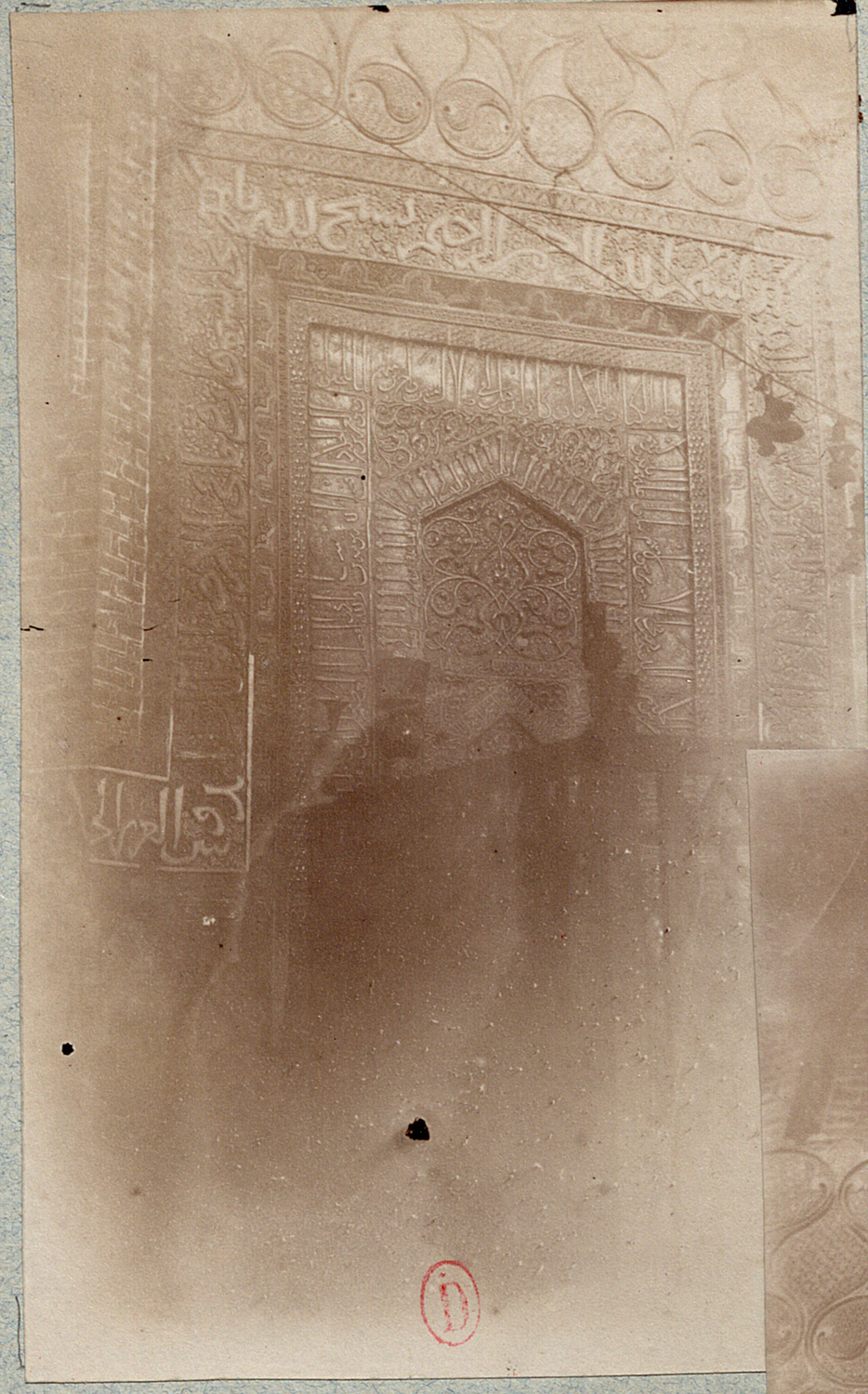
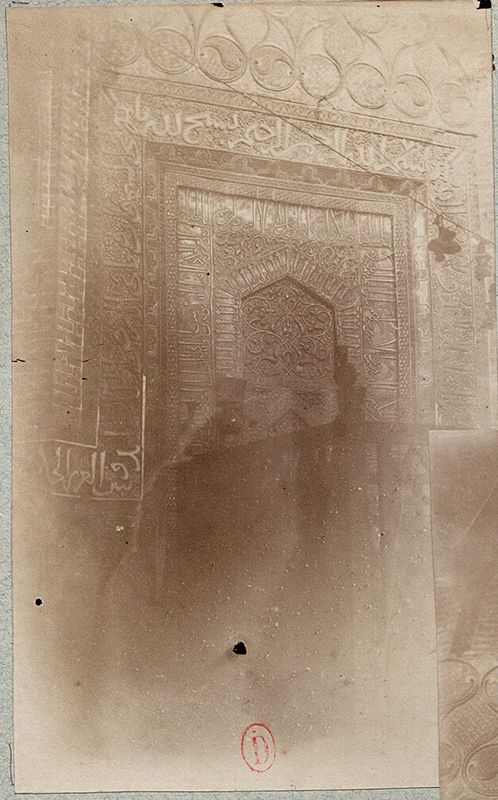
One of the best sources for understanding the tomb’s luster revetment in situ is a photograph taken by French explorer Jane Dieulafoy (d. 1916) in 1881 (fig. 7). It captures the upper half of the mihrab and its framing borders, including one composed of alternating half star and cross luster tiles. Some of these tiles’ imprints (the traces left behind from their adhesion to the wall with mortar) were subsequently uncovered, and they measure about 30 centimeters (see fig. 6). Imprints recorded in a 2015 photograph, and subsequently covered with plaster, likewise confirm the presence of stars and crosses in the dado.
While this physical and archival evidence strengthens attribution to the tomb, many questions remain. Were the stars and crosses only inscribed with Qur’anic verses, or did some have verses of Persian poetry?16 Were they only decorated with vegetal patterns, or did some potentially have figural motifs?17 What are we to make of similar stars and crosses measuring 20 centimeters and sometimes carrying the same range of dates?18 If these tiles are also from the shrine, what was their function and location? At present, we must leave open the possibility that luster tiles could have been used elsewhere in the complex, including an octagonal structure with a conical roof destroyed around the early 1900s.
Returning to the development of this independent scientific project, after conducting preliminary research in several museums, Overton began assembling the team of scientists. In the summer of 2023, archaeological scientist Moujan Matin provided critical advice on the necessary techniques and specialists. She emphasized that the luster layers of the Emamzadeh Yahya tiles were extremely thin, making them challenging to study with a regular scanning electron microscope (SEM) of the sort found in many museum conservation labs. The use of non-invasive portable XRF (X-ray fluorescence or EDXRF) was also discouraged for several reasons. First, the relatively large beam size limits spatial resolution and effectively requires a broader, more uniform surface area for reliable analysis. Second, because the glaze surfaces are often poorly preserved, the measured chemical composition can be altered and reduce the accuracy and reliability of the results. As a result, this method is generally more suitable for qualitative or semi-quantitative assessment.19
To achieve this project’s goal of precise quantitative analysis, more advanced techniques would be required, namely Field Emission Scanning Electron Microscopy (FESEM) with a Focused Ion Beam (FIB) for the imaging and an attached Energy Dispersive Spectroscopy (EDS) detector for the chemical analysis. The analysis would focus on areas of the glaze that were still well preserved and would involve cutting cross-sections of the glazes, hence a selectively invasive process, and taking SEM-EDS analyses of selected sub-millimeter areas. The identification of microcrystalline precipitates, bubbles, and other structures present in the glazes could also help to correlate the samples (tiles) to a specific production area. Matin recommended Barcelona-based physicist Trinitat Pradell, who in turn collaborated with geologist Judit Molera.
With the scientists in place, Overton submitted sampling proposals to several museums in North America and Europe, outlining the goals of the project and explaining each tile’s reason for inclusion. Unlike some recent scientific projects devoted to ceramic vessels presumed to have been made in medieval Kashan, the goals of this one were not to authenticate the selected tiles as thirteenth-century or unpack their layers of repair but rather to investigate their microstructural and chemical compositions.20 Some guiding questions included: What exactly are the tiles composed of? What is the relationship between the glaze and luster? How consistent are the compositions? Moving into broader contexts: How do the Emamzadeh Yahya tiles compare to those from other contemporary sites decorated with luster tilework? Can scientific data yield any preliminary conclusions on workshops and their methods? Finally, what are we to make of the many nineteenth-century tiles preserved in museums that seem to imitate, or at least be in conversation with, medieval luster models?21
The list of tiles proposed for inclusion in the project satisfied the following criteria:
- All tiles were in museum storage and already exhibited some loss to the luster and glaze, thus providing an optimal zone for selective invasive sampling
- Emamzadeh Yahya star and cross tiles could be confidently attributed to the tomb (dado or border around the mihrab) and reflected a variety of acquisition and provenance histories from the 1870s to the present century.22 Examples of both the 20- and 30-centimeter types were proposed.
- Comparanda fell into two categories: contemporary luster tiles from other sites, hence thirteenth or fourteenth century (vid. 4), or nineteenth-century tiles imitating medieval luster models
Video 4. Comparison of three tips of luster cross tiles, presumably all made in Kashan during the thirteenth or fourteenth centuries. The smallest fragment is attributed to the Emamzadeh Yahya at Varamin, hence circa 1262–63. Sèvres, Musée national de Céramique (Manufactures nationales, Sèvres & Mobilier national), D.933.2.63 (Emamzadeh Yahya), MNC 24946.1, and MNC 23415.P17 (all links are to Medieval Kāshi Online). This silent video focuses on the broken edges of the tiles and aims to offer a detailed naked-eye view of the ceramic body, glaze, and luster layers. Video by Keelan Overton, June 2024, taken in storage. For a high-resolution version with a soundtrack, please visit the Emamzadeh Yahya Project’s YouTube channel.
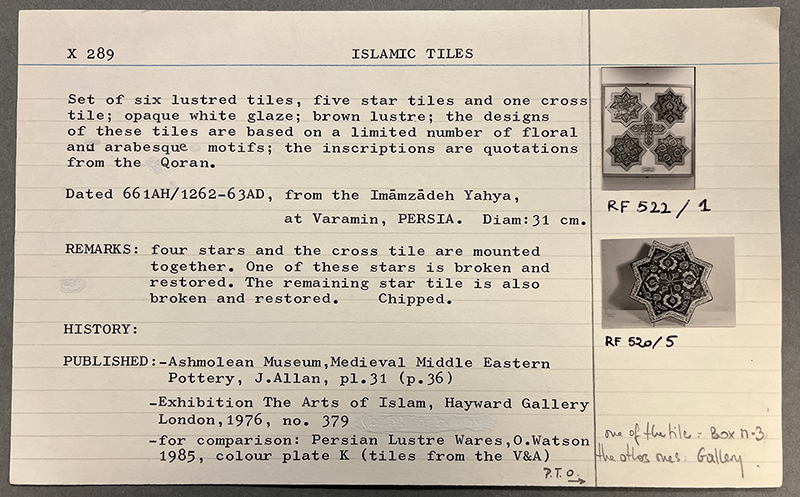
Four tiles attributed to the Emamzadeh Yahya were ultimately selected for sampling: one cross in the Ashmolean, two crosses in the V&A, and one star in the V&A composed of two halves joined together as one, meaning a true total of five tiles from the tomb. The tiles were acquired during an early period of collecting (1875–1932) and included examples purchased in 1875 from Jules Richard (d. 1891), one of Tehran’s most active and well-connected collector-dealers (Table I; fig. 8).23 This corpus enabled the consideration of many of the project’s initial art historical questions, but not all of them. Excluded were a 20-centimeter tile, a contemporary comparanda, and any examples acquired on the recent art market.24
Table I. Acquisition and provenance histories of the four (truly five) luster tiles from the Emamzadeh Yahya at Varamin analyzed in study. All tiles are presumed to have been made in Kashan, dated or dateable between 660/1262 and 661/1263, and measure about 30 centimeters. [pdf]
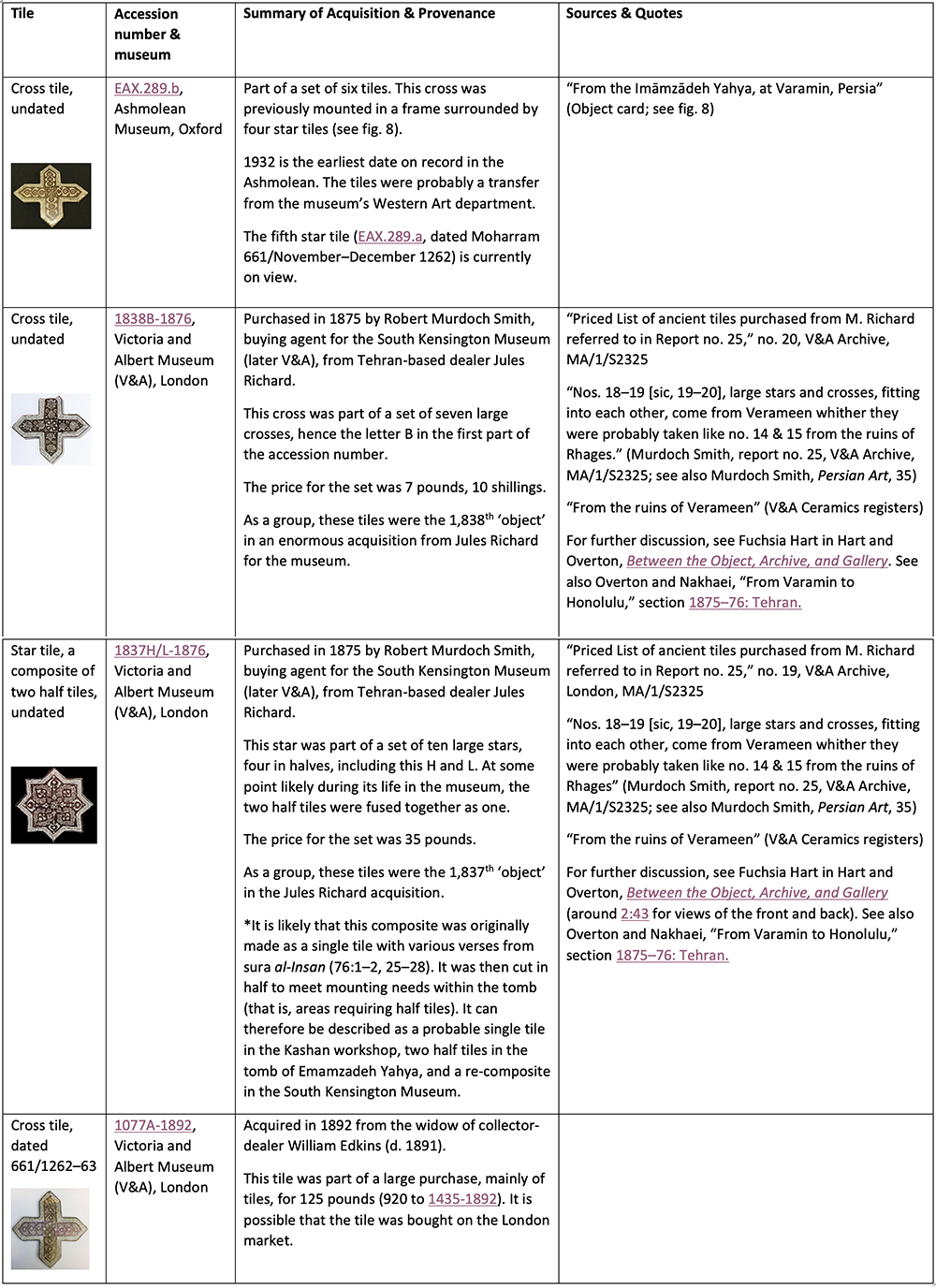
The selected comparanda—ʿAli Mohammad Esfahani’s imitative ‘luster’ tile made around 1887—offered an opportunity to consider nineteenth-century production alongside the insatiable collecting of medieval luster tiles from sites like the Emamzadeh Yahya (vid. 5).25 In 1875, Major General Sir Robert Murdoch Smith (d. 1900), buying agent for the South Kensington Museum (later V&A), purchased the first of several large batches of medieval luster tilework for the museum from Jules Richard. The acquisition included dozens of star and cross tiles that had likely been recently removed from the Emamzadeh Yahya, including two in this study (see Table I).26
Video 5. Tilting and animation of the imitation ‘luster’ tile by ʿAli Mohammad Esfahani, Tehran, ca. 1877. Victoria and Albert Museum, London, 567-1888. Video by Fuchsia Hart, June 2024, taken during preliminary research and the creation of this website’s Between the Object, Archive, and Gallery.
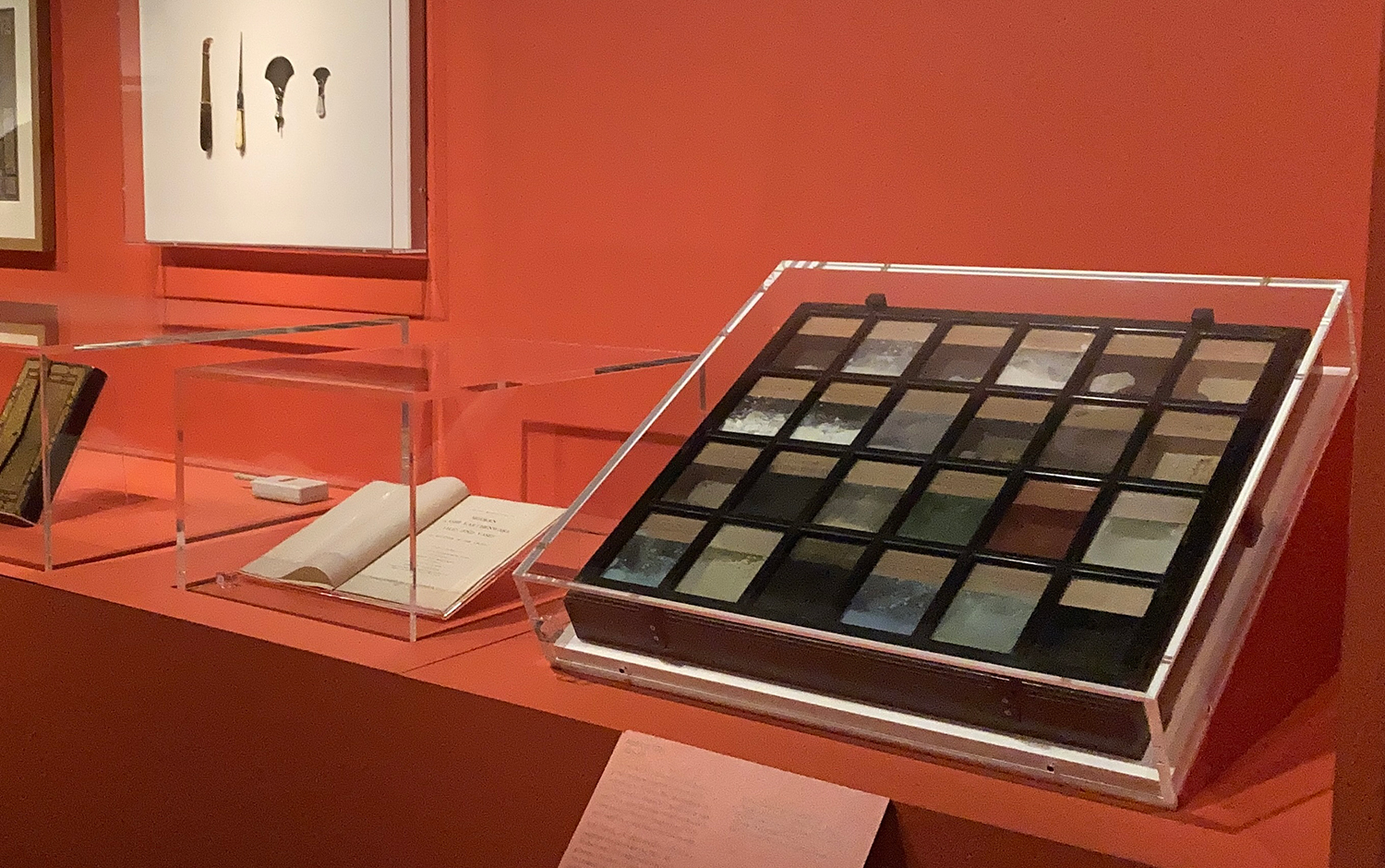
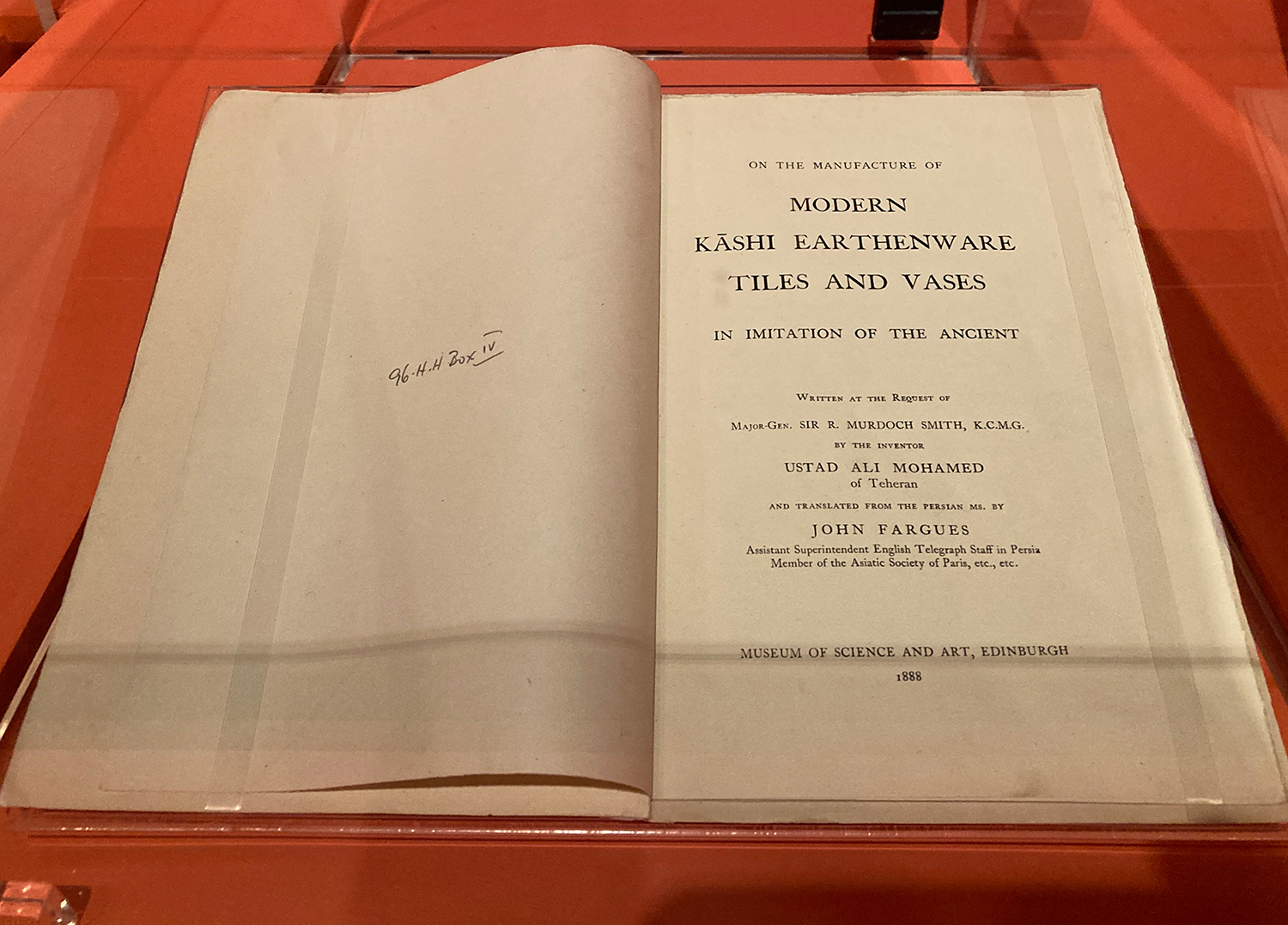
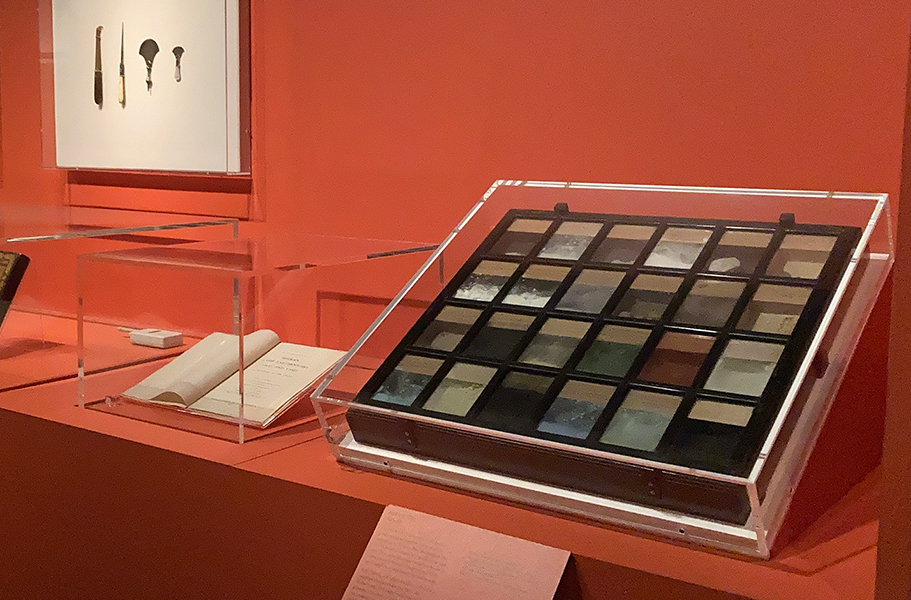
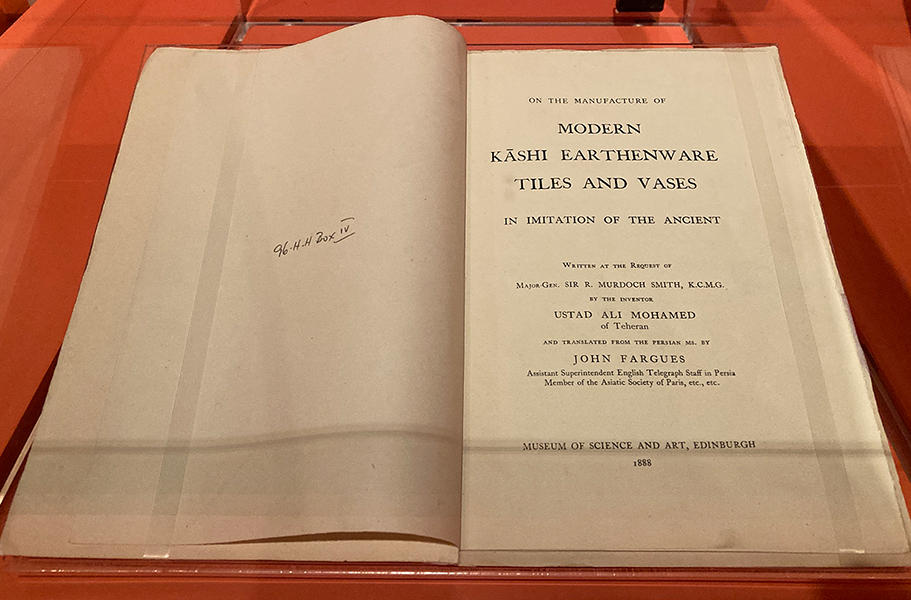
In 1887, Murdoch Smith, now the director of the Edinburgh Museum of Science and Art (today’s National Museum of Scotland), visited ʿAli Mohammad’s workshop in Tehran and commissioned a variety of underglaze tilework from the potter, including a fireplace surround, several circular table tops, and portrait tiles of himself. He also purchased samples of the potter’s pigments and other materials (“23 packets of paints, clays, etc.”; fig. 9) and the imitative ‘luster’ tile, which was described in museum correspondence as “modern reflêt” (short for the French ‘reflet métallique’).27 Murdoch Smith also commissioned a treatise on ʿAli Mohammad’s methods in Persian, which was soon published in English translation as On the Manufacture of Modern Kāshi Earthenware Tiles and Vases in Imitation of the Ancient (fig. 10). The potter’s samples were analyzed at the Edinburgh Museum using wet chemical methods, and his tiles were accessioned into the South Kensington and Edinburgh collections.28
Sampling the Tiles: Oxford and London
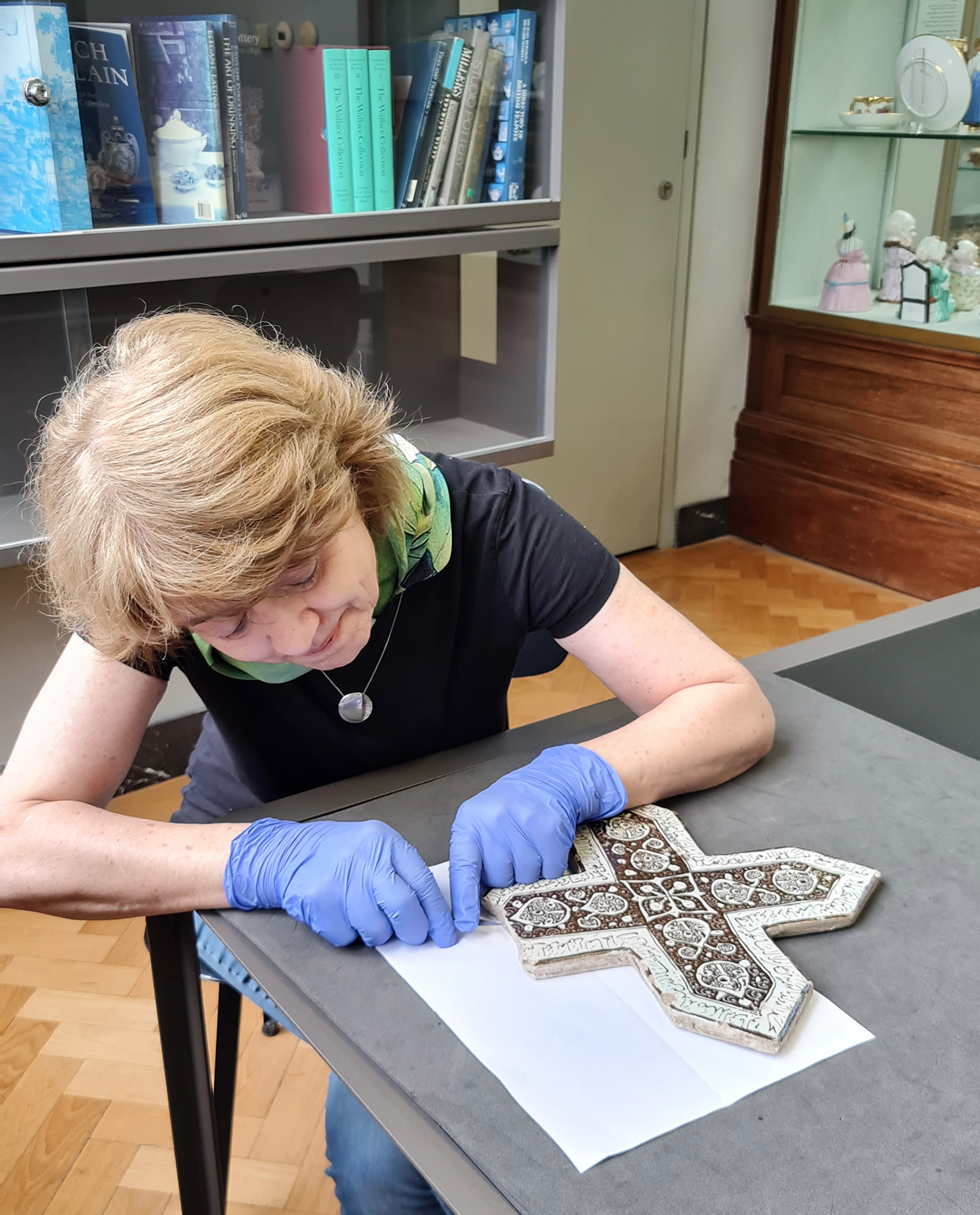
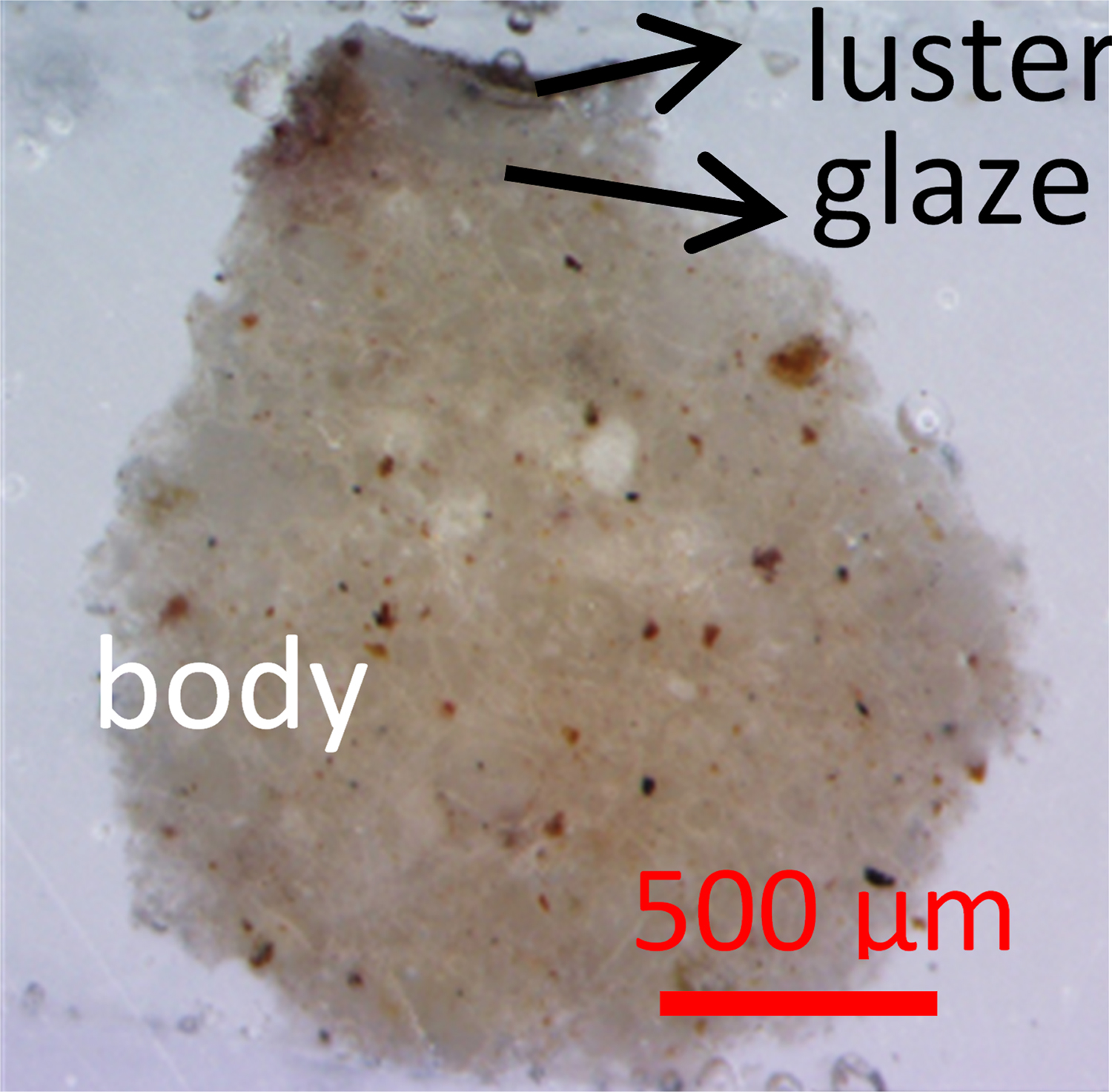
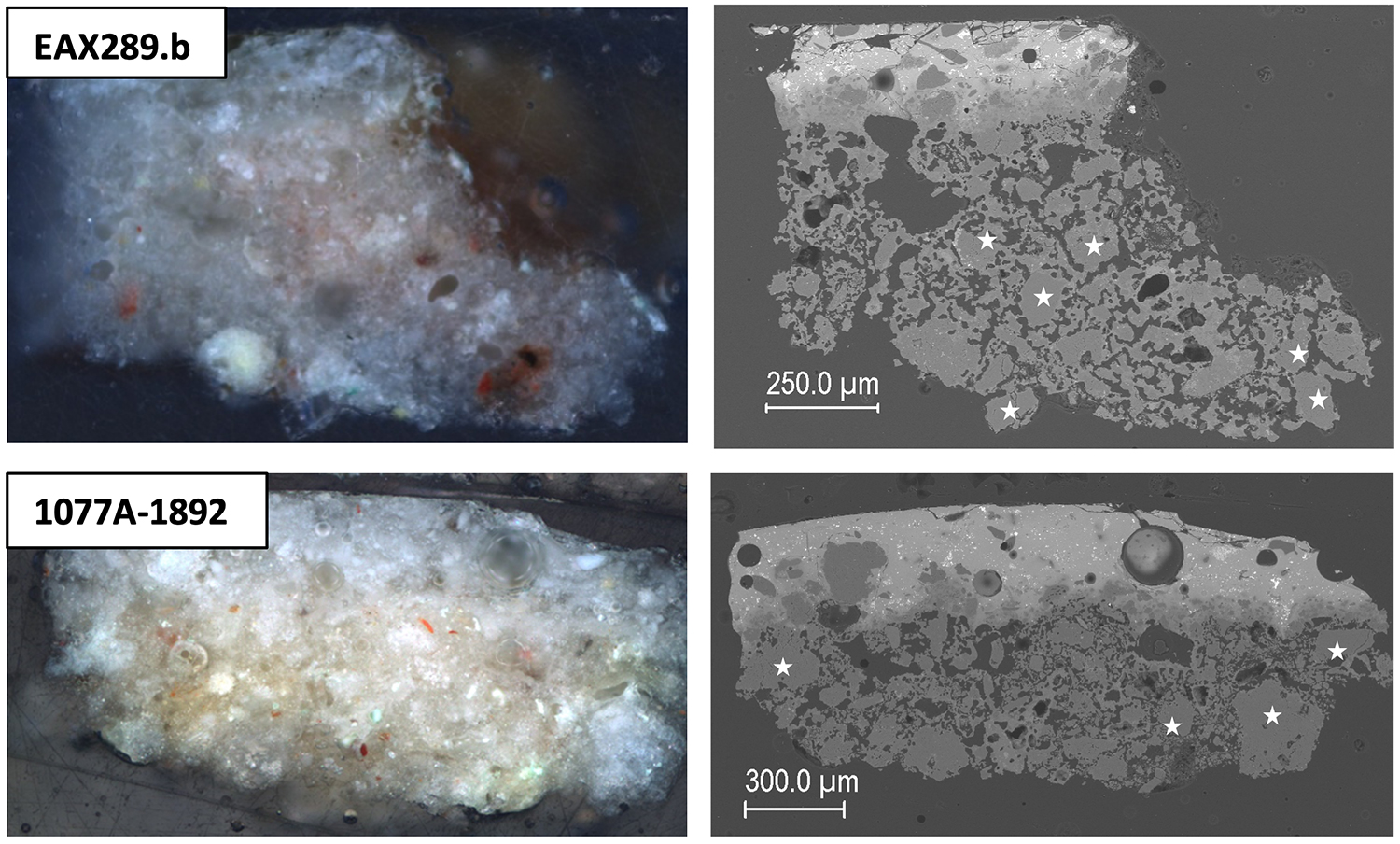
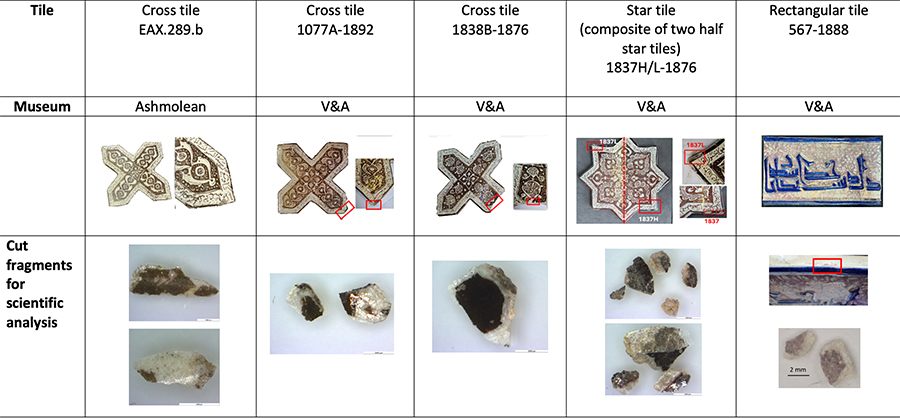
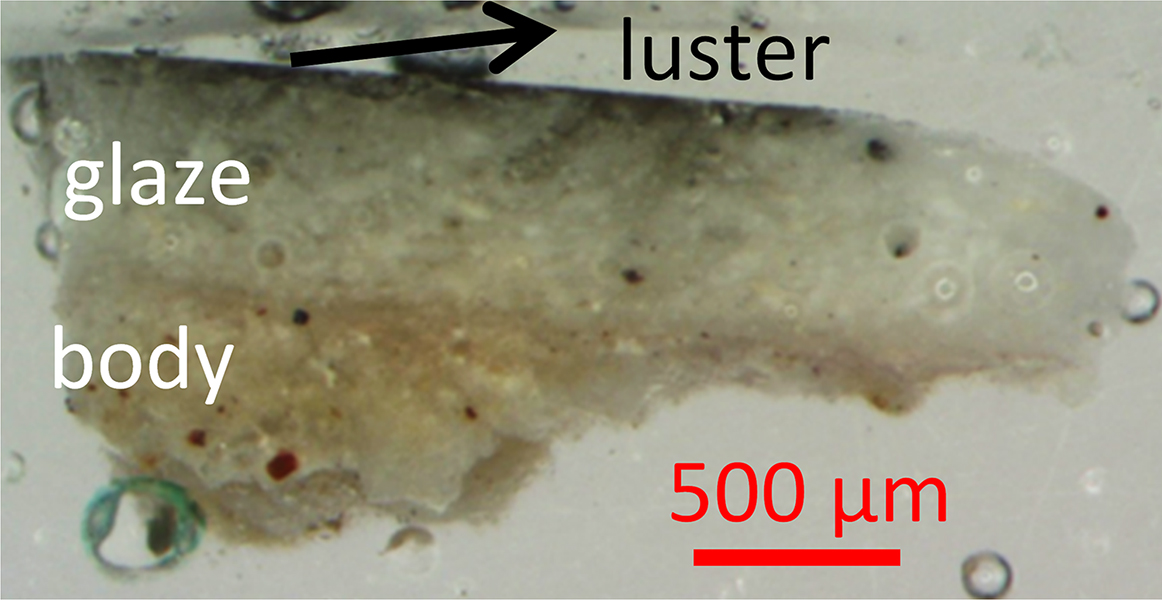
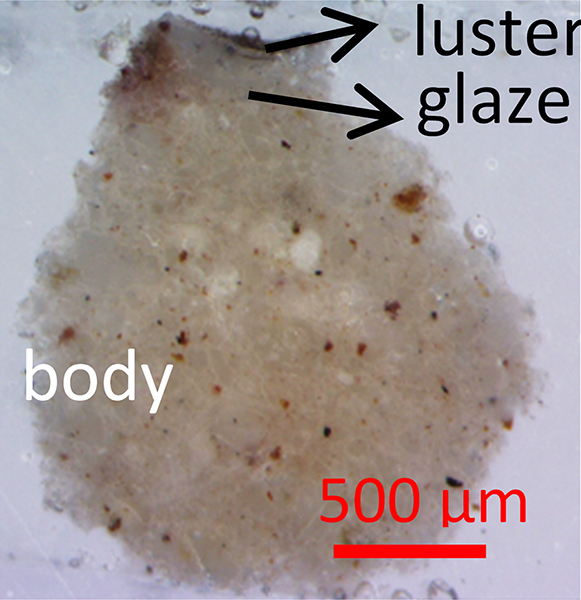
In July 2024, Trinitat Pradell and Judit Molera traveled to Oxford and London to take the samples. For the thirteenth-century Emamzadeh Yahya tiles, they extracted very small samples (about 2 × 3 mm2) for the purpose of analyzing three distinct components: the ceramic body, glaze, and luster decoration (fig. 11, Table II). The samples were taken from the tiles’ broken edges. Since the glazes are very hard while the ceramic body is very sandy and tends to disintegrate, a scalpel was used to erode the stonepaste area below the glaze.29 Next, a diamond tool was employed to cut around the glaze surface. Finally, a scalpel was used as a lever to extract a very small sample. These samples were in turn cut into smaller pieces for different analyses (see Techniques of Analysis). The nineteenth-century tile was sampled from one of the sides retaining some white glaze and ‘luster’ (see vid. 5). It was not possible to sample the blue areas of the glaze, as they could only be accessed from the front, and the tile was intact.
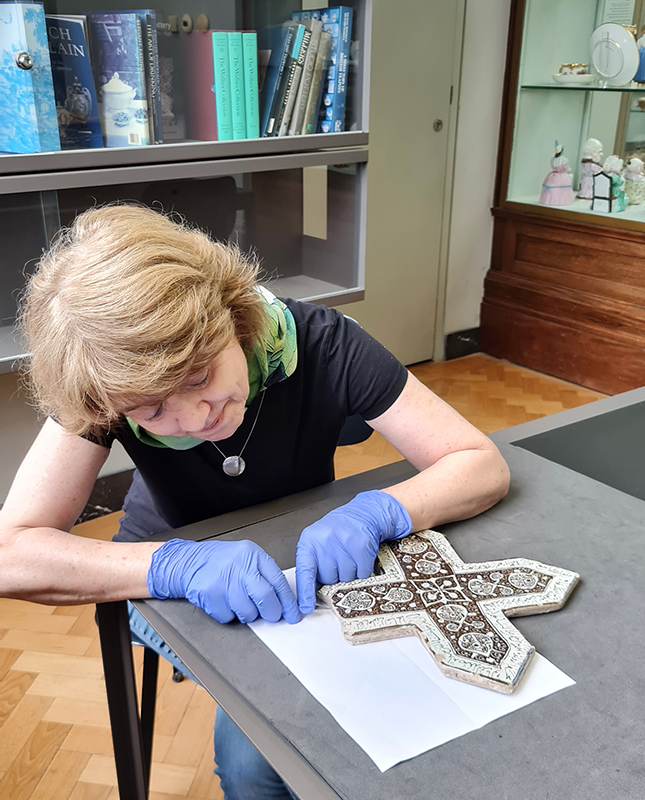
Table II. Areas of sampling in the analyzed tiles (top row) and the extracted fragments (bottom row). The star and cross tiles are attributed to the Emamzadeh Yahya at Varamin, ca. 1262–63. The rectangular tile was made by ʿAli Mohammad Esfahani in Tehran around 1877. [pdf]
Techniques of Analysis and Preparing the Samples: Barcelona
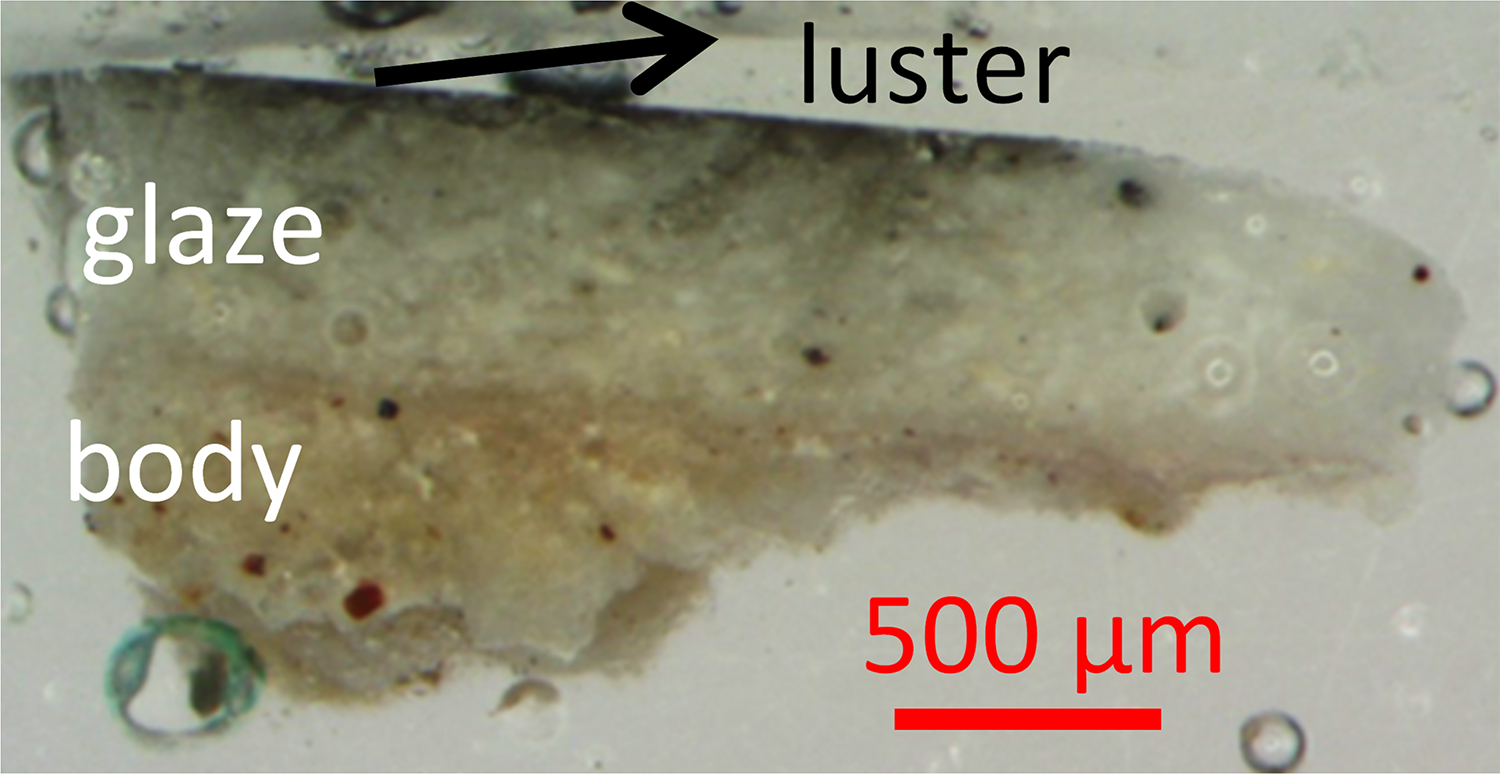
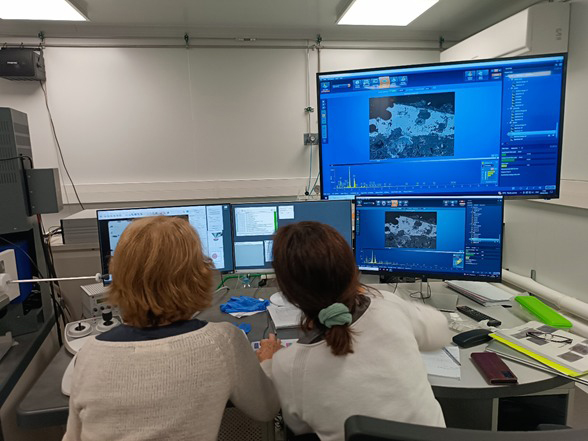
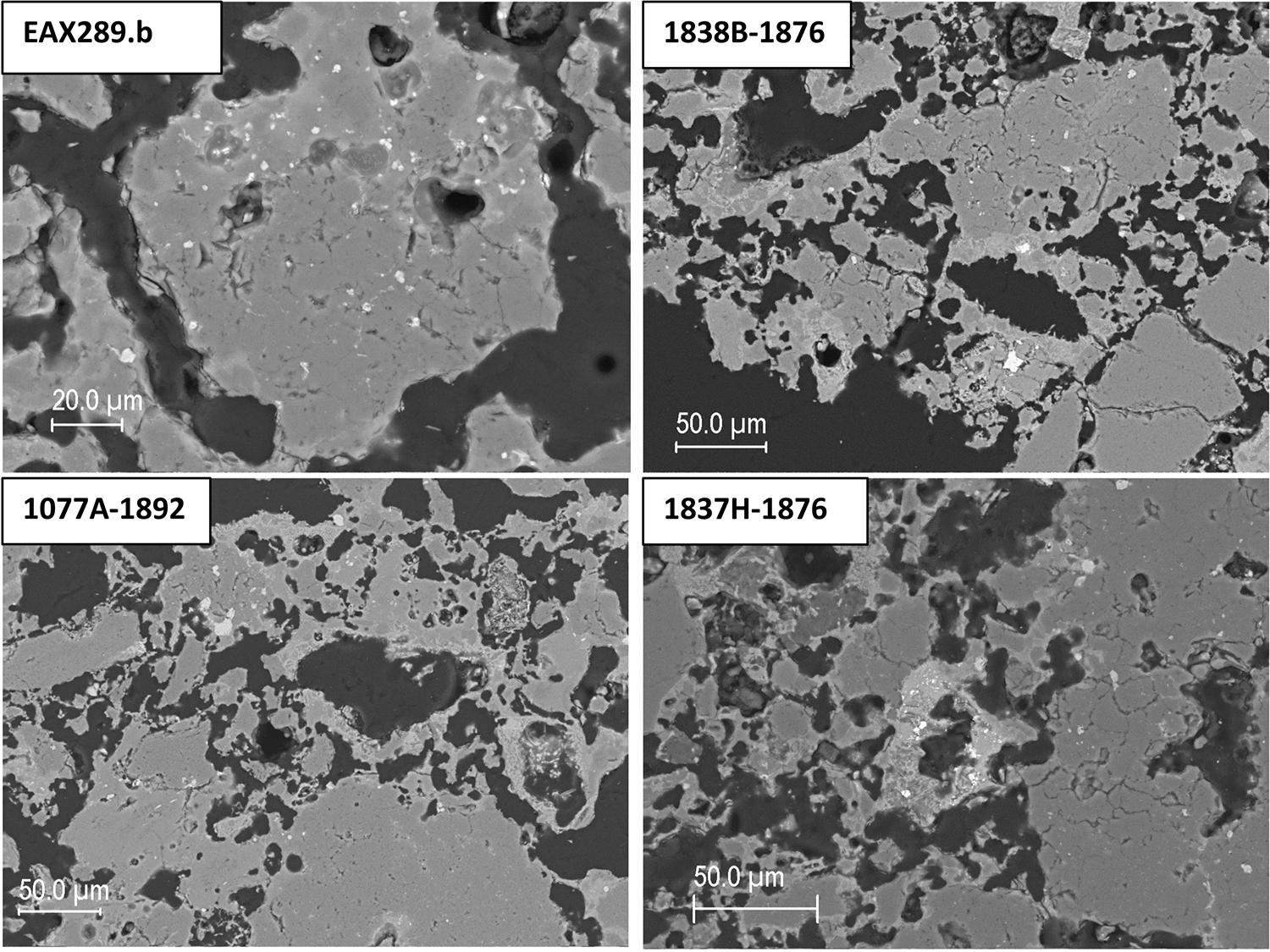
Several techniques of scientific analysis were used during this project. To determine the chemical composition and microstructure of the samples, cross-sections through the ceramic body, glazes, and luster layers were prepared and analyzed using Optical Microscopy (OM) and Field Emission Scanning Electron Microscopy (FESEM) equipped with an Energy Dispersive X-ray Spectroscopy (EDS) detector (figs. 12–14). To investigate the internal structure of the luster layer, cross-sections from the luster layer were obtained using Focused Ion Beam (FIB) milling equipment integrated to the FESEM (vid. 6). This technique uses a focused beam of ions to precisely cut into the sample and polish the resulting cross-section, enabling nanoscale imaging of the luster layer.30 Finally, to identify the crystalline compounds present in the luster layer (metallic nanoparticles), glaze (crystalline precipitates), and ceramic compounds, micro-X-ray diffraction (micro-XRD) was performed on a thin cross section.
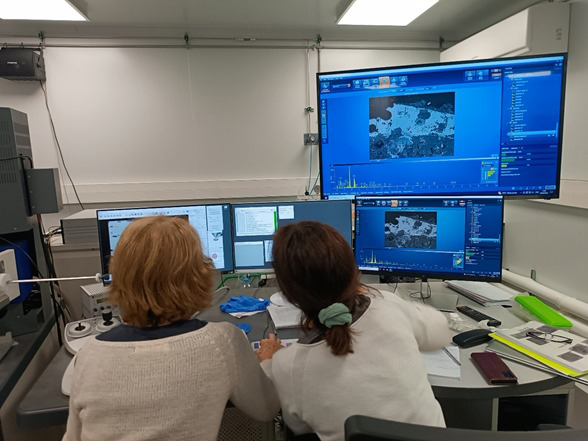
Video 6. Profs. Drs. Trinitat Pradell and Judit Molera preparing luster samples from the Emamzadeh Yahya and analyzing them using a Field Emission Scanning Electron Microscope (FESEM) with a Focused Ion Beam (FIB). The sample preparation, loading, and microscope set up sections follow the standard procedure for every SEM examination. The section from 2:27 to 2:57 (“Luster imaging”) is specific to FIB analysis, which is particularly important for luster examination. Prof. Dr. Pradell is shown using FIB to cut a cross-section of the luster layer at the nanoscale (for a photograph of the end result, see fig. 31). The film concludes with a brief view of the scientists analyzing cross-sections of the circa 1887 tile made by ʿAli Mohammad Esfahani, confirming the presence of gold (see figs. 36–39). This research was conducted at the Barcelona Research Centre for Multiscale Science and Engineering (UPC BarcelonaTech), whose facilities are available to the scientists as members of the Group of Characterization of Materials (GCM). This ~3-minute silent film was kindly edited by Trifon Trifonov and can be watched on the Emamzadeh Yahya Project’s YouTube channel in high resolution and with a soundtrack.
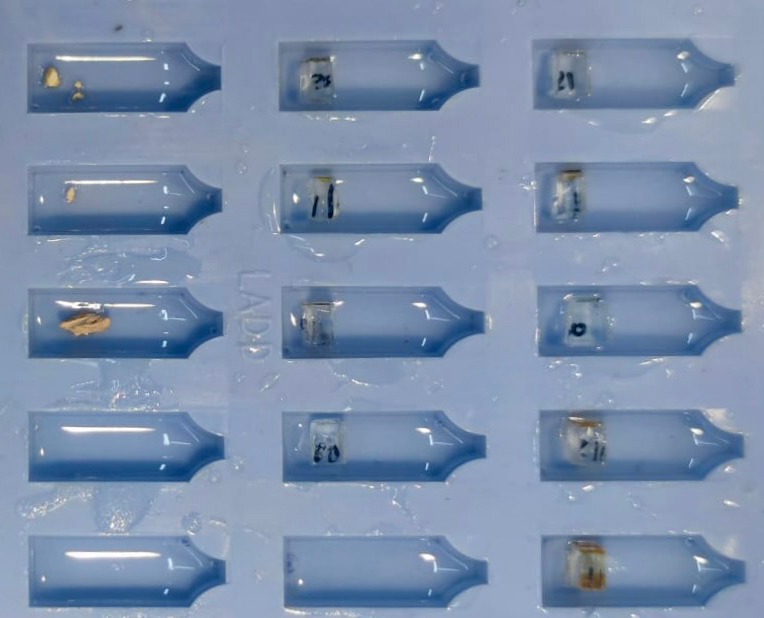
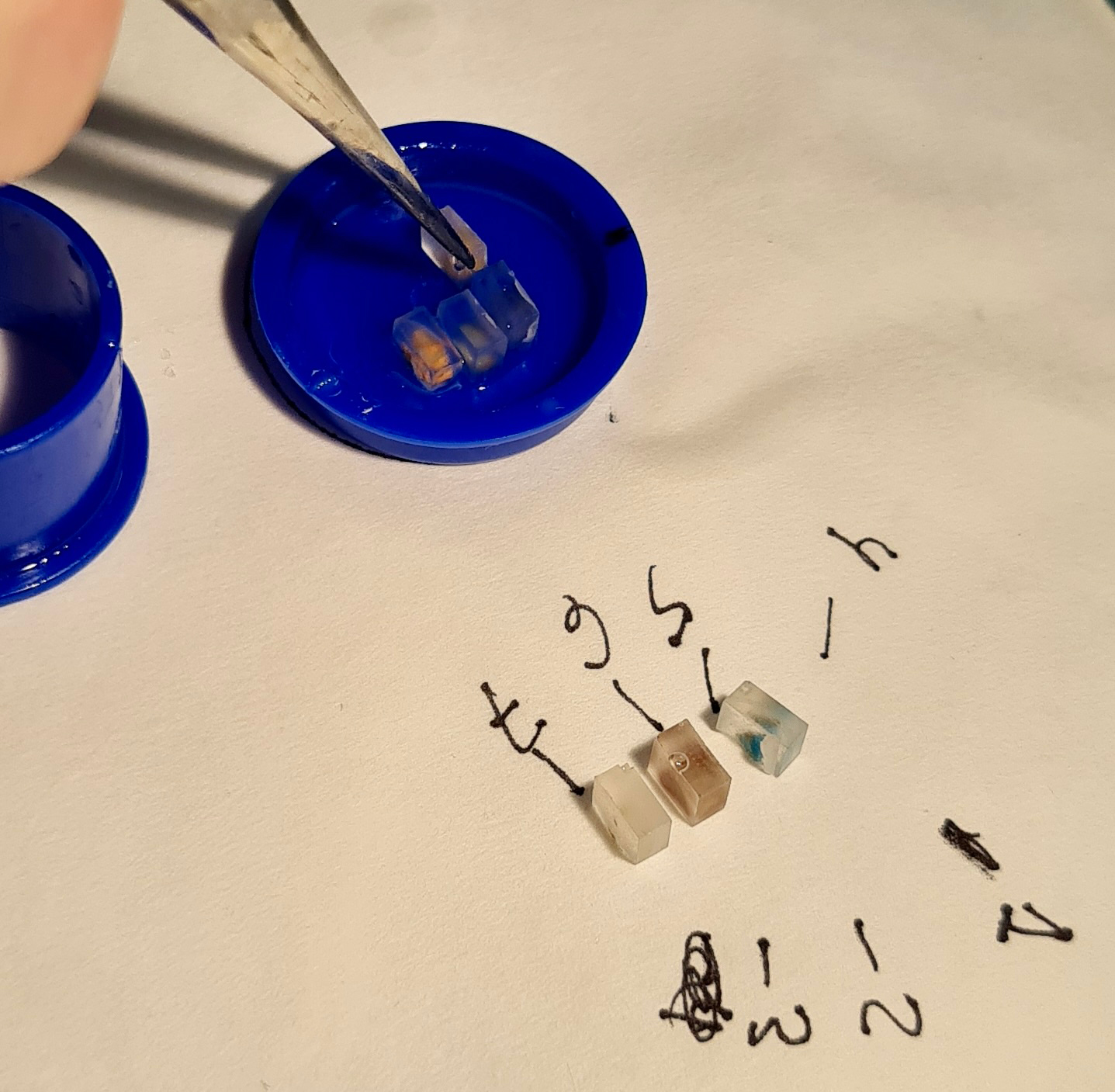
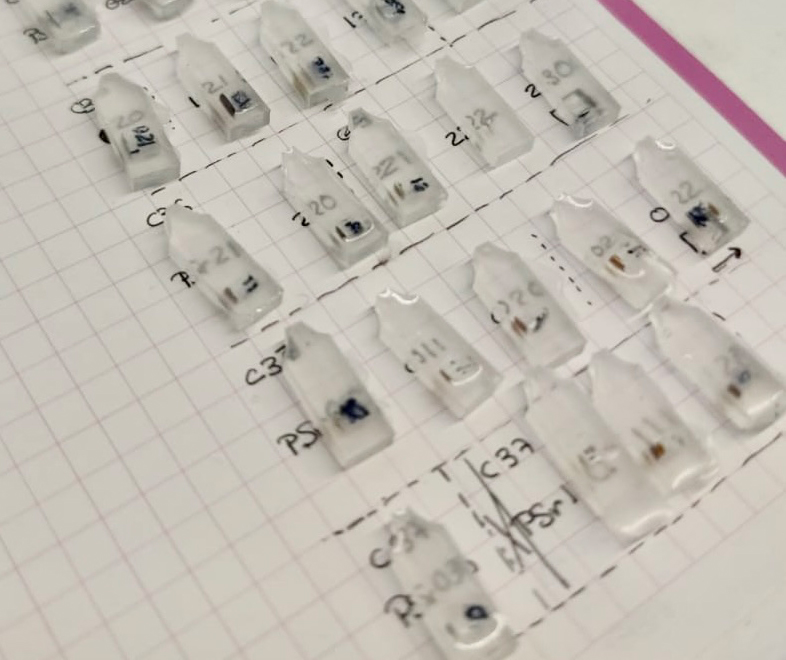
The samples taken at the V&A and Ashmolean (see Table II) had to be carefully prepared for each of these scientific techniques. The first step of sample preparation was to place the samples in resin in small tube-shaped molds in order to stabilize and solidify them (fig. 15).
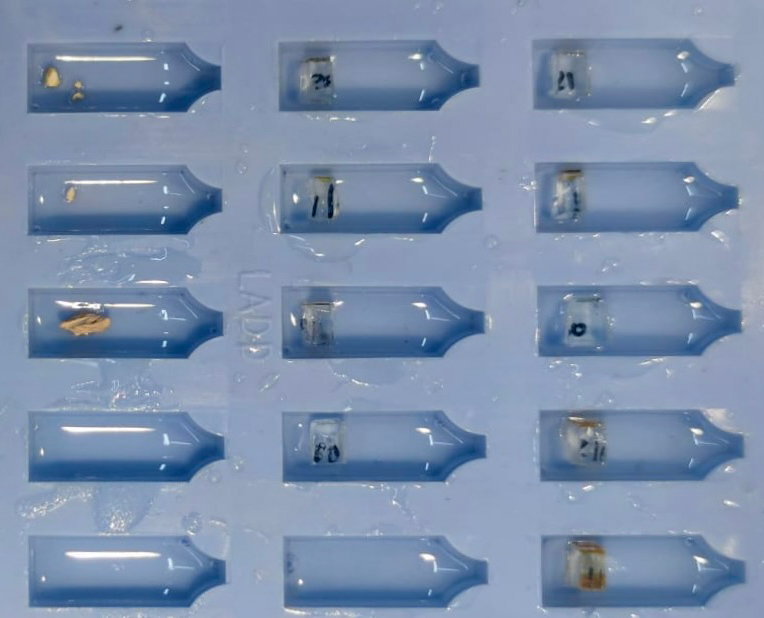
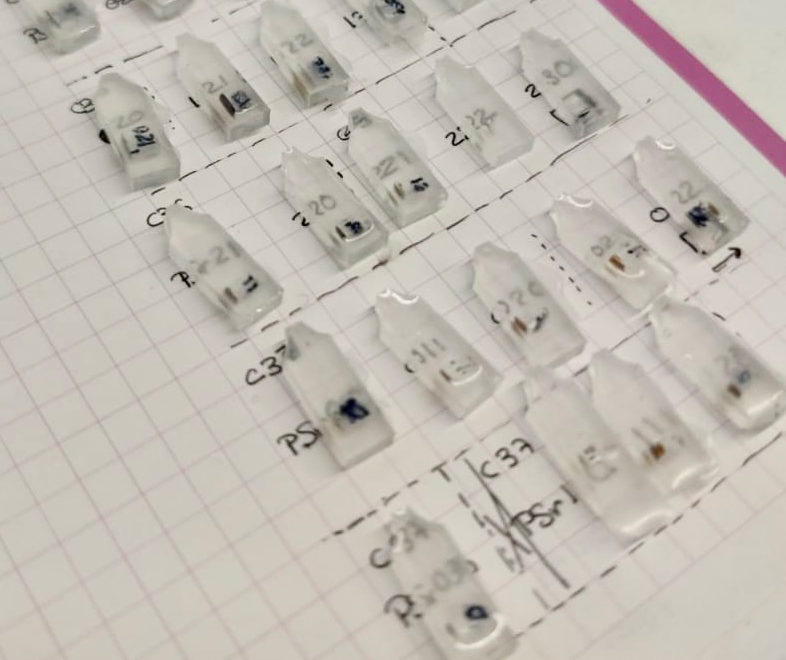
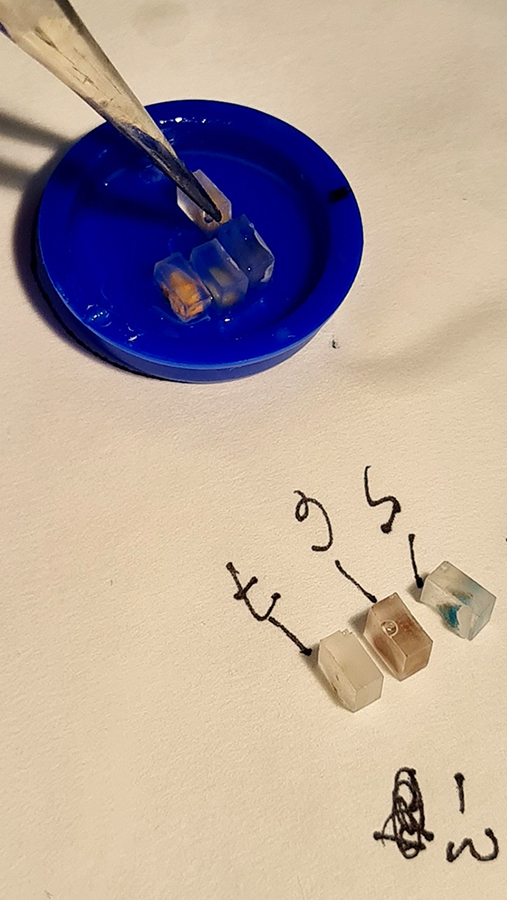
Next, the solidified resin blocks (fig. 16) were cut in the cross-sectional direction (vid. 7) to expose the different layers (ceramic body, glaze, luster). This cutting produced two sets of cross-sections, each intended for a different analytical purpose.
Video 7. Cutting the solidified blocks on the diamond saw to obtain cross-sections. Video (with sound) by Trinitat Pradell, 2024, taken in the laboratory at BarcelonaTech.
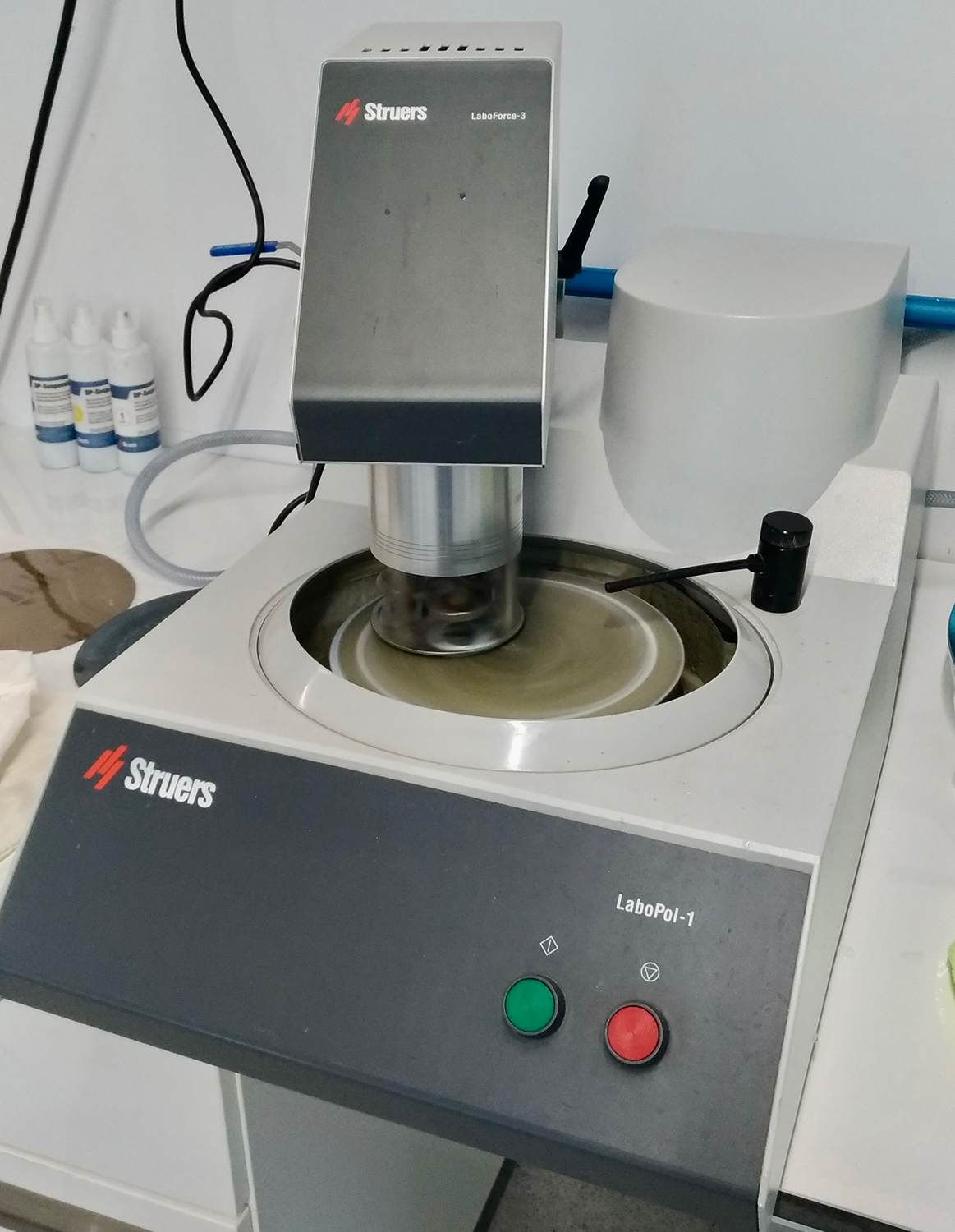
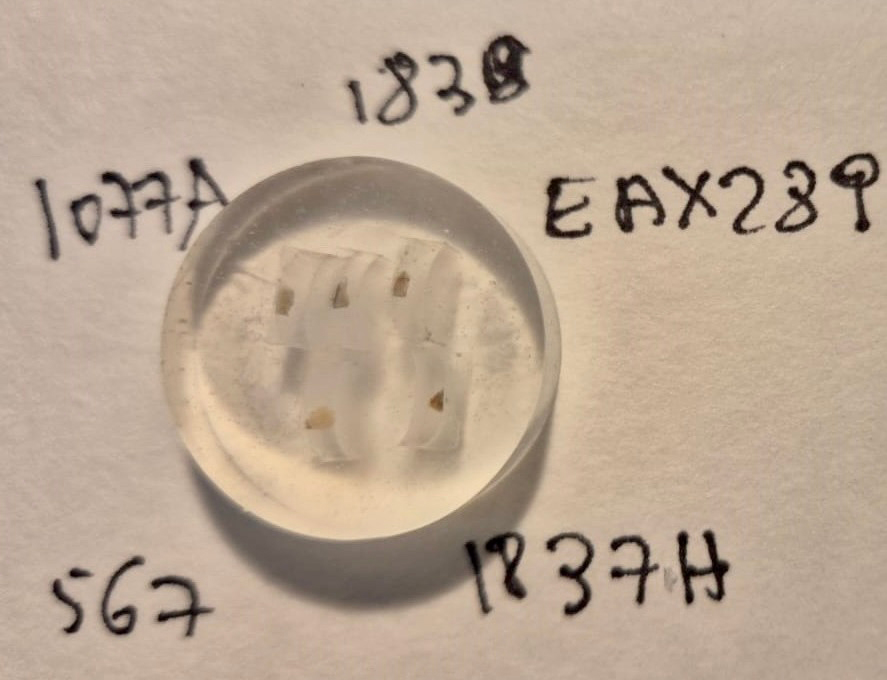
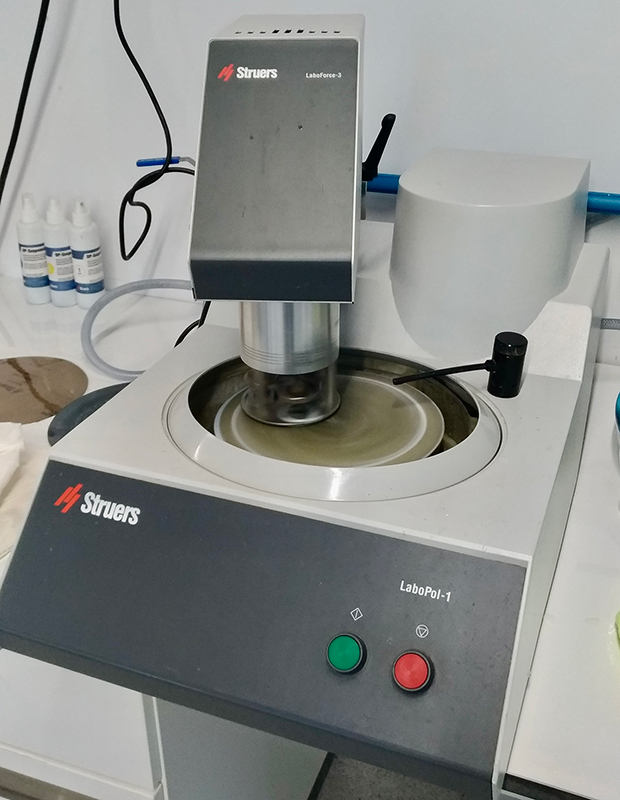
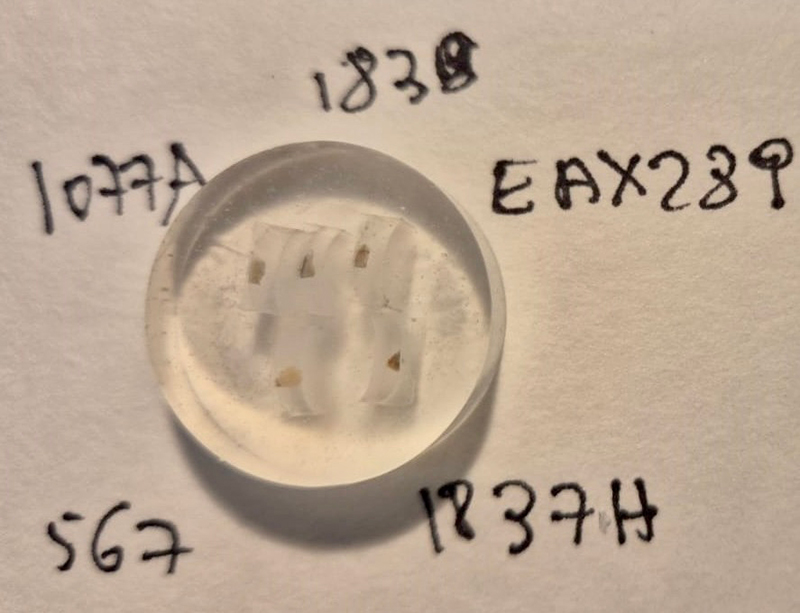
The first set of cross-sections were mounted in a circular resin block (fig. 17, vid. 8) and polished with diamond paste down to 1 μm (fig. 18). These polished cross-sections (fig. 19) allowed for the simultaneous analysis of the ceramic body and glaze using Optical Microscopy (OM) and FESEM-EDS.
Video 8. Adding the resin over the cross sections. Video by Judit Molera, 2024, taken in the laboratory at BarcelonaTech.
The second set of cross-sections were further prepared as thin sections (approximately 100 μm) for micro-XRD analysis at ALBA Synchrotron.
Scientific Results: Ceramic Bodies
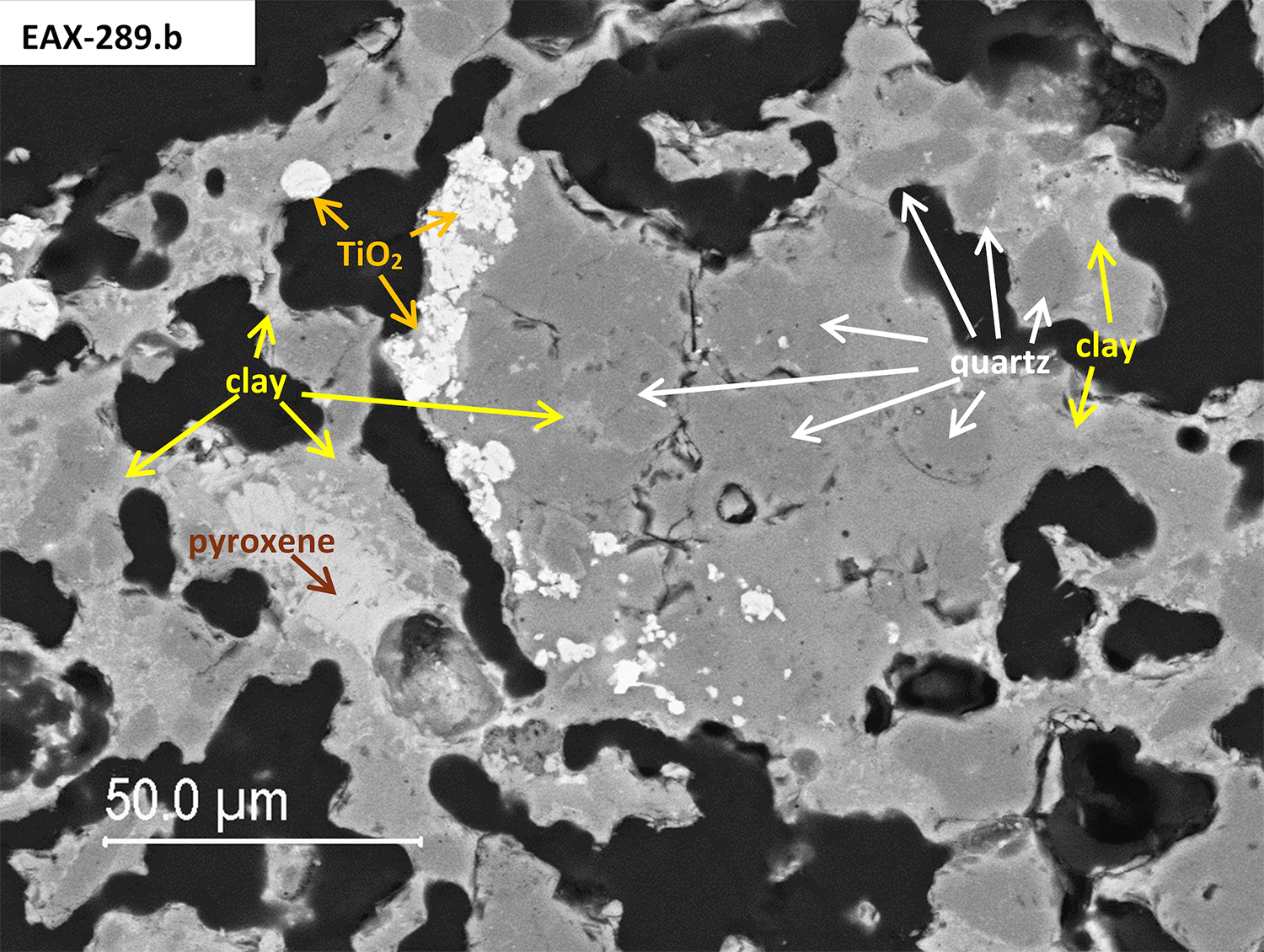
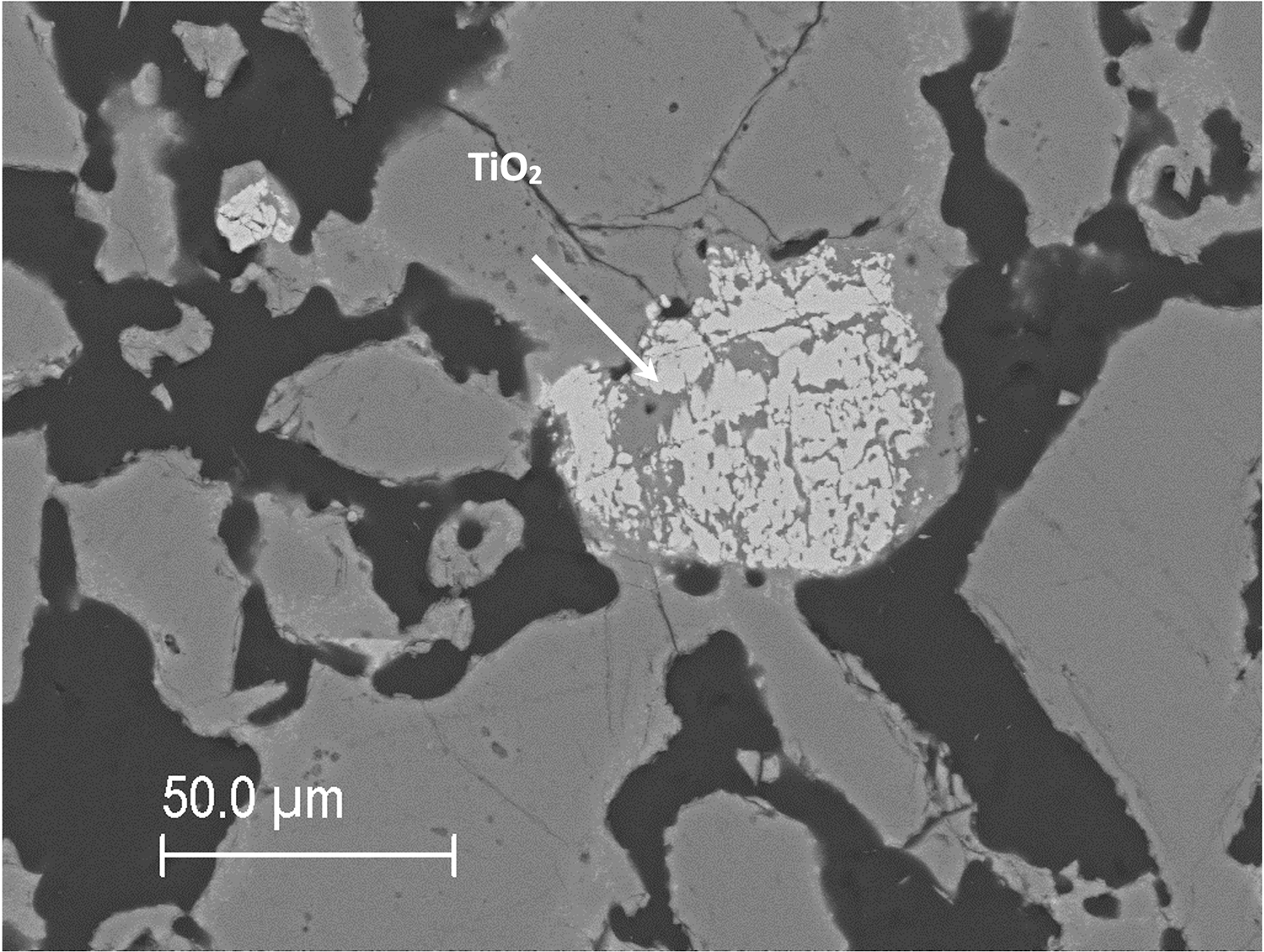
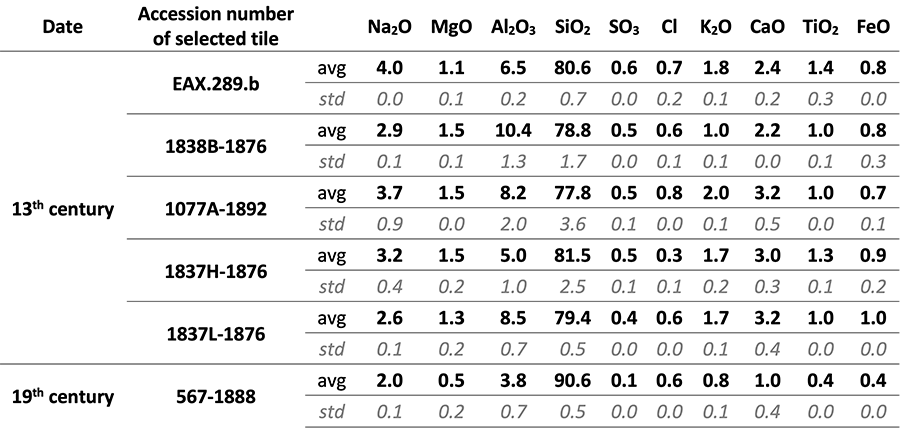
The ceramic bodies of all analyzed tiles, both thirteenth and nineteenth century, correspond to stonepaste (بدنه جسمی), which consists of quartz sand bonded together with clay and some glass frit.31 The chemical composition of the five samples attributed to the Emamzadeh Yahya (presumably made in Kashan around 1262–63) includes a silica (SiO2) content of about 80%; a relatively high alumina (Al2O3) content of about 5-10%; and 2–3% of sodium (Na2O), potassium (K2O), and calcium oxide (CaO). The iron oxide (FeO) content is below 1%, and the titanium oxide (TiO2) content ranges from 1.0 to 1.4% (Table III). The high alumina content is a distinctive feature of Saljuq (ca. 1040–1157) and Kharazmshah (Khwarazmian, ca. 1077–1231) stonepastes produced in Iran and seems to have persisted into the Ilkhanid period (1256–1353). During this time, the silica content of stonepastes typically ranged from approximately 75% to 90%. The tiles from the Emamzadeh Yahya closely align with this group in terms of their compositional characteristics.32
Table III. Stonepaste composition of all samples determined by FESEM-EDS (wt%). avg: average over at least two areas of the ceramics. std: standard deviation of the measurements. [pdf]
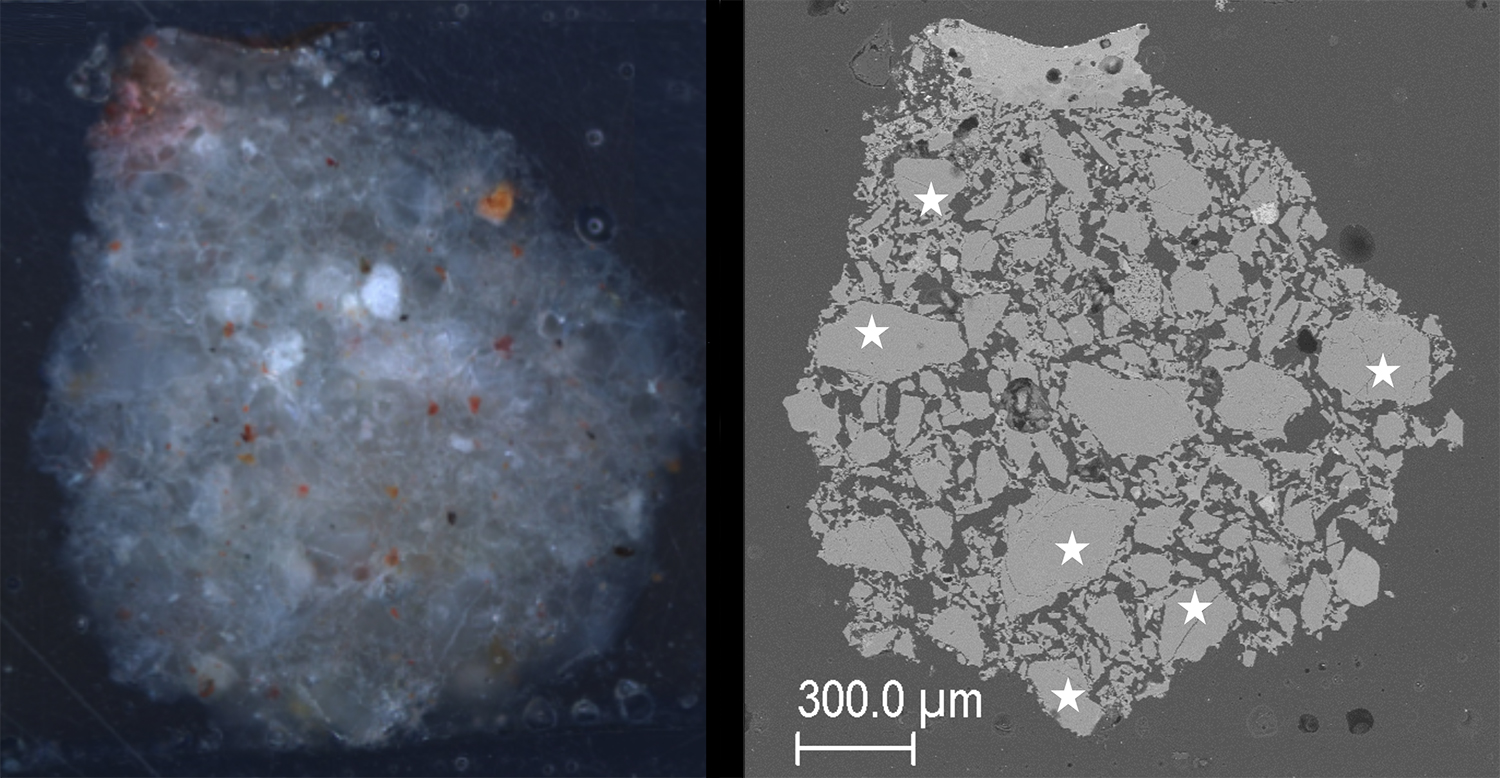
The microstructures of the five Emamzadeh Yahya tiles are all very similar (figs. 20–22). The stonepaste bodies indicate a limited extent of vitrification, and no fragments of frit glass were identified.33 As a result, the stonepaste bodies are porous, with compositional totals indicating just under 30% porosity.
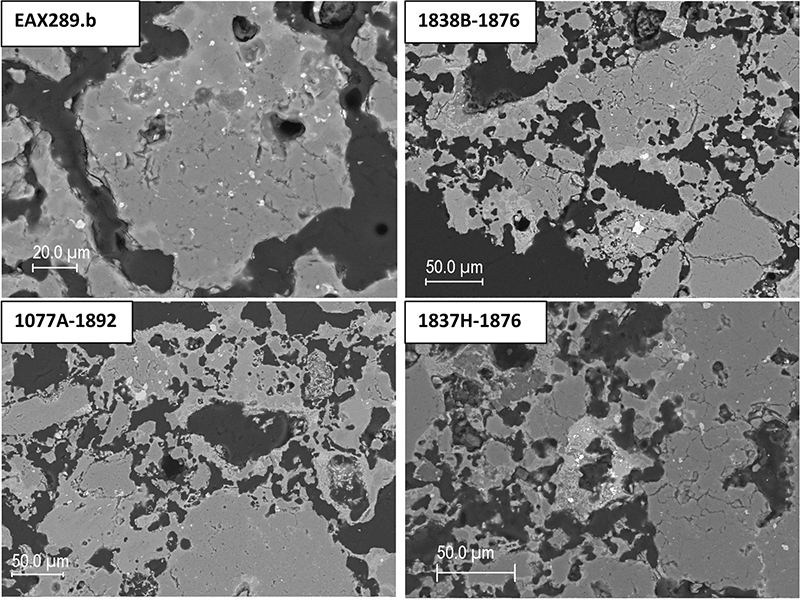
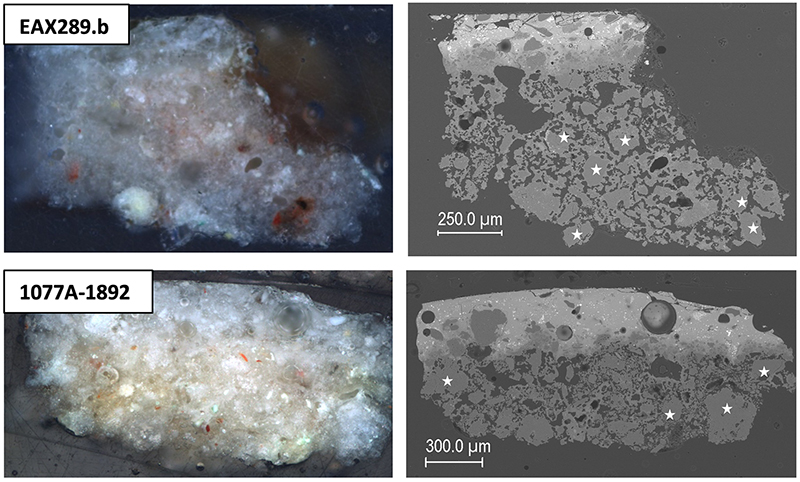
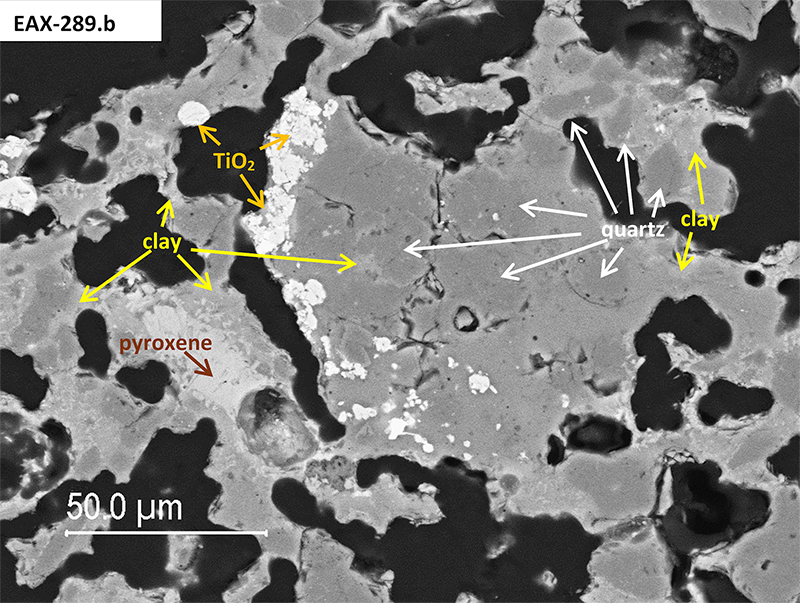
Turning to the nineteenth-century tile by ʿAli Mohammad Esfahani, its chemical composition is significantly different, with higher silica content (90% SiO2) and lower alumina (2% Al2O3), as well as alkalis (2% Na2O, 1% CaO, 0.8 % K2O) (see Table III). Its microstructure contains larger quartz particles (up to 420 μm, compared to up to 270 μm in the Emamzadeh Yahya tiles), and the structure is more porous, with compositional totals indicating approximately 40% porosity (figs. 23–24).
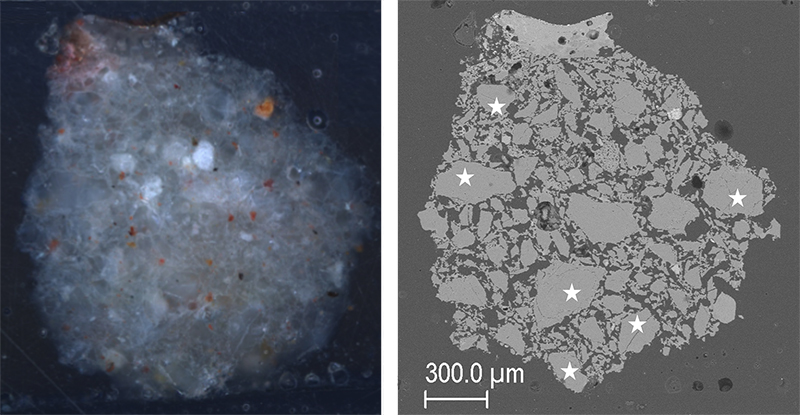
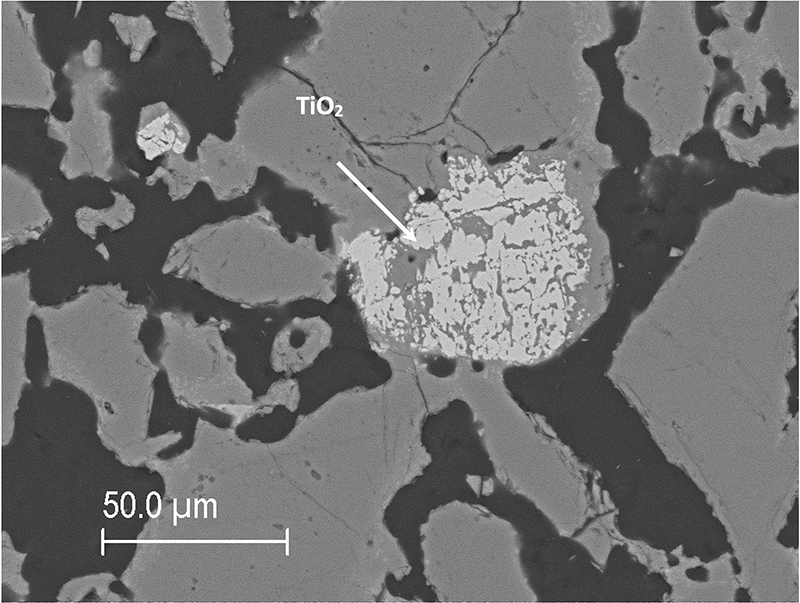
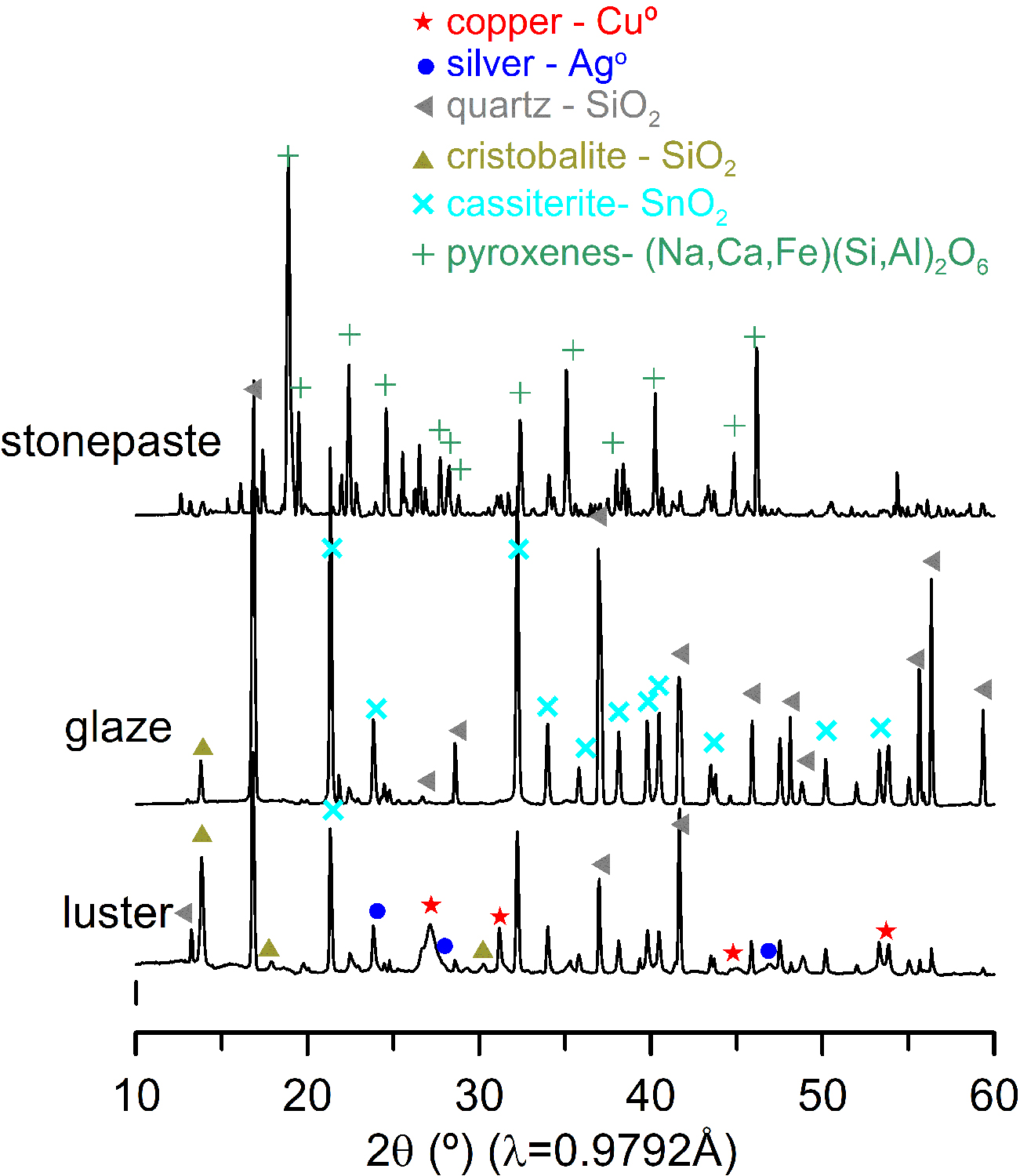
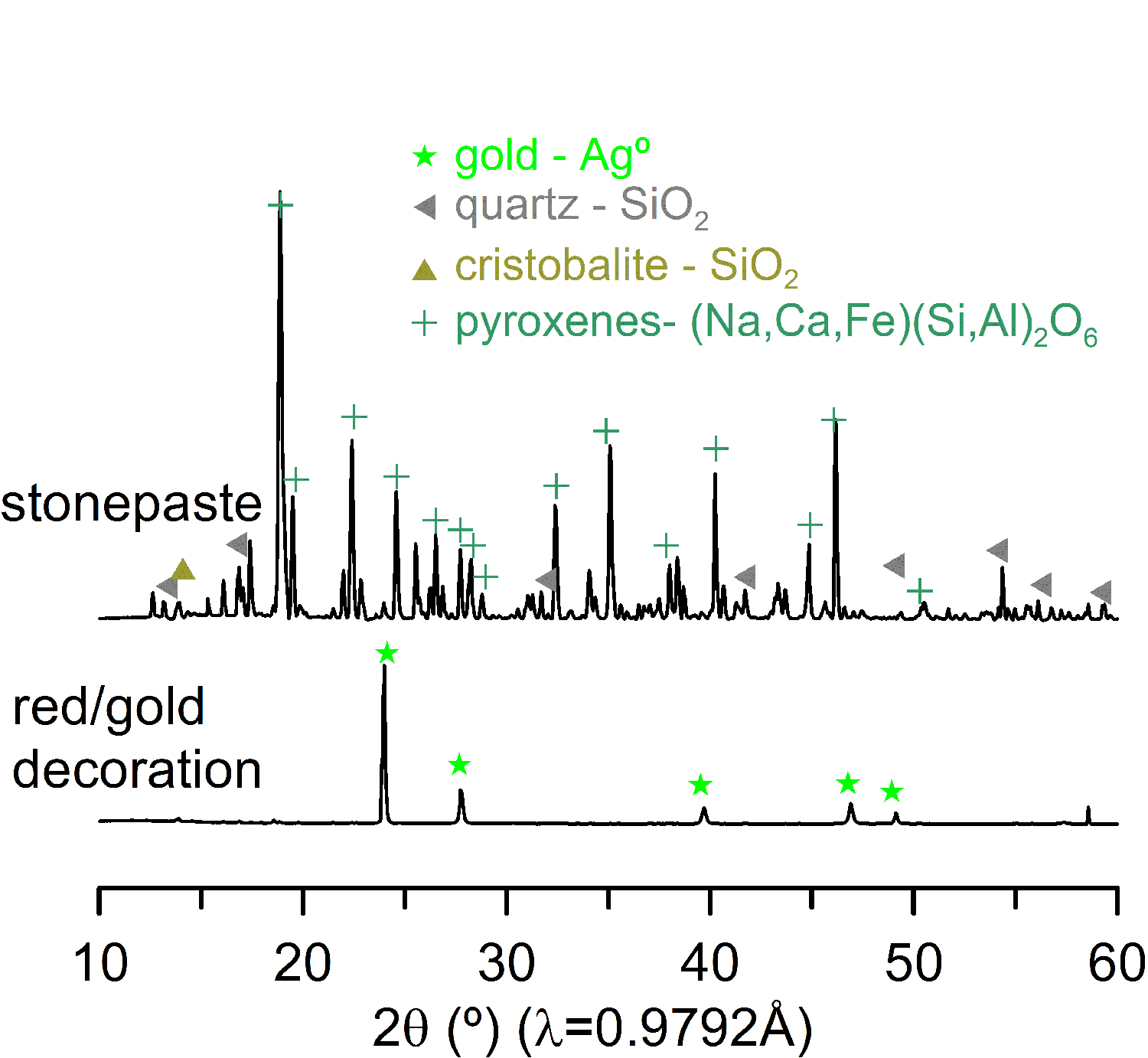
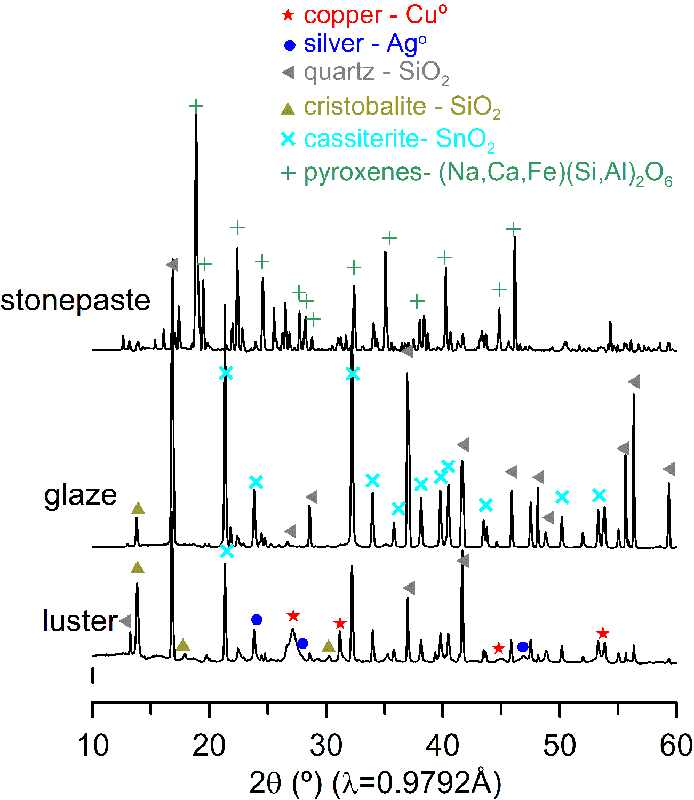
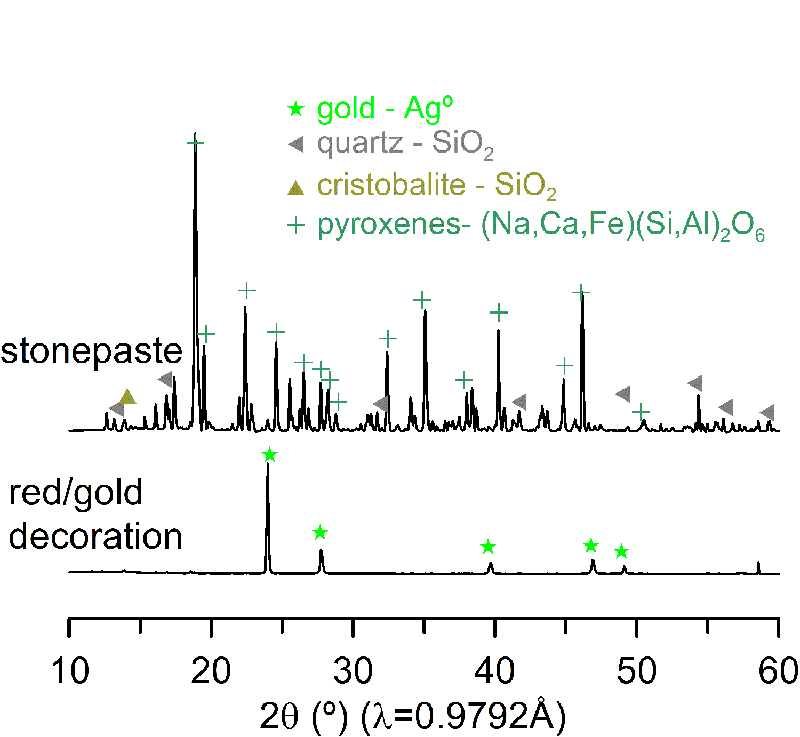
Micro-XRD with a beam of 5 x 20 μm (hxw) conducted at ALBA Synchrotron (Cerdanyola del Vallès, Barcelona; map) revealed the presence of quartz and cristobalite in all samples.34 Additionally, synchrotron XRD allowed the identification of the very small neoformed crystals in the stonepaste produced during firing. Although these crystals can be observed in SEM-EDS as sodium, calcium, and iron aluminosilicate particles, they cannot be correctly identified by SEM alone due to their extremely small size. XRD further confirmed that these particles correspond to pyroxenes: (Na,Ca,Fe)(Si,Al)2O6.35
Historical Context: Iranian Stonepaste between the Thirteenth and Nineteenth Centuries
The composition of the stonepaste bodies of the thirteenth-century Emamzadeh Yahya tiles closely aligns with that of a broader group of tiles presumed to have been produced primarily in Kashan, including luster, mina’i, and lajvardina wares. However, microstructural changes in these bodies have not yet been studied in sufficient detail to yield meaningful comparative results. To further investigate the production of these tiles, we must turn to textual sources, particularly the treatise of Abo’l Qasem Kashani. Written in 1301, approximately forty years after the creation of the Emamzadeh Yahya star and cross tiles, this text provides a detailed stonepaste recipe comprising eight parts ground siliceous stones (صا اشکنه), one part clay (گل لوری/ورکانی), and one part ground glass frit (جوهر آبگینه).36 Kashani underscores the importance of the clay’s white and plastic quality (سفید لزج), noting that such clays were rare. He especially praises a variety found in the mountains of Na’in (map), near Esfahan, describing it as resembling white snow and of exceptionally high quality.37 These white kaolinitic clays likely account for the high alumina content observed in the Emamzadeh Yahya tiles, as well as in pre-Mongol and Ilkhanid Iranian ceramics more generally.
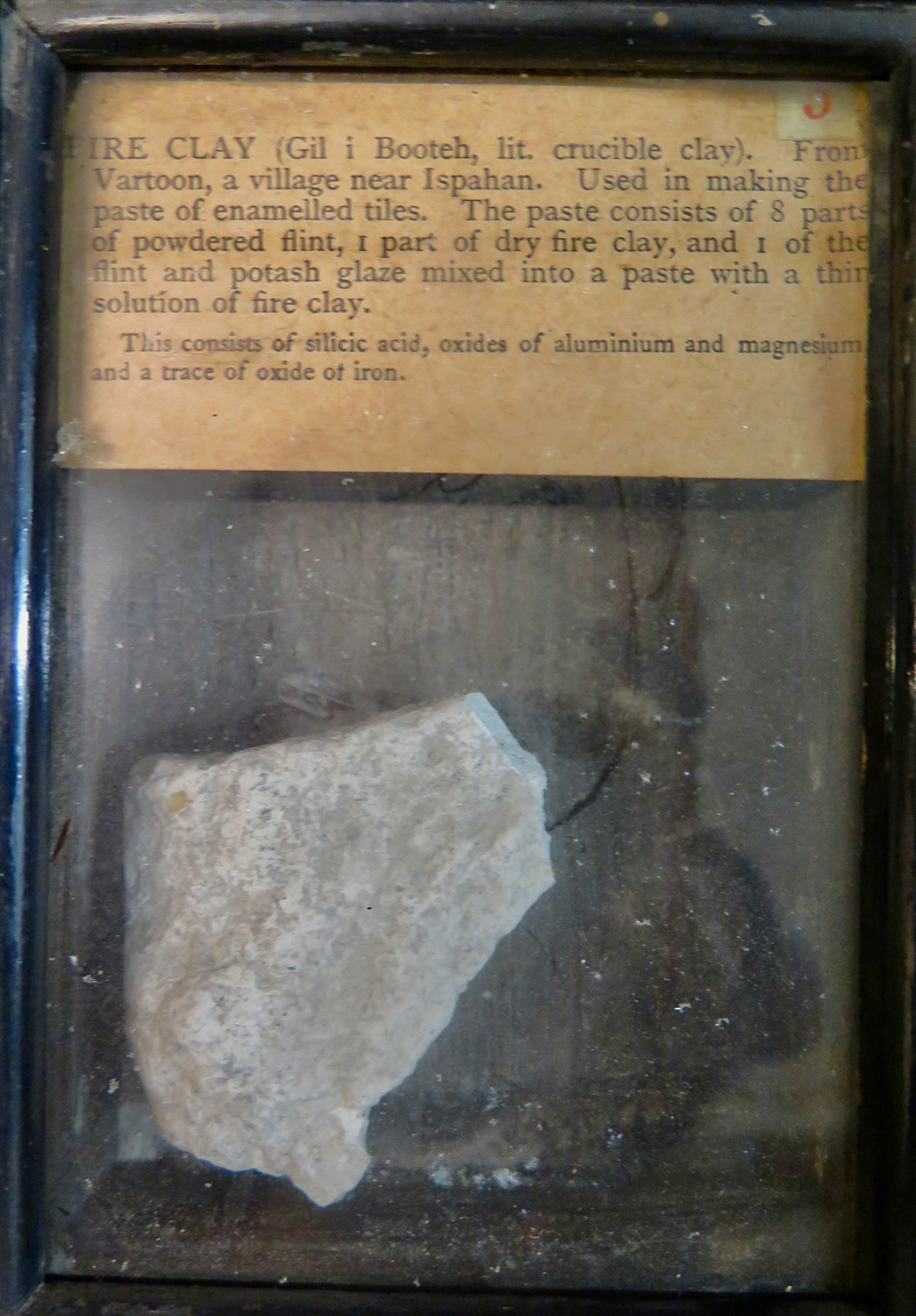
Moving forward into the late nineteenth century, ʿAli Mohammad Esfahani’s 1888 treatise likewise provides instructions on the preparation of stonepaste bodies, noting “with what difficulty the workman procures the ingredients and works them up.”38 He describes pounding siliceous stones (سنگ چخماق) with an iron hammer, passing the material through a sieve, and grinding it on a millstone until it becomes very fine, emphasizing that the finer, the better. He then describes the preparation of the clay (گل بوته), which was sourced from the village of Vartoon (map), near Esfahan (fig. 27). The clay was soaked in water to produce a thick slurry (دوغاب), which was then strained through cloth.39 Eight parts of the finely ground siliceous stones were then mixed with one part of this clay and one part of ground glass, forming a paste. This paste was pressed into plaster molds to shape the tiles. Engraving tools may then have been used to carve designs onto the surface.
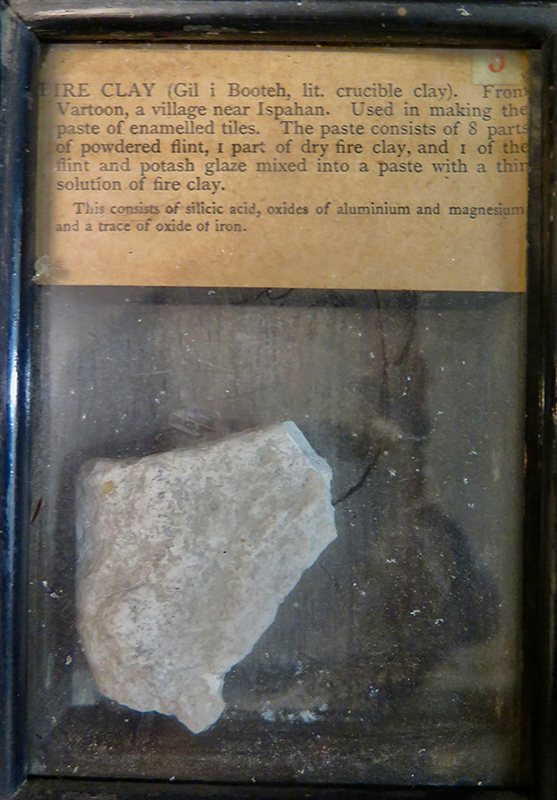
It remains unclear whether the kaolinitic clay sourced from Varatoon was the same as that mentioned by Abo’l Qasem Kashani, also located near Esfahan. However, this project’s analysis of ʿAli Mohammad’s imitative ‘luster’ tile in the V&A has revealed its significantly lower alumina content (see Table III), suggesting that less aluminous and possibly lower-quality clays were used in the nineteenth-century production. ʿAli Mohammad also notes that a similar clay was found near Tehran, but it was considered inferior, likely due to its reduced whiteness and plasticity.
Scientific Results: Glazes
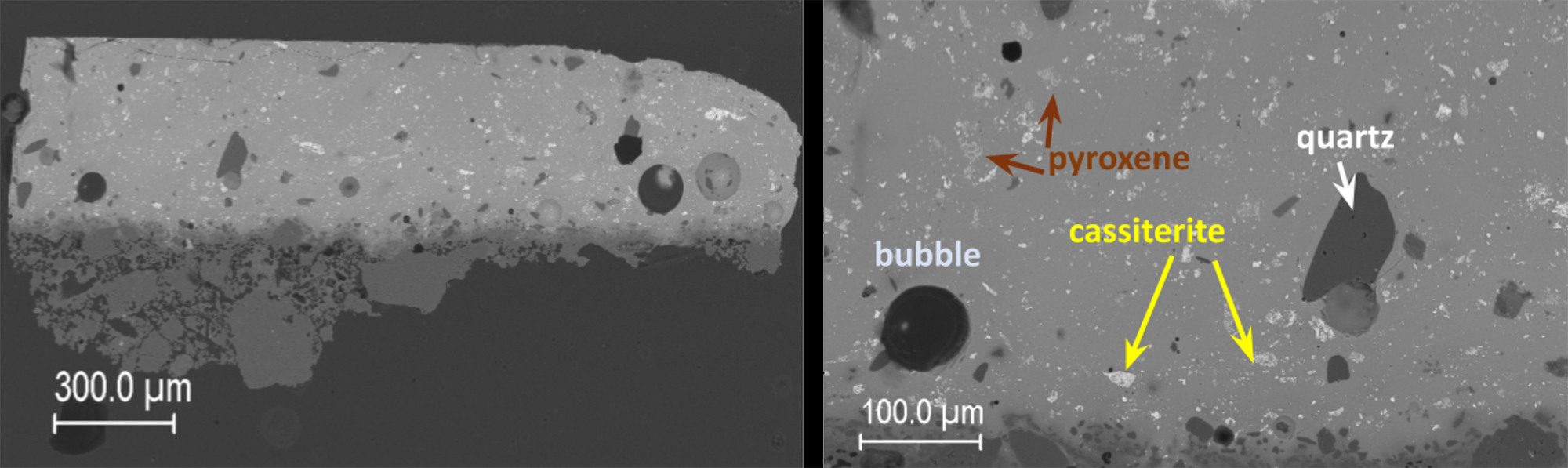
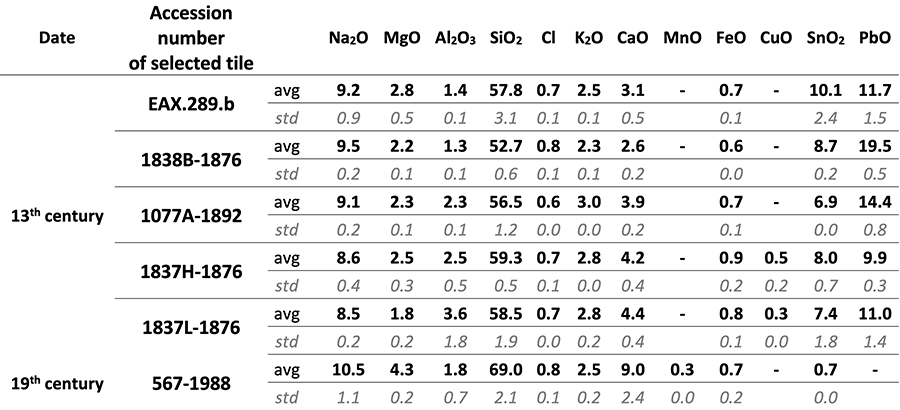
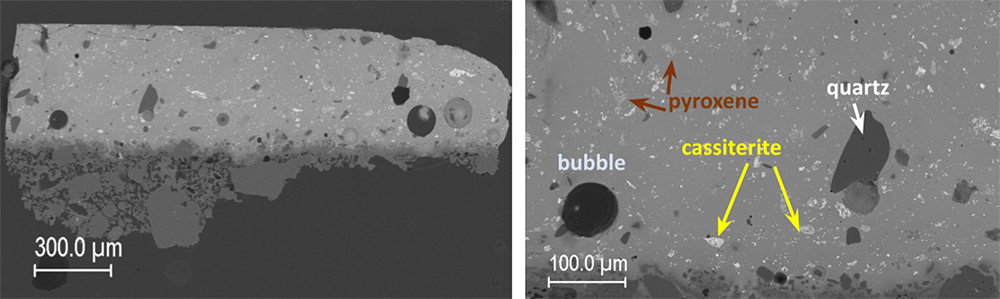
The glazes of the five sampled Emamzadeh Yahya tiles (ca. 1262–63) are alkali-lead opacified with tin oxide (SnO2) (Table IV). There are some differences in the lead oxide (PbO) and silica (SiO2) content, but the content of the alkali (Na2O, K2O, MgO, CaO) and iron oxide (FeO) is quite similar across the samples and seems to correspond to the same production, but not necessarily the same firing. The glazes contain some bubbles, some quartz grains that are not completely reacted, pyroxenes (aluminosilicates of calcium sodium and iron), and small tin oxide (cassiterite) crystals responsible for the opacity of the glaze (fig. 28; see also fig. 25). The tin oxide content varies between 7 and 10 wt%, quantities that effectively opacify a lead glaze.40 Sample 1837H-1876 contains a small amount of copper, which is not uncommon. Copper can be inadvertently incorporated into the glazes due to the use of brushes that were not perfectly cleaned.
Table IV. Glaze composition of all samples determined by SEM-EDS (wt%). avg: average over at least two areas of the ceramics. std: standard deviation of the measurements. [pdf]
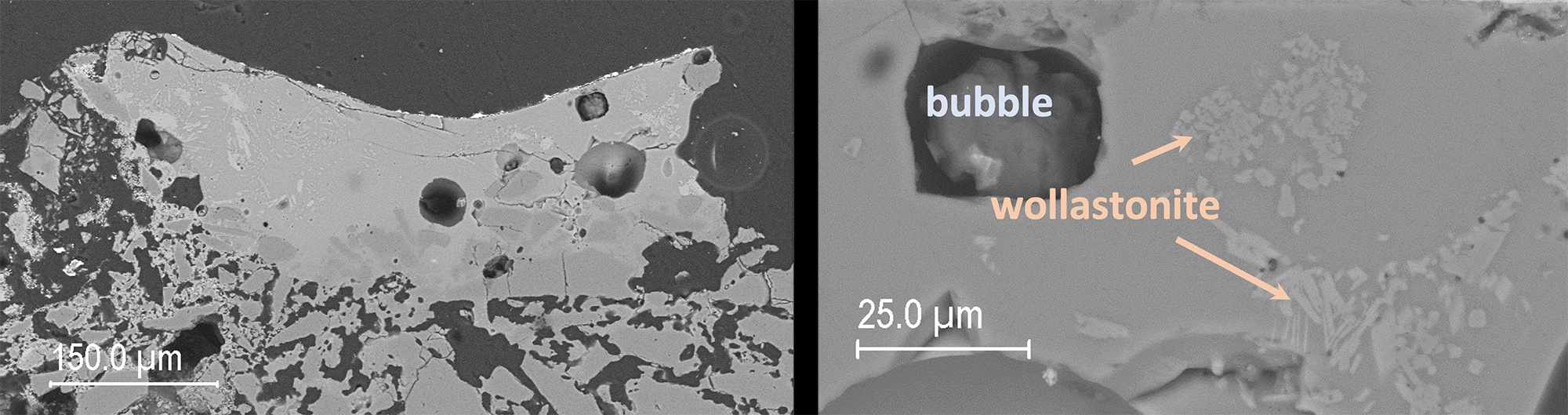
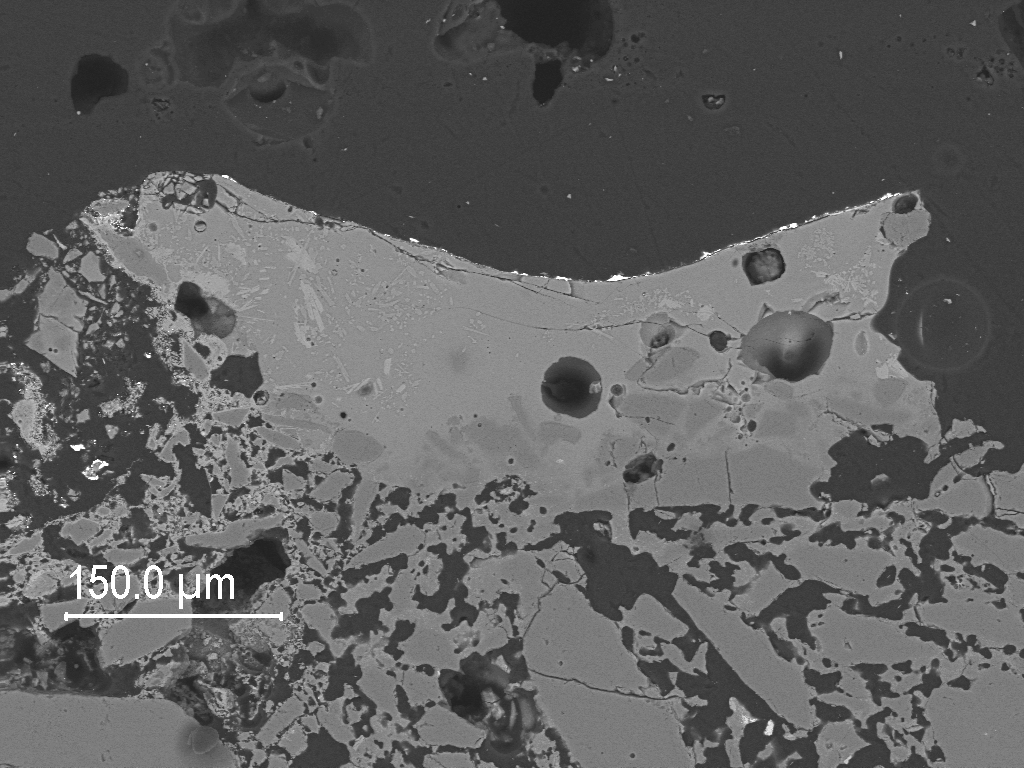
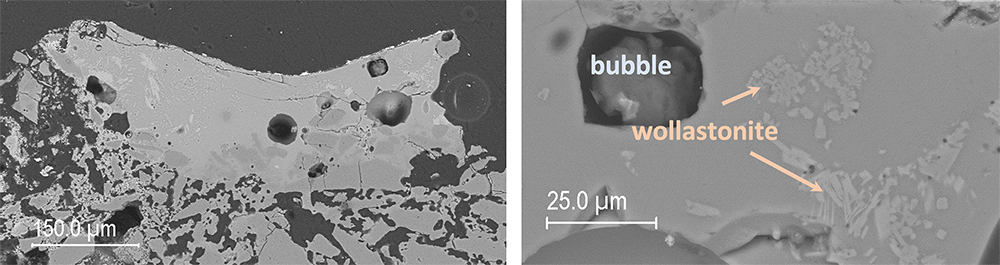
Once again, the nineteenth-century tile is different and in fact a lead-free glaze. The low alkali content suggests that it may contain some boron (B2O3), which will have to be verified by another analytical technique, since FESEM-EDS is insufficient.41 The glaze in this case is not opacified with tin oxide crystallites, but it contains many calcium silicates precipitates (wollastonite) and quartz particles (fig. 29).42
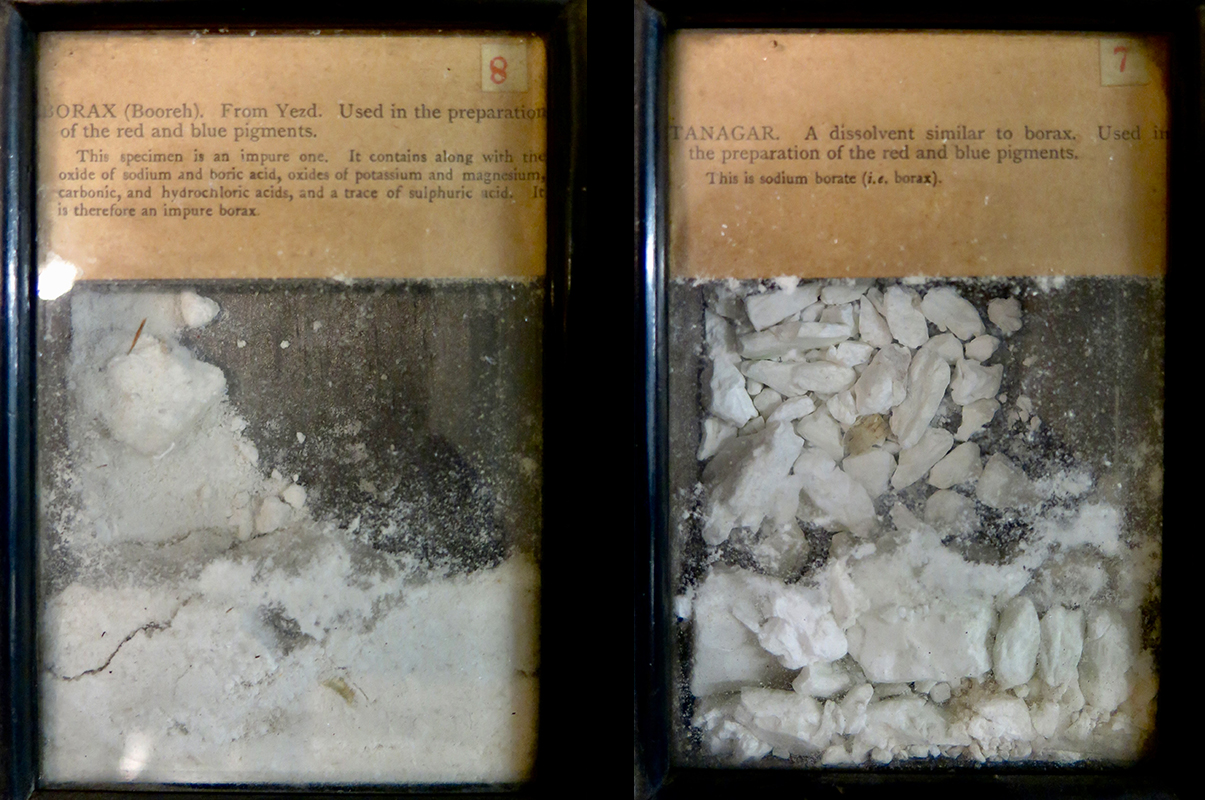
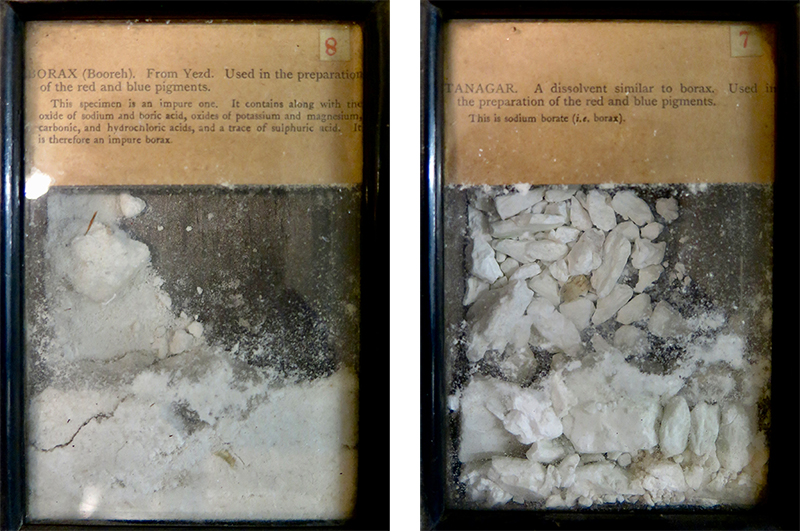
In his 1888 treatise, ʿAli Mohammad Esfahani refers to borax using the terms tangār (تنکار) and būreh-ye Yazd (بوره یزد) (fig. 30).43 Subsequent scientific analyses of the pigment by Ina Reiche and Friederike Voigt have confirmed that both refer to borax in composition (Na2B4O7·10H2O), with tangār appearing to be a more homogeneous and purified form.44 The source of būreh-ye Yazd (lit. borax from Yazd) is believed to correspond with a deposit referenced in several contemporary accounts, including those by Albert Houtum-Schindler (d. 1916), George Curzon (d. 1925), and others.45 Based on these sources, it is speculated that the būreh-ye Yazd deposit was located near the town of Soltanabad (formerly Deh Shotoran) (map), approximately 31 km southeast of Shahr-e Babak. Although now part of Kerman province, this area was historically within Yazd province.46
Scientific Results: Luster Decoration of the Thirteenth-Century Emamzadeh Yahya Tiles
Luster is a micrometric layer made of silver and/or copper metallic nanoparticles lying beneath the glaze surface that presents a wide variety of colors (green, yellow, amber, red, brown, white) with a metallic (golden, coppery, silvery) and iridescent (bluish, purplish) appearance.47 It is formed by a reaction between the luster pigment and the glaze in a separate low-temperature firing (about 500–600ºC) for a short time.48 Since the luster pigment is applied over a previously fired glaze, the process often involves up to three firings: the first for the ceramic bisque, the second for the glaze, and the third for the luster.
The paint contains silver and copper salts and sulfur-based compounds (either copper iron sulfides or mercury sulfide) and clay or Arabic gum. Silver and copper ions enter the glaze by diffusion. Inside the glaze, they are reduced to the metallic state as small metallic spherical particles of nanometric size (1 nanometer [nm] is one thousandth of a micrometer [µm]) responsible for the luster color and shine. After the final firing, the luster pigment residue is rubbed off revealing the luster layer beneath.49
The mechanism by which silver and copper compounds react with the glaze surface is known as ionic exchange.50 Silver and copper ions from the luster paint are exchanged by the sodium ions from the glaze. Metallic silver and/or copper nanoparticles then precipitate, forming a thin layer near the glaze surface. The luster layer typically has a thickness below 1 micrometer (µm). As a point of comparison, we can consider that a strand of hair has a thickness of about 50 micrometers, making it 50 to 100 times thicker than luster decoration. Luster layers applied over cobalt blue tinged glazes can be up to 10 micrometers thick and are typical of Iran and Syria during the fourteenth century.51
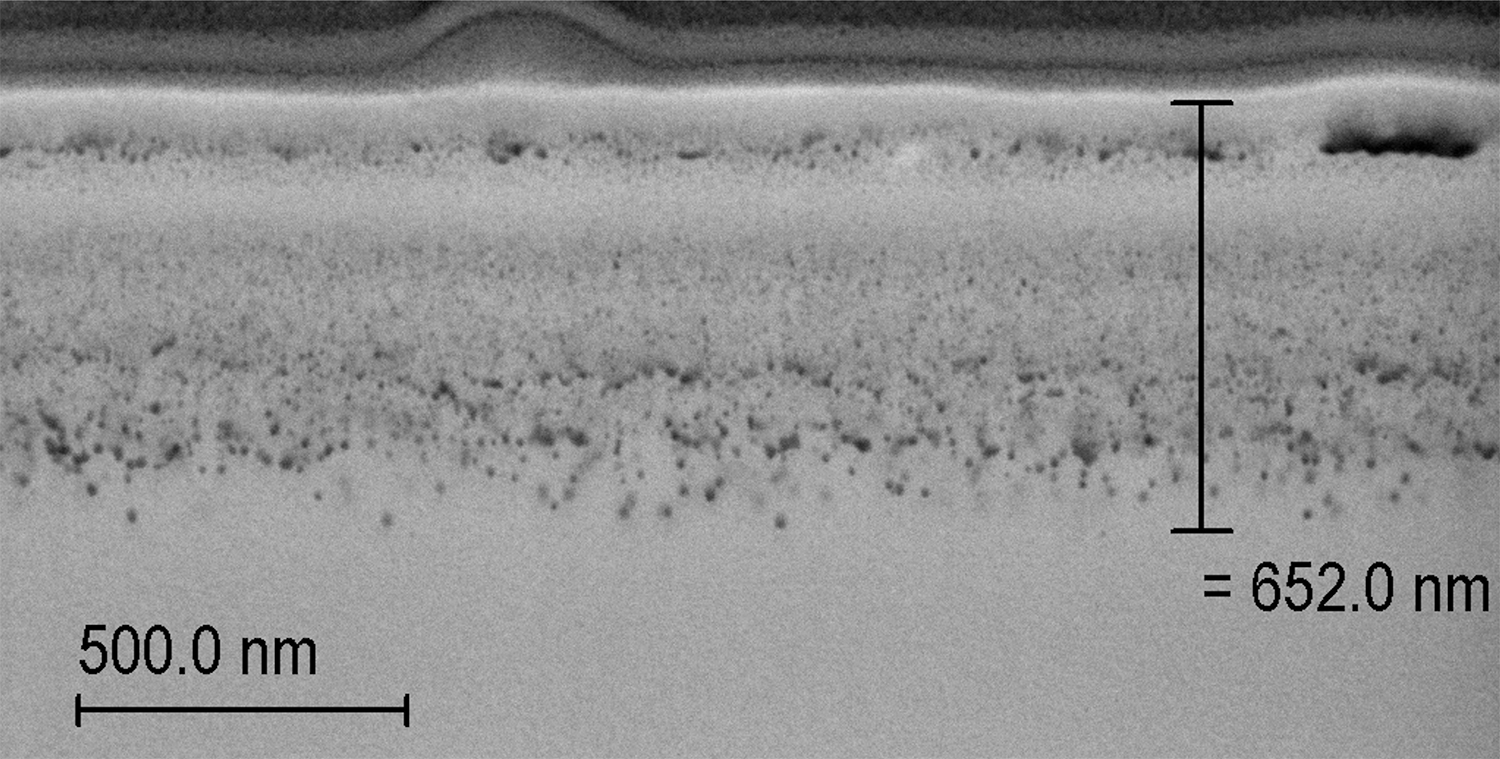
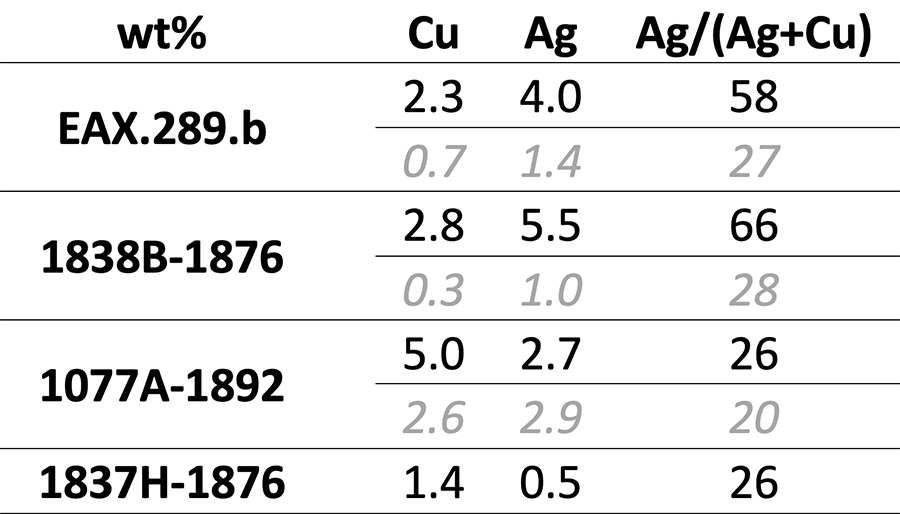
All of the Emamzadeh Yahya tiles analyzed in this study show a similar luster decoration containing both copper and silver (Table V). The amount of copper is high (20–60 wt% Ag/[Ag+Cu]), and both metallic copper and silver nanoparticles are present, resulting in the brown color characterizing this luster decoration (fig. 31).52 Silver appears more heterogeneously distributed on the surface, while copper is more homogeneously distributed. The luster layers of the tiles are extremely thin: below 1 micrometer. As a result, scratches and weathering have a greater impact on them than the glaze, and the measured chemical composition of luster appears more variable due to cracks and surface degradation.
Table V. Luster composition of four of the five sampled tiles from the Emamzadeh Yahya at Varamin, presumably made in Kashan, dated 661/1262–63 (1077A-1892) or dateable between 1262–63. The other side of the V&A’s composite star (1837L-1876) was not analyzed. [pdf]
Overall, the composition and nanostructure of the Emamzadeh Yahya tiles are characteristic of medieval Iranian lusters, and we can again contextualize our scientific findings against Abo’l Qasem’s 1301 treatise.53 He describes the preparation of a luster pigment by mixing various arsenical compounds with calcined copper to form a paste, which was then ground thoroughly. A quarter part of this mixture was combined with six parts of pure silver that had been burned with sulphur and finely ground, hence the Ag/Ag+Cu ratios observed in this analysis. This blend was then dissolved in grape juice or vinegar and applied to the surface of the glazed tiles. The tiles were subsequently placed in a secondary kiln, specifically constructed for this purpose, and exposed to a light reducing atmosphere (smoke firing) for seventy-two hours. Once cooled, the surface was rubbed with a damp cloth to reveal the luster decoration.
Scientific Results: Imitation ‘Luster’ Decoration of the Nineteenth-Century Tile by ʿAli Mohammad Esfahani
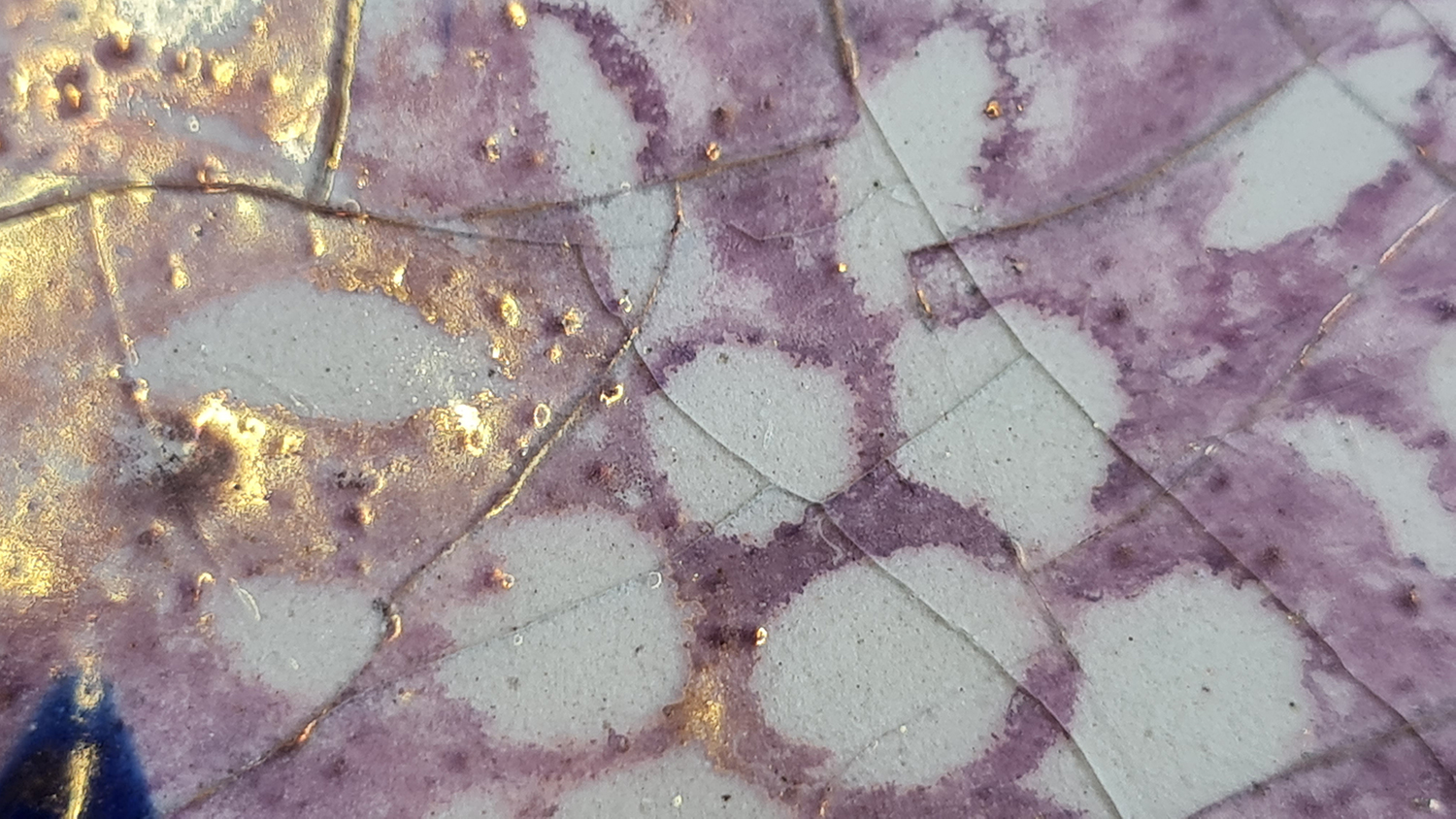
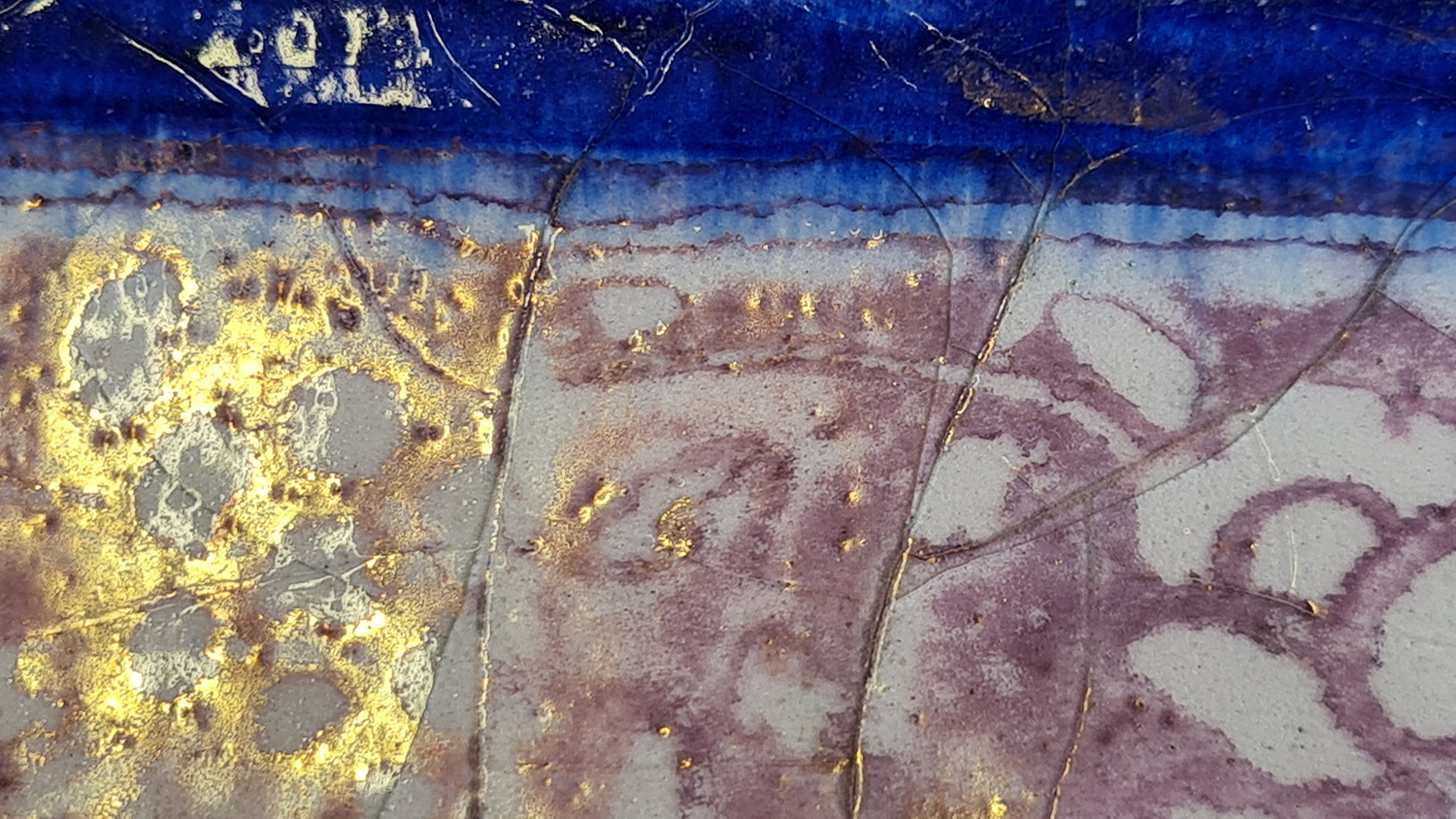
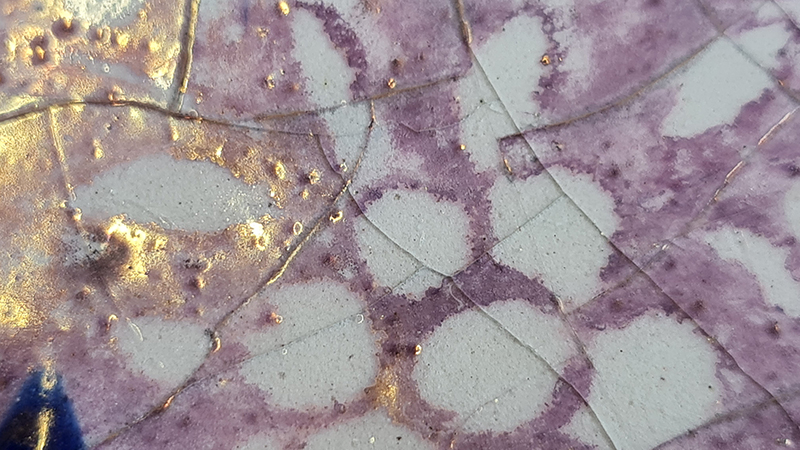
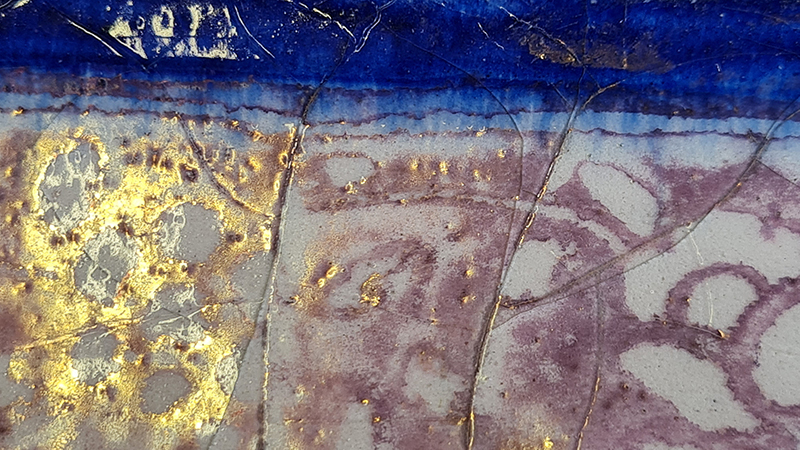
The decoration of the tile made by ʿAli Mohammad Esfahani is completely different from the Emamzadeh Yahya examples. The epigraphy was painted in cobalt blue applied before glazing, and the base of the tile has a purplish decoration with golden reflectivity (figs. 32–33; see vid. 5).54 Contrary to some expectations, and how the tile has been published to date, this decoration is not luster, as scientifically defined here as “a micrometric layer made of silver and/or copper metallic nanoparticles lying beneath the glaze surface” (see the previous section).55 Instead, it is a pigment using gold that is generally known in English-language circles as Purple of Cassius, after physician Andreas Cassius of Leiden (d. 1673), who first described it in his 1685 Latin treatise De Auro (De extremo illo et perfectissimo naturae opificio ac principe terraenorum sidere auro…).56 This pigment (xH2SnO3·yAuo) is a colloid of gold and stannic acid (H2SnO3), a hydrous form of tin oxide, produced by adding a solution of stannous chloride (SnCl2) to a solution of gold in aqua regia (Lat. royal water), a mixture of hydrochloric acid (HCl) and nitric acid (HNO3). When Purple of Cassius is fired with raw glass products (silica, with mainly sodium and calcium carbonate), as soon as the melt is produced, gold nanoparticles (Auo) precipitate, and after cooling, a glass containing gold nanoparticles is obtained. The gold nanoparticles give the glass a red or purple hue.
Around 1679, Potsdam-based chemist and glass technologist Johannes Kunckel von Löwenstern (d. 1703) used Purple of Cassius to produce ruby red glass, keeping the recipe a secret.57 At the end of the nineteenth century, this secret was rediscovered in the glassworks of the Ehrenfeld district in Cologne, and Bohemian glass became famous for its ruby red color. Purple of Cassius was not only used to produce ruby red glass but also purple and pink enamels, including the famous Famille Rose porcelain (consider V&A dish 1991C-1855).58
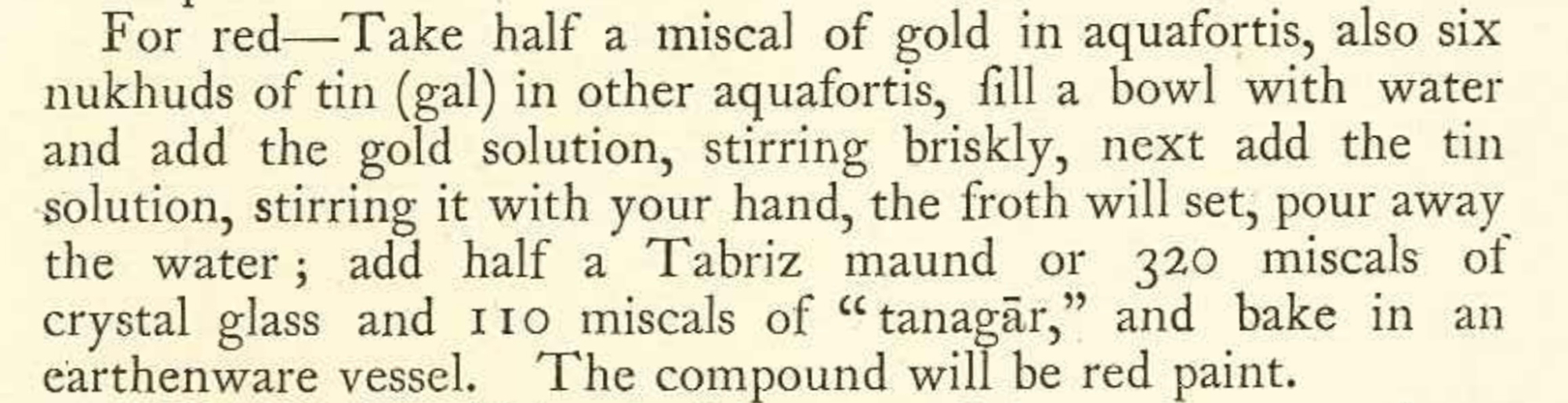
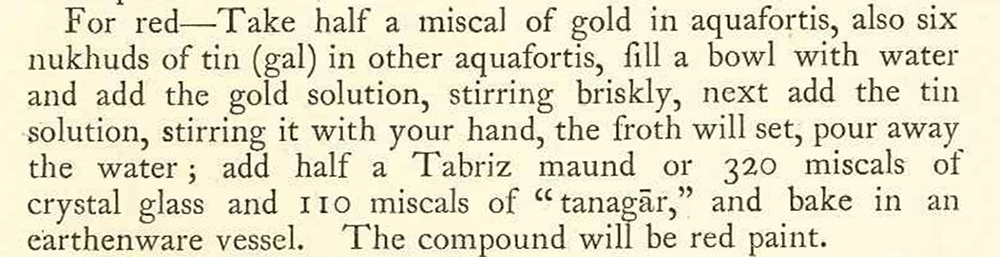
In his 1888 treatise, ʿAli Mohammad describes the production of “red paint” (fig. 34). First, tin and gold are mixed with “aquafortis” (nitric acid).59 Then, the precipitate (solid compound) is mixed with “crystal glass” (a glass of unknown composition) and “tanagār” (tangār, borax). Finally, this mixture is fired at a high temperature, producing a sintered substance that was probably ground into the powder used for red paint. What ʿAli Mohammad describes is in fact the production of a red enamel.
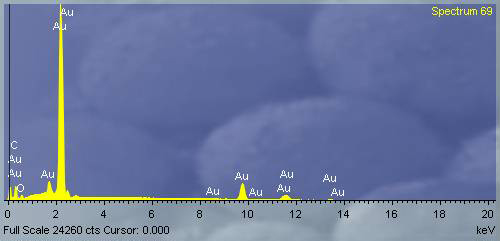
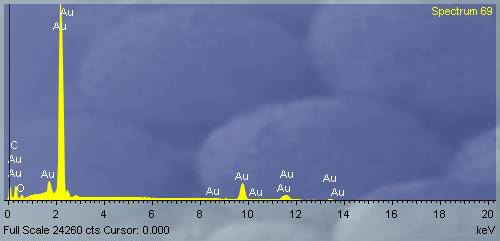
During the 2012 study of the materials used by ʿAli Mohammad, the red pigment was analyzed, and it was found to contain sodium, potassium, calcium, iron, and silica, as well as the presence of boron.60 This confirms that the potter was using a borax-based recipe for the glass. The analysis also identified gold, but not tin. In our analysis of the V&A’s rectangular tile, we have identified the presence of both gold and tin. In sum, this research shows that ʿAli Mohammad was using Au (gold) and not the Cu (copper) and Ag (silver) recipes of medieval luster.
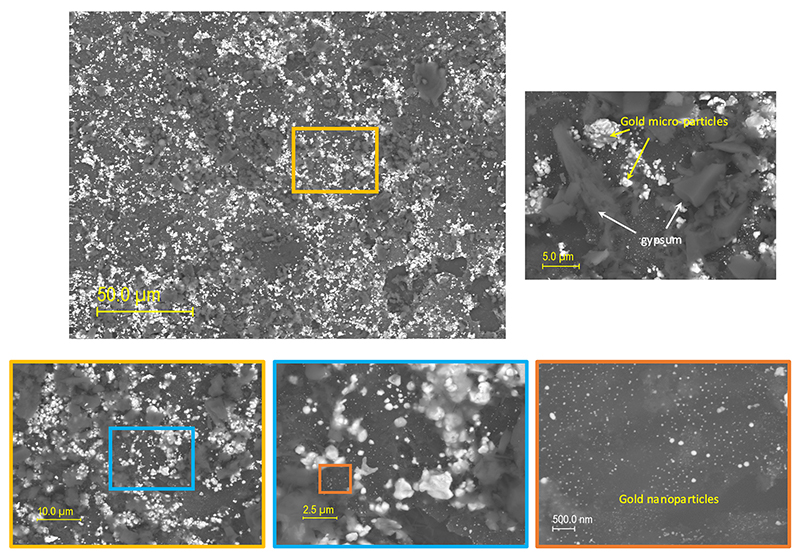
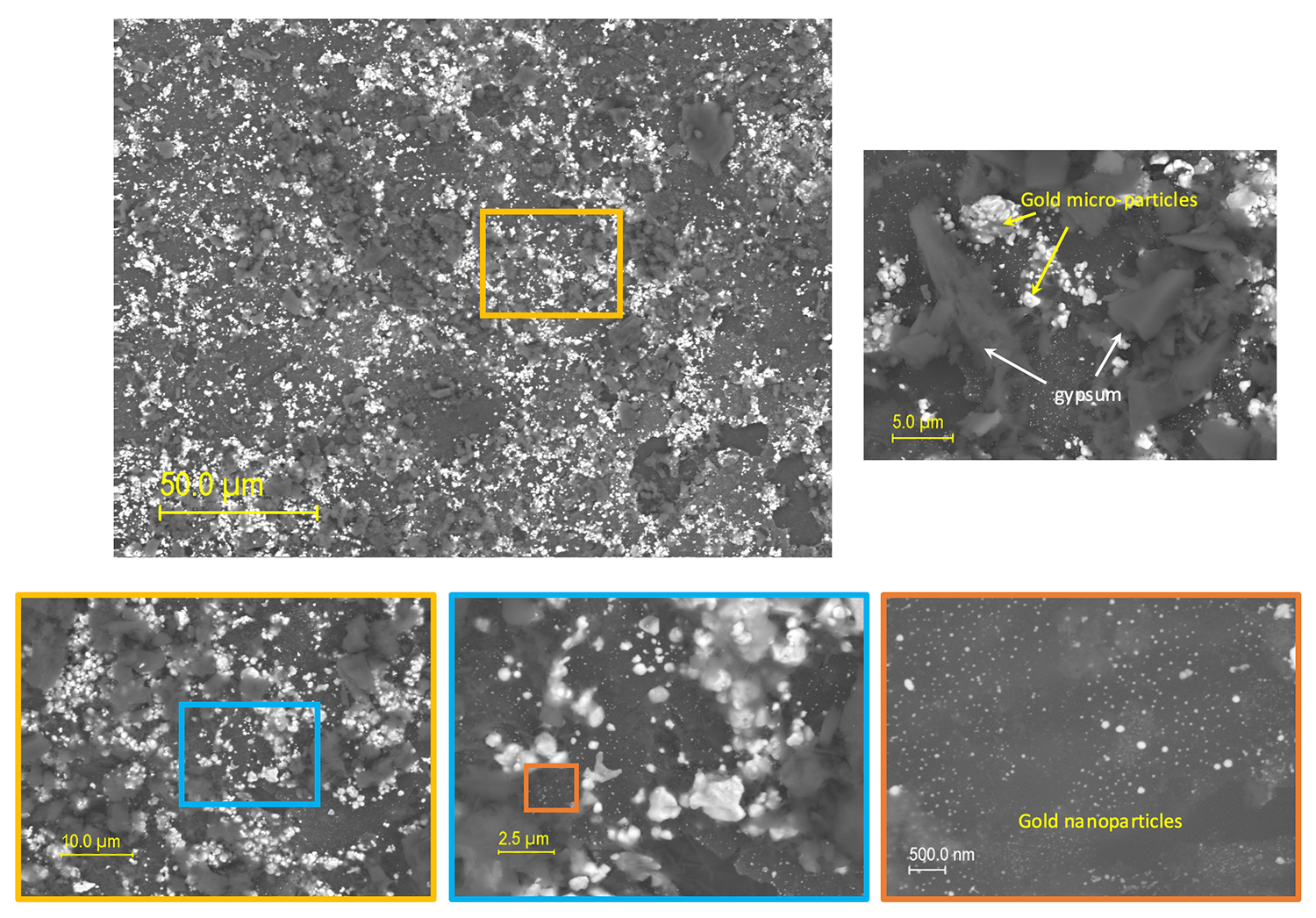
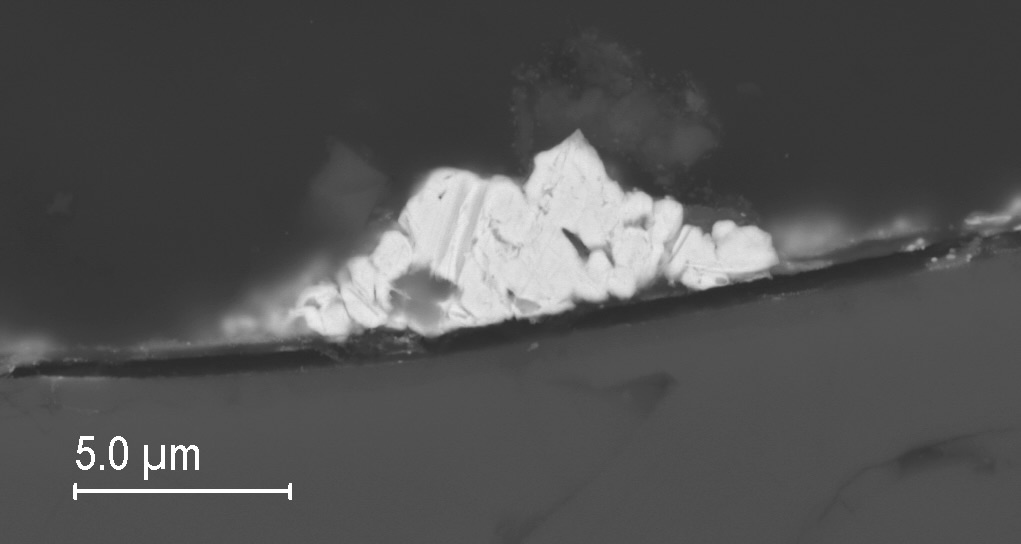
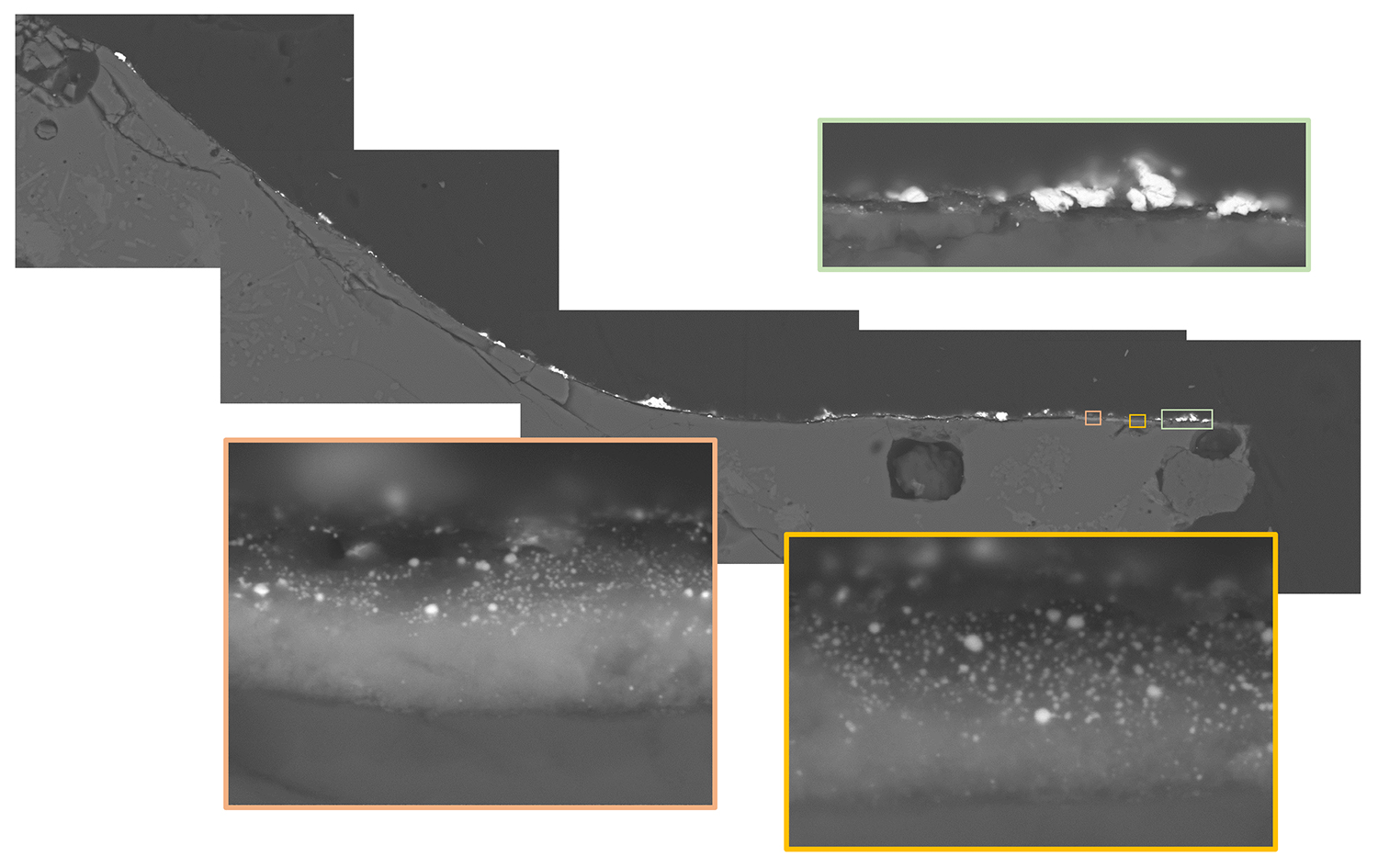
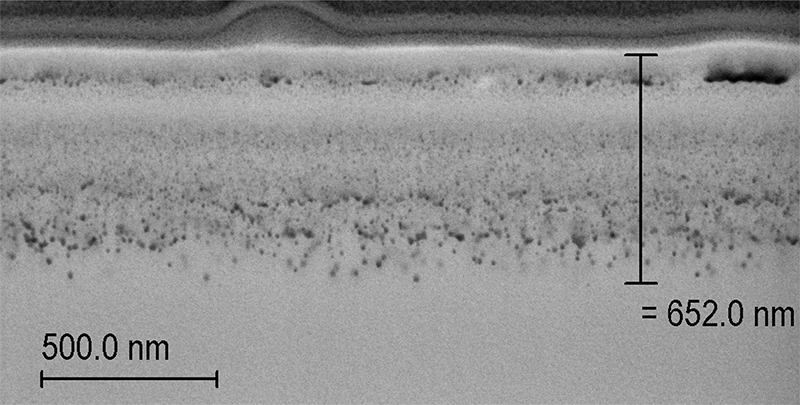
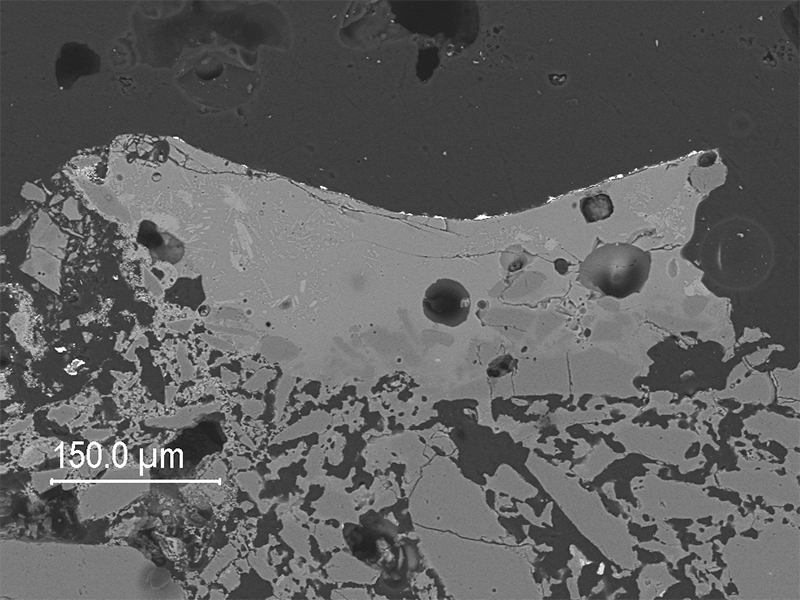
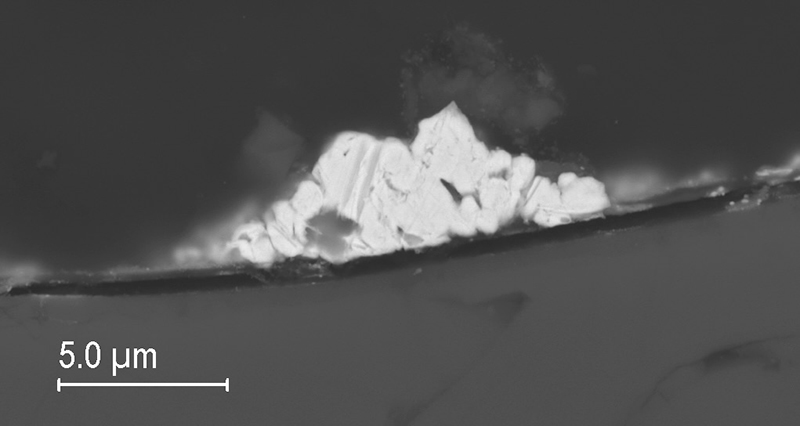
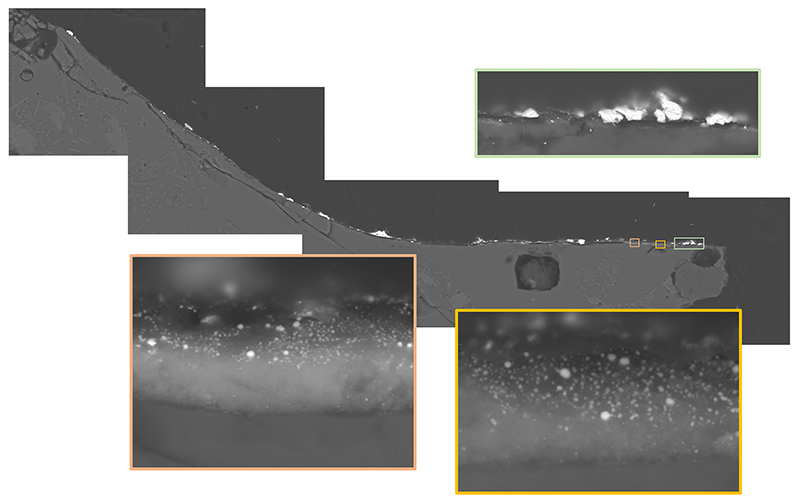
The way that ʿAli Mohammad applied the “red paint” (or Purple of Casius) to the V&A tile is also unique. Typically, all of the gold is incorporated into the glass as nanoparticles (that is, mixed into the glaze), and the result is red or purple decoration with no golden reflectivity. In this case, the pigment was applied to the surface of the glaze (that is, over the glaze). As a result, only part of the gold was absorbed into the glaze and precipitated as gold nanoparticles (fig. 35). Some larger gold particles (5 to 10 micrometers in size) remained stuck on the surface, creating the stunning golden reflection amid the purple color (figs. 36–37).
Researchers are left to ponder whether ʿAli Mohammad stumbled upon this technique by accident or developed it through deliberate innovation. It is certain that Purple of Cassius was well known at the end of the nineteenth century and used to produce red glass and also red/purple enamels, both of which were manufactured in Europe and sold around the world.61 However, given the mention of the use of gold (زر محرق) to produce ruby glass in some medieval Persian treatises, we must also leave open the possibility that ʿAli Mohammad’s technique was a continuation of local technology, rather than the result of an encounter with European methods.62 ʿAli Mohammad’s treatise indicates that he produced his own paint comparable to Purple of Cassius but then applied it over the glaze in a distinct way. The result was a beautiful and unique effect: a tile with a purple hue and an intriguing golden shimmer.
Conclusion
This project has presented a first step in the scientific investigation of luster tiles from the Emamzadeh Yahya. The aim has been to provide a comprehensive scientific study of the tiles, including both the microstructural and chemical compositions of the body, glaze, and luster layers. Such an integrated approach has often been lacking in the analysis of luster ceramics but is essential for a more thorough comparative understanding of lusterware production in Iran.63
The four (or five) thirteenth-century luster tiles from the Emamzadeh Yahya analyzed in this study exhibit remarkable consistency in their composition and decoration. The ceramic bodies of the analyzed samples correspond to medieval Iranian stonepaste. The chemical composition includes 80% of SiO2, 5–10% of Al2O3, 2–3% of Na2O, K2O and CaO, below 1% of FeO, and 1 to 1.4 of TiO2. The glazes on the tiles are alkali-lead glazes opacified with tin oxide (SnO2). The alkali content is similar across the samples: Na2O is about 9%, K2O is about 2.7%, and CaO is about 3.6%. The FeO content is also similar across the samples, around 0.7%. PbO varies from 10% to 19%, and SiO2 ranges from 53% to 59%—variations that appear related to differences in firing temperature, which may vary within the same kiln. The glazes contain bubbles, unreacted quartz grains, pyroxenes, and small cassiterite crystals, with tin oxide content between 7–10 wt%, effectively opacifying the glaze. The luster decoration on all tiles is a thin layer near the surface of the glaze, between 0.5 and 1 micrometer (µm) thick, and composed of copper and silver nanoparticles below 20 nm. Given this uniformity across body, glaze, and luster, it is likely that these tiles were produced using the same products and method and presumably in the same place. In the future, we look forward to comparing these samples to other samples of medieval Iranian luster tiles already collected.
The imitative ‘luster’ tile made by ʿAli Mohammad Esfahani around 1887 differs significantly from the Emamzadeh Yahya examples. It features a lead-free glaze with low alkali content, suggesting possible boron presence, and is notable for its inclusion of gold. ʿAli Mohammad used a perhaps self-made version of what is commonly known in English-language circles as Purple of Cassius, a pigment made from gold and stannic acid. What distinguishes ʿAli Mohammad’s tile is the application of this pigment to the surface of the glaze, resulting in both absorbed gold nanoparticles and larger gold particles on the surface, and in turn a stunning golden reflection. In sum, ʿAli Mohammad seems to have tried to imitate aspects of the aesthetics of medieval luster but used completely different materials and methods, suggesting a desire to innovate or at least experiment.
Given this study’s relatively small sample size, it can naturally be expanded in the future. To complement our focus on the tomb’s star and cross tiles that once clad the dado and framed the mihrab in half versions, it would also be ideal to investigate the mihrab itself and the cenotaph of Yahya b. ʿAli. Individual tiles removed from the mihrab and preserved in storage (as in Vienna; MAK KE 3570-23), enclosed in antiquated frames (as in Denver; DMA 1958.4), and already broken or chipped (as in St. Petersburg; Hermitage ИР-1350) present opportunities for continued analysis. These results could then be compared to the already analyzed star and cross tiles: Do the microstructural and chemical compositions suggest or rule out that they were made in the same workshop? In the case of the cenotaph’s cover/tombstone (705/1305), does its production around forty years after the stars and crosses (660–61/1262–63) and mihrab (663/1265) illuminate any shifts in scientific composition and hence materials and methods?
Future analysis would ideally also return to the shrine of Emamzadeh Yahya itself, thus providing an important balance to displaced tiles in foreign museums. The fragment of a cross remounted at the top of the mihrab void (see fig. 6) offers an ideal in situ control, despite not being in its original location in the tomb.64 Would the results be consistent with the tiles sampled to date? On a larger scale, comparing the microstructures of the Emamzadeh Yahya tiles to those from other contemporary sites would be helpful, as little is currently known.65 The glaze compositions of tiles studied to date suggest the use of homogeneous recipes and appear fairly consistent over medieval luster, minaʾi, and lajvardina tiles.
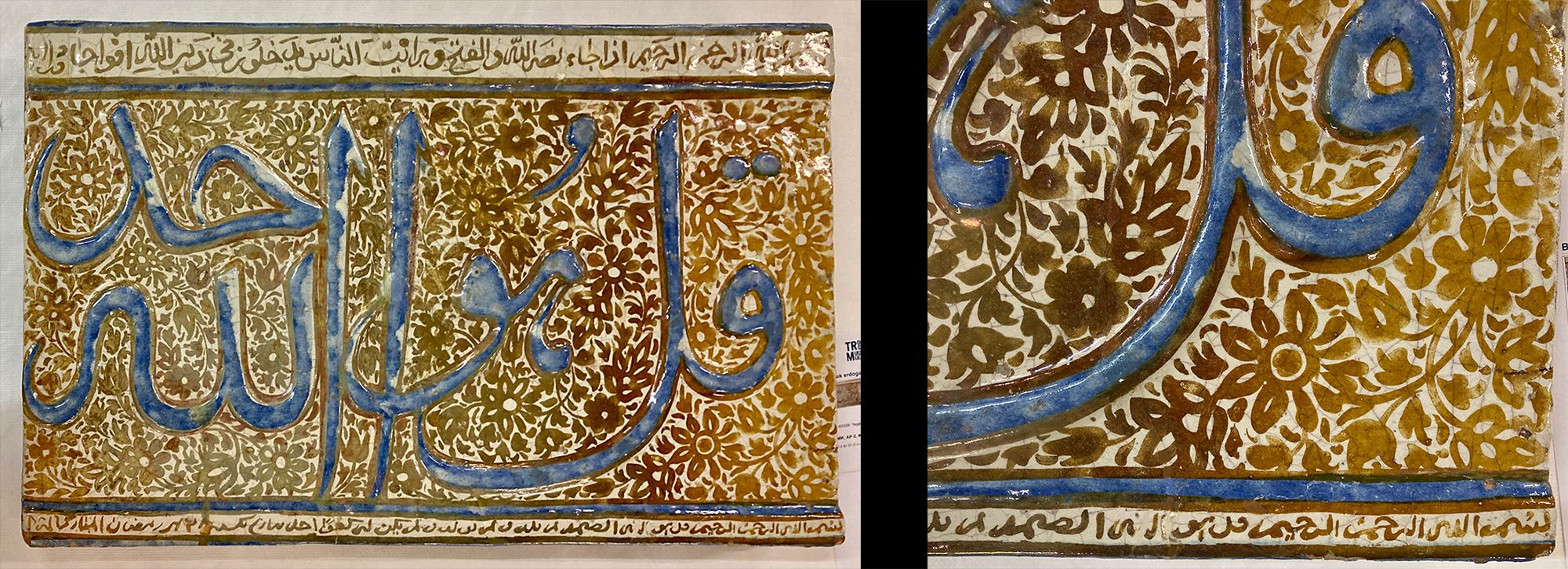
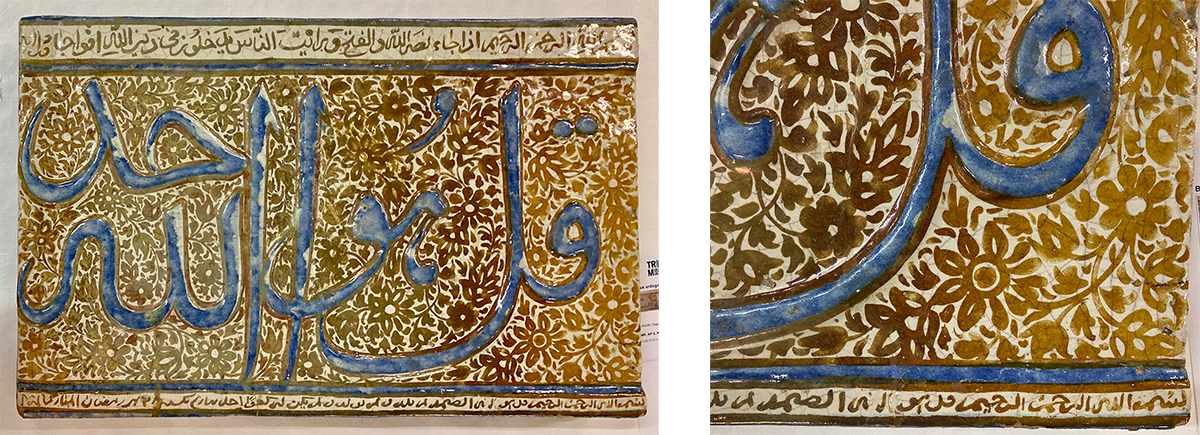
This scientific analysis project has also contributed additional quantitative data to comparative studies of medieval luster tilework and nineteenth-century responses. The exact intentions of the latter will need to be addressed on a case by case basis. To date, we have not identified a close comparison to ʿAli Mohammad’s imitative ‘luster’ tile in the V&A and are unable to conclude if it was made for the foreign client (Robert Murdoch Smith and UK museums) or just bought by Murdoch Smith.66 A few nineteenth-century tiles are known that more faithfully mimic the aesthetics of medieval luster models, including their copper-brown hue and epigraphic content and style. One example is a rectangular tile in the Wereldmuseum with a molded inscription in blue and smaller painted inscriptions on the edges with Qur’anic verses (fig. 40). This more imitative tile raises many questions: Was it conceived as part a larger nineteenth-century architectural element (epigraphic frieze, mihrab, cenotaph) intended for a building? Or, was it created to fill a missing part of an earlier luster ensemble, hence part of a restoration?67 Alternatively, was it not created for a site at all but rather as an artistic experiment or as a commodity for sale on the international art market? If so, how was it dated, described, and marketed? Finally, how exactly was the luster-like look achieved, and how do these techniques compare to those used by ʿAli Mohammad in the V&A tile, as well as much earlier medieval potters?
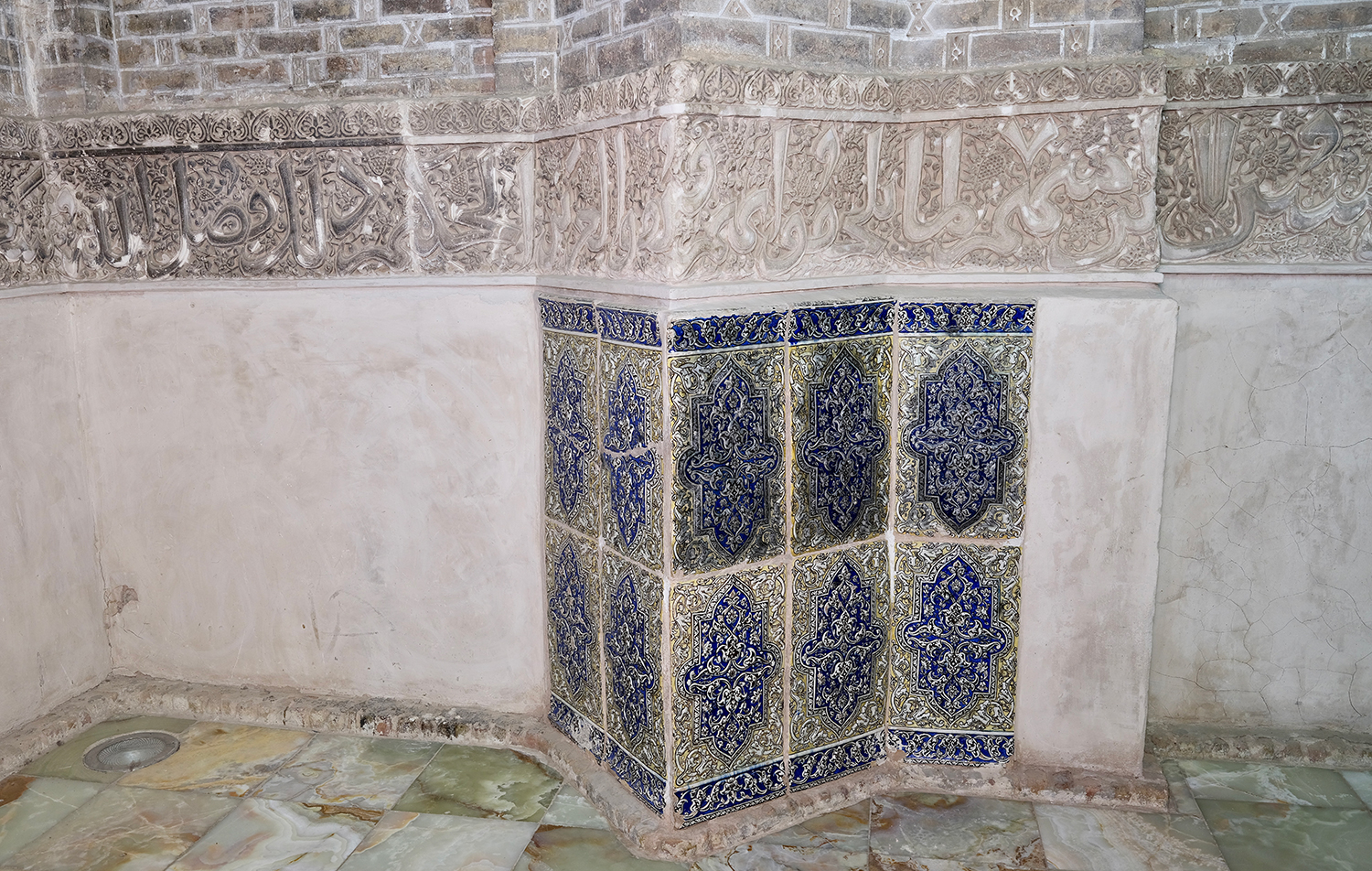
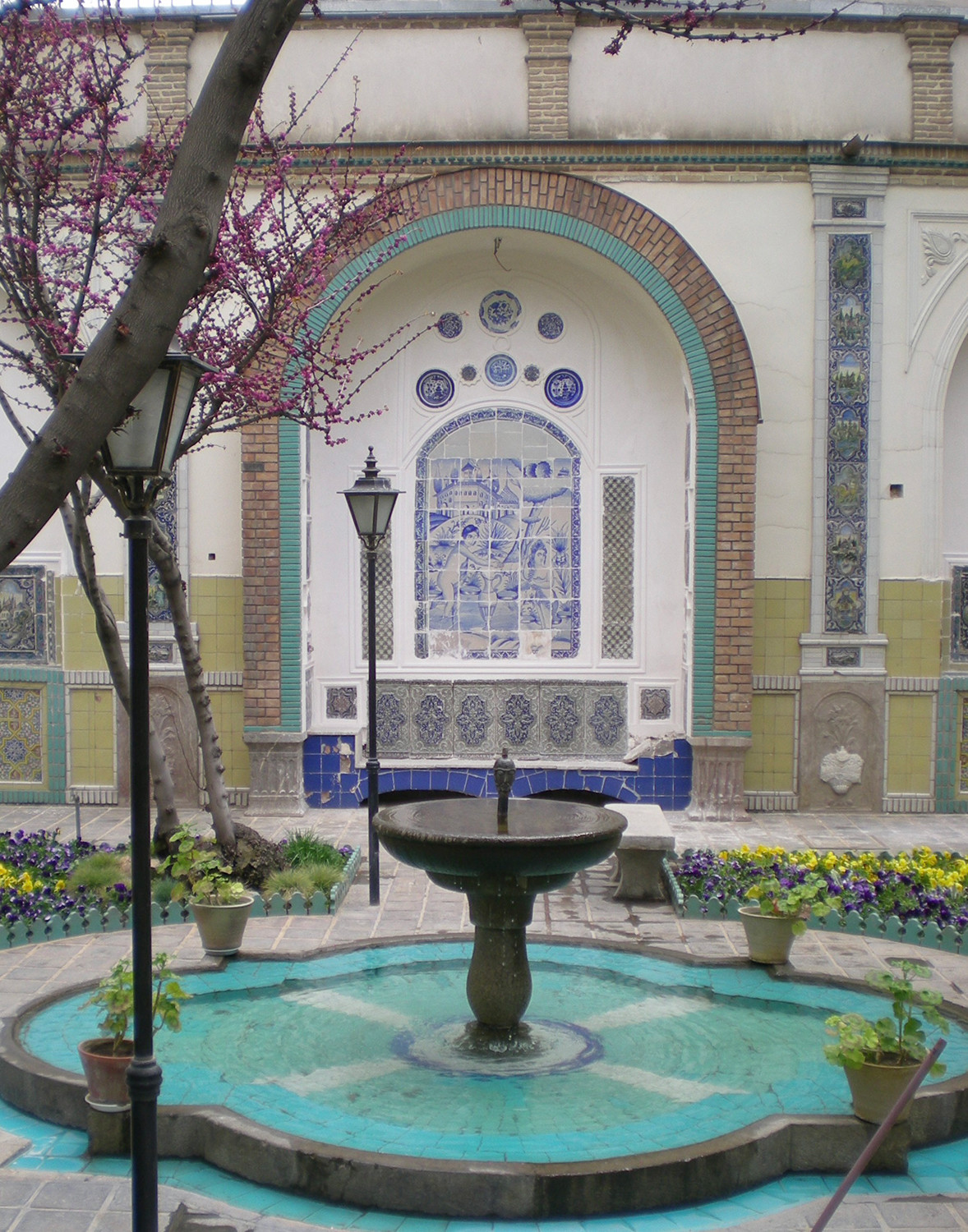
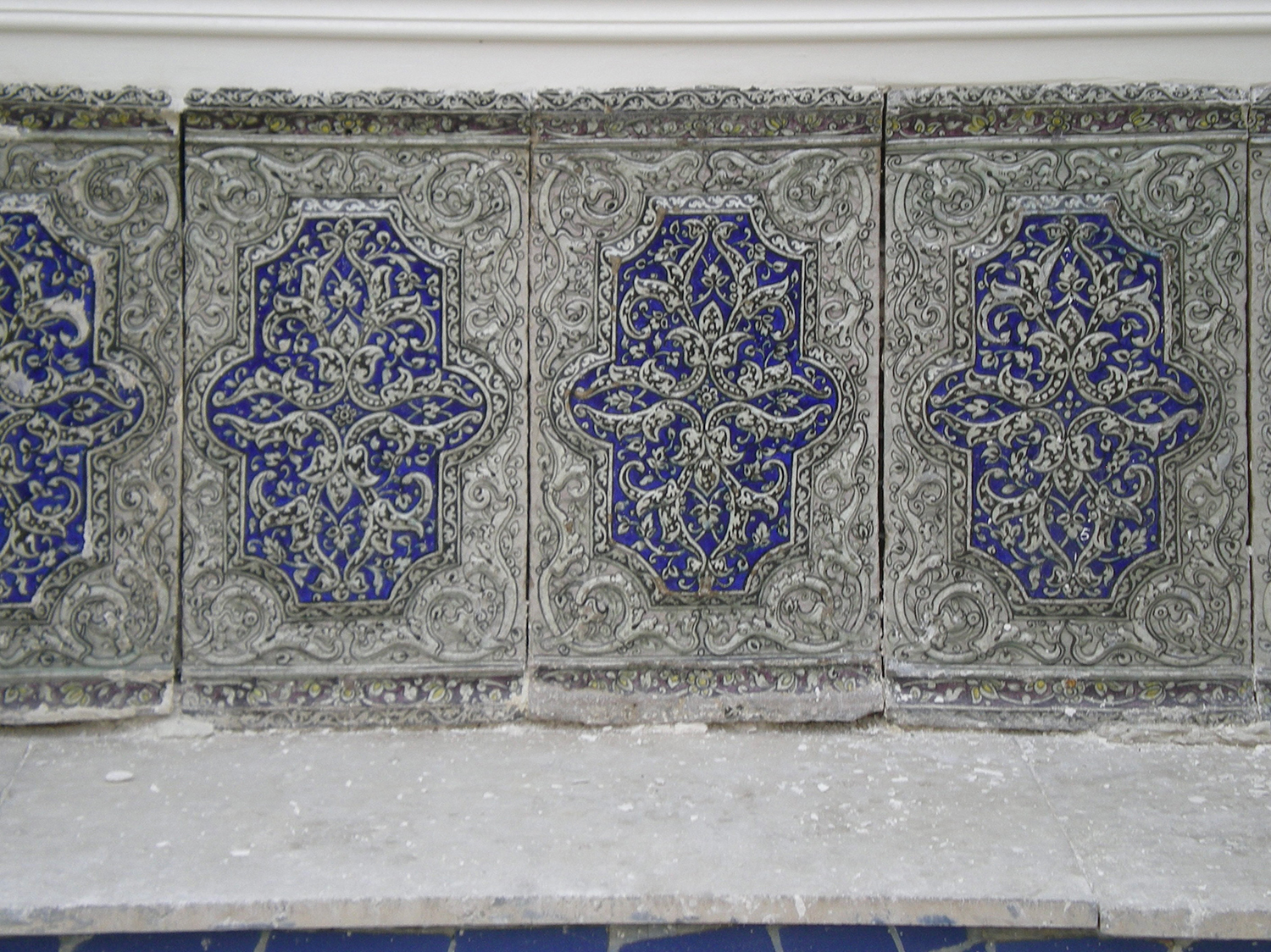
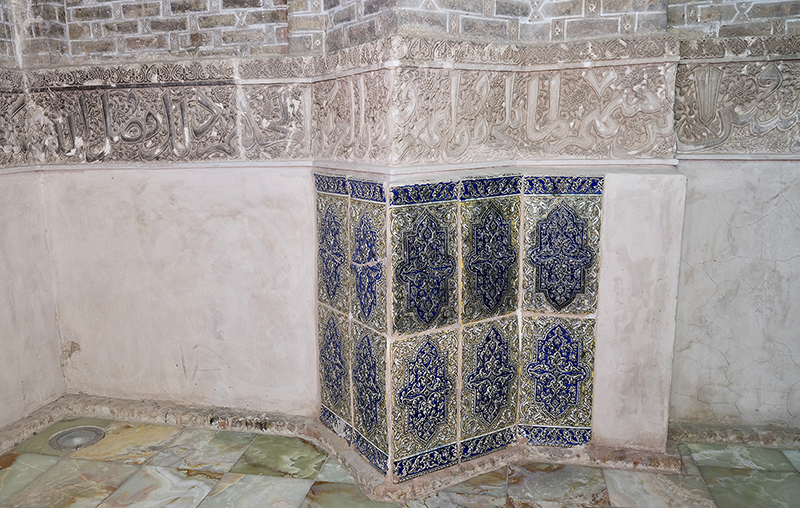
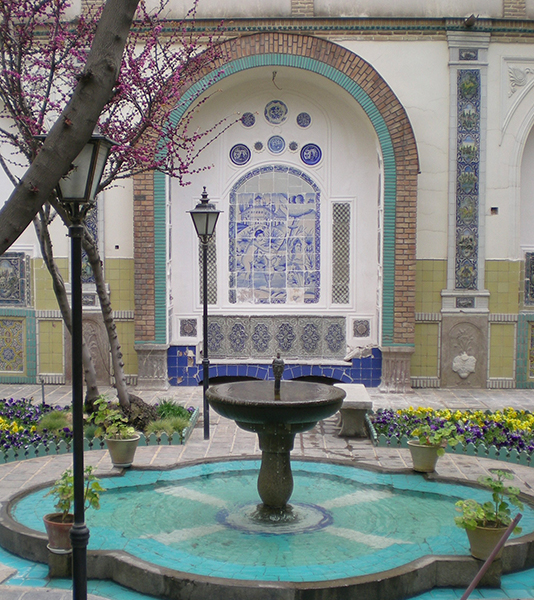
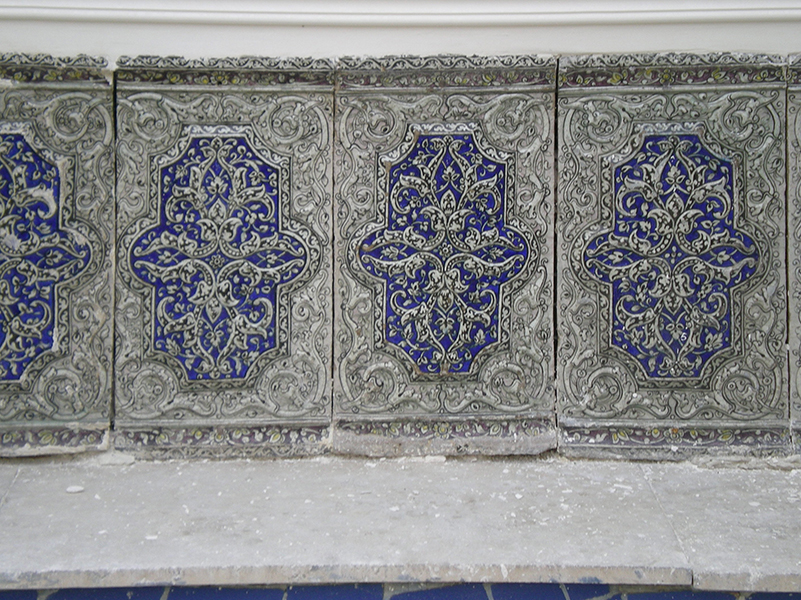
The consideration of continuities and ruptures between thirteenth- and nineteenth-century tilework fittingly returns us to the tomb of Emamzadeh Yahya at Varamin. At some point around the turn of the twentieth century, presumably after all of its luster stars and crosses had been taken (ca. 1860s–90s), the dado was decorated with rectangular underglaze tiles in relief. This new high-quality revetment did not seek to imitate the original luster but instead contributed a distinctly contemporary (late nineteenth century) aesthetic (fig. 41). This extensive commission attests the tomb’s importance at the end of the Qajar period and remains the only known example of an interior’s recladding soon after, and possibly even in relation to, the thefts of its medieval luster tilework.68 Comparable underglaze tiles are known in other sites in and near Tehran, including the house-turned-museum of professor-archaeologist Mohsen Moghadam (d. 1987) (map) (figs. 42–43). This museum also preserves many medieval luster tiles in its hauz-khaneh, including three crosses attributable to the Emamzadeh Yahya (see this 360° tour), which may present more opportunities for research.
Citation: Trinitat Pradell, Judit Molera, Moujan Matin, and Keelan Overton. “Microanalytical and Microstructural Analysis of Thirteenth-Century Luster Tiles Attributed to the Emamzadeh Yahya in Varamin and a Comparison to a Nineteenth-Century Imitation ‘Luster’ Tile by ʿAli Mohammad Esfahani.” Essay in The Emamzadeh Yahya at Varamin: An Online Exhibition of an Iranian Shrine, directed and edited by Keelan Overton. 33 Arches Productions, June 7, 2026. Host: Khamseen: Islamic Art History Online.
Notes
Acknowledgements: For approving and facilitating our requests for sampling, we thank the Victoria and Albert Museum and Ashmolean Museum and especially Fuchsia Hart, Mariam Rosser-Owen, and Francesca Leoni. Most scientific techniques—Scanning Electron Microscope with an energy dispersive spectroscopy detector (SEM-EDS) and Field Emission Scanning Electron Microscope (FESEM) with a Focused Ion Beam (FIB)—were performed in the laboratories of the Center for Research in Multiscale Science and Engineering (CCEM) at Universitat Politècnica de Catalunya · BarcelonaTech (UPC). The micro-XRD experiments were performed using the BL13 XALOC Beamline at ALBA Synchrotron, with the collaboration of ALBA staff, project number 2024098586. We are grateful to all individuals who contributed visual materials and to all museums who allowed the use of research photos and videos taken in storage. Throughout this writing process, the authors have provided peer review to one another. We also thank Martiana Rugiadi for providing an external review.
Editor’s note (Overton): The addition of this essay to the website/exhibition in June 2026 marks the completion of the Luster gallery, which includes many related works.
- For a recent (November 2025) historiographical study of the Emamzadeh Yahya’s mihrab, see Overton and Nakhaei, “From Varamin to Honolulu” (in this website as an essay and a visual timeline). ↩
- In this website, see Blair, “The Luster Cenotaph” (also in Persian translation). ↩
- For some preliminary observations, see Sadofeev, “Questions of Attribution of Some Tiles” (in Russian). ↩
- Throughout this essay, when discussing the tomb’s star and cross tiles, we use the phrases “attributed to the Emamzadeh Yahya” and “from the Emamzadeh Yahya” while generally favoring the former out of a spirit of caution. It is impossible to describe a single star or cross tile as irrefutably from the shrine without concrete evidence of its existence in situ, namely archival photographs showing it on the wall. At present, such documentation only exists for the mihrab and some half tiles surrounding it, thanks to Jane Dieulafoy’s 1881 photograph (jump ahead to fig. 7). The question of attribution also pertains to the place of production. While the tomb’s star and cross tiles are presumed to have been made in Kashan (about 200 km south of Varamin, map), we cannot be certain. For further discussion, see Overton and Nakhaei, “Chronological Overview,” below figs. 10–11. ↩
- Some possible exceptions to these perceived rules are discussed below. For other examples of luster star and cross tiles dated to the second half of the thirteenth century, see Watson, Ceramics from Islamic Lands, 374–76; Overton and Nakhaei, “Sites with Luster Tiles;” and vid. 4 here. ↩
- In his 1985 monograph on luster (Persian Lustre Ware, 191), Watson lists 150 star and cross tiles attributed to the Emamzadeh Yahya in twenty-four collections. In her 2021 dissertation (“Revêtements au lustre métallique,” 207, 416–26), Anaïs Leone expands this number to 280 (see also her essay in this website: Leone, “La partie et le tout,” below fig. 17). The exact number of stars and crosses in various shapes that originally revetted the walls of the tomb of Emamzadeh Yahya, including the dado and around the mihrab, remains to be precisely proposed and analyzed in relation to all surviving complete and fragmentary tiles in collections worldwide. The discovery (or rediscovery) of more archival photographs of the tiles in situ would sharpen and facilitate the reconstructive process. ↩
- The Shangri La Museum of Islamic Art, Culture & Design in Honolulu also preserves a large number of star and cross tiles attributed to the tomb, and at the time of press (May 2026), is planning an onsite installation devoted to this material. The museum recently (November 2025) hosted Hossein Nakhaei for a research residency and facilitated his virtual reunion of the mihrab with some of the shrine’s community gathered in the tomb. For further information, see this conversation. ↩
- For a filmed tour of these displays with V&A curator Fuchsia Hart, see Hart and Overton, Between the Object, Archive, and Gallery. ↩
- The photograph of this half star in the museum’s collections online shows the four pieces placed closed together. The pieces were staged this way for recent (2026) photography and remain detached. ↩
- Shahidi Marnani, “If some day a noble soul reads this…” (in this website in Persian and in English translation. ↩
- For an overview of these tiled puzzles, see Leone, “La partie et le tout.” On the forty-two sites currently known to have been decorated with luster tilework or associated with it in some way, see Nakhaei and Overton, “Sites with Persian Luster Tiles.” ↩
- Hossein Nakhaei’s 2025 working visualization of the tomb’s luster tilework and original environment (see fig. 2 and this other version) is being expanded, sharpened, and further contextualized in his dissertation in progress at the University of Pittsburgh entitled “Luminous Past, Fragmented Present: Persian Luster Tiles from Sacred Architecture to Museum Galleries.” ↩
- Overton and Nakhaei, “From Varamin to Honolulu,” chapter one, sections 1875–76: Tehran, 1878–80: Sèvres, and March–July 1885: London. It is possible that some tiles entered collections in the 1850s and 1860s. ↩
- On this three-year restoration project (1361–63 Sh/1983–85), see Khademi, “History of Architectural Preservation” (in this website). ↩
- Consider British Museum, London, 1896,0201.101; Metropolitan Museum of Art, New York, 08.169.4a,b (two separate pieces previously adhered as one); and Rijksmuseum, Amsterdam BK-NM-11750-A (dated). ↩
- Consider the State Hermitage Museum, St. Petersburg, IR-1052 and IR-75, discussed in Sadofeev, “Two cross tiles with Persian verses,” no. 19 in this exhibition’s Checklist. ↩
- Figural drawings of animals and humans appear on the versos of many star and cross tiles attributed to the Emamzadeh Yahya and are presumed to have been drawn by the potters. Consider, for example, cross tile D.933.2.63 in Sèvres, Musée national de Céramique. A sketch of interlocking star and cross tiles also appears on the verso of cross tile 07.902 in the Museum of Fine Arts Boston. ↩
- Consider Museum Boijmans Van Beuningen, Rotterdam, A 3875 [KN&V] and Metropolitan Museum of Art, New York, 91.1.105. ↩
- For a recent (2024) study of Iranian archaeological materials using X-ray fluorescence [EDXRF] alongside other techniques to increase precision, see Holakooei et al., “A provenance study.” ↩
- Some museum-based projects devoted to single vessels include Holod, “Event and Memory” and the related McCartney and Holod, “Under the Microscope” (on a mina’i bowl in the National Museum of Asian Art, Washington, DC, F1943.3); Michelsen and Olafsdotter, “Telling Tales: Investigating a Mīnāʾī Bowl” (on a mina’i bowl in the Museum of Islamic Art, Doha, PO.230.MIAQ); and Leoni et al., “‘The Illusion of an Authentic Experience’” (on a luster bowl in the Ashmolean Museum, Oxford, EA1956.88). For a recent (2026) publication addressing fabrication and forgery, see Graves, Invisible Hands, especially chapter 3. ↩
- Throughout this essay, the term ‘medieval’ is employed for purposes of simplicity to refer to luster tilework production during the thirteenth and fourteenth centuries; that is, spanning the Kharazmshah (ca. 1077–1231) to Ilkhanid (1253–1356) periods. Luster was also produced during the Timurid (1370–1507) and Safavid (1501–1722) periods, but that production is not considered here. ↩
- Some star and cross tiles from the shrine entered collections in recent decades and still appear on the market. Consider those in the Museum of Islamic Art, Doha (see this website’s “From Storage to Showcase” with curator Nicoletta Fazio) and a panel of five tiles (four stars around one cross) offered at auction in 2005 (Christie’s, “World Ceramics: The J.W.N. Van Achterbergh Collection,” 1 November 2005, lot 81). This panel was acquired by the Sarikhani Collection, published in a sizeable monograph (Watson, Ceramics of Iran, no. 214, 412–13), and then displayed in the “Epic Iran” exhibition at the V&A in 2021 (see the thumbnail of the Museum gallery). The Achterbergh collection also includes some fragmented star tiles from the tomb, which have been on loan to the Princessehof Ceramics Museum in Leeuwarden since before 1982 and are included in the museum’s collections online (see vid. 3). ↩
- In the V&A accession numbers, the second half of the number refers to the year of accessioning into the collection. See Fuchsia Hart’s explanation in Hart and Overton, Between the Object, Archive, and Gallery. ↩
- Several European museums subsequently approved the sampling of their tiles, but the V&A and Ashmolean tiles were deemed sufficient for this first study. In the future, this research can be expanded and more comparisons made. ↩
- For a 1976 publication of this tile, see Scarce, “Ali Mohammad Isfahani, Tilemaker of Tehran,” 283–84. ↩
- For additional information on these collecting contexts, see Carey, Collecting Persian Art, 97–108 and Overton and Nakhaei, “From Varamin to Honolulu,” chapter one, section 1875–76: Tehran. ↩
- Letter from John Joseph Fahie to Robert Murdoch Smith, 30 September 1887, V&A Archive (thank you to Fuchsia Hart for sharing information and photographs). See also Carey, Persian Art, 163 and her wider discussion of the potter. In this essay, we date ʿAli Mohammad Esfahani’s imitation ‘luster’ tile to circa 1887, with the caveat that it could have been made earlier. From the surviving evidence, it is not clear if Murdoch Smith saw this tile and purchased it or if he requested it to be made. On the potter’s portraits of Murdoch Smith, two of which were offered as ‘presents,’ see Carey, Persian Art, 254, note 118. For one surviving example, see National Museums Scotland, Edinburgh, V.2019.63. ↩
- The Edinburgh Museum disposed of the samples, but they were accessioned into the South Kensington collection and displayed in the box reproduced here (fig. 9). In 2012, seventeen of ʿAli Mohammad’s pigments were further analyzed; see Reiche and Voight, “Technology of Production.” These findings were then utilized for a study dedicated to tiles excavated in the Ettehadieh House Complex in Tehran (map); see Matin, Gholamnejad, and Abkenari, “‘We must send you a sample’—A Persian-European Dialogue.” ↩
- Throughout this study, we employ the term ‘stonepaste,’ as opposed to ‘fritware,’ given the former’s etymological significance as a literal translation of the Persian word sangīneh (سنگینه) and the fact that some bodies of this type lack frit altogether. In Persian literature, stonepaste is also referred to as jesmī (بدنه جسمی). For the first use of ‘stonepaste’ to designate this type of body, see Wulff, The Traditional Crafts of Persia, 1966, 151. On jesmī, see Zamani, “Honar-e sefālsāzī.” ↩
- Typical mechanical polishing with diamond paste particles of 1 micrometer or 0.25 micrometers results in a surface too rough for luster observation. Since the particles of luster are so small—about 1000 times smaller than 1 micrometer—they require a finer level of polishing to be able to see them. The ion beam allows the researcher to cut across the surface into the luster layer. Then, the ions are also used to polish the cross-section surface. ↩
- Matin, “A Medieval Stonepaste Ceramic Production Site;” Pradell et al., “Early Islamic lustre from Egypt, Syria and Iran,” 2653 and 2657–58; and Matin, “Appendix: The Technology of Medieval Islamic Ceramics,” 466. On stonepaste versus fritware, see note 29. ↩
- Matin and Tite, Glazed Ceramics of the Islamic Lands 700–1600 CE, Table 1, 9–10. ↩
- This appears to reflect a frequently observed feature of Iranian stonepaste raw materials, particularly in comparison with Egyptian and Syrian traditions. Iranian stonepaste bodies are typically kaolinitic and contain little or no frit. ↩
- Cristobalite has the same composition as quartz but a different crystalline structure. At about 1000ºC, quartz transforms into cristobalite. This process should be reversible, and after cooling, it should return to the quartz form. However, the presence of sodium and iron are known to stabilize cristobalite. ↩
- The presence of pyroxenes is very typical of Iranian ceramics, although not exclusive. The thickness and appearance of the glazes are likewise quite typical of Iranian productions. See Pradell et al., “Early Islamic lustre from Egypt, Syria and Iran.” ↩
- For my (Matin) recent transcription, English translation, and analysis of this source, see Matin, “Appendix: The Technology of Medieval Islamic Ceramics,” 461–74. ↩
- The exact phrase in translation reads: “One type of it is like white snow, and its mine is in the mountains of Na’in near Isfahan [Esfahan].” Matin, “Appendix: The Technology of Medieval Islamic Ceramics,” 463. ↩
- Esfahani, tr. Fargues, On the Manufacture, 5. ↩
- Esfahani, tr. Fargues, On the Manufacture, 5–6. ↩
- During this process, very small tin oxide crystallites (also known as cassiterite) scatter light, preventing it from transmitting through the glaze. Consequently, the glaze becomes an opaque white, a perfect surface for painting the decorative motifs in luster. ↩
- Due to boron’s low atomic number, its characteristic X-rays have very low energy, making them difficult to be determined by EDS detectors, even if present in high amounts. ↩
- This was not the case for examples of analyzed nineteenth-century underglaze and so-called seven-color (haft rengi) tiles, whose compositions span lead–alkali, alkali, and alkali–lead types. See, for example, the analysis of tiles from the Ettehadieh complex in Matin, Gholamnejad, and Abkenar, “‘We must send you a sample’–A Persian-European Dialogue.” ↩
- Esfahani, tr. Fargues, On the Manufacture, 6, 11. ↩
- Reiche and Voigt, “Technology of Production.” ↩
- Schindler, Reisen im südlichen Persien, 364; Curzon, Persia and the Persian Question, vol. 2, 518; and anonymous, Safar-nameh-ye Telegrafchi-ye Farangi. ↩
- Matin and Pollard, “Historical Accounts of Cobalt Ore,” 180. ↩
- Pradell et al., “The invention of lustre: Iraq 9th and 10th centuries AD” and Pradell “Lustre and Nanostructures—Ancient Technologies Revisited.” ↩
- Pradell et al., “Technology of Islamic lustre.” ↩
- For a contemporary view of this step within the clay paste method, see Akbari, “The History of Zarrinfam Pottery,” fig. 5. ↩
- Pradell et al., “Ionic-Exchange Mechanism in the Formation of Medieval Luster Decorations.” ↩
- Pradell et al., “Technology of production of Syrian lustre.” ↩
- Silver lusters—lusters high in silver and with little copper, typically Ag/(Ag+Cu) above 80%—are green or yellow. Adding more copper results in an ochre or brown color. The final color also depends on the firing. ↩
- Matin, “Appendix: The Technology of Medieval Islamic Ceramics,” 461–74. ↩
- Although it was not possible to analyze the tile’s blue glaze, other sources help to illuminate this pigment. In his 1888 treatise, ʿAli Mohammad refers to it as lapis lazuli (رنگ لاجورد), and he included two forms of it—fired lapis lazuli (لاجورد سرخ آتش داده) and essence of lapis lazuli (جوهر لاجورد)—in his samples sent to Britain (see fig. 9). Analysis of these pigments in 2012, along with studies of cobalt ores from Kashan, confirm that ʿAli Mohammad used cobalt sourced from the mine in Qamsar (map), near Kashan. This is the same mine used for cobalt blue decorations found in many Ilkhanid tiles, including the Emamzadeh Yahya’s mihrab (663/1265) and cenotaph cover (705/1305). See Reiche and Voigt, “Technology of Production;” Matin and Pollard, “From Ore to Pigment;” and Matin and Pollard, “Historical Accounts of Cobalt Ore Processing.” ↩
- Pradell, “Luster and Nanostructures—Ancient Technologies Revisited.” In 1976, Jennifer Scarce described the tile as “painted in the lustre technique” and “painted in golden lustre.” See Scarce, “Ali Mohammad Isfahani, Tilemaker of Tehran,” 283–84. ↩
- Habashi, “Purple of Cassius” and Weyl, Coloured Glasses, chapter entitled “Gold in gold ruby glasses.” For a copy of De Auro in the Welcome Collection, London, see EPB/A/16983/1–3. ↩
- Kunckel, “Ars vitraria experimentalis.” ↩
- For a useful comparative study, see Mills and Kerr, “A Study of Ruby-Pink Enamels.” ↩
- In fact, if ʿAli Mohammad used only aqua fortis (nitric acid), gold could not have been dissolved. It is therefore probable that he used aqua regia, since only the mixture of hydrochloric and nitric acid is capable of dissolving gold. Historically, there has been some confusion with the names of the acids, so it is possible that this was just a semantic mistake by the potter or translator. A copy of ʿAli Mohammad’s original treatise in Persian is not currently known. ↩
- Reiche and Voigt, “Technology of Production,” 522–23 and fig. 19.10. ↩
- Adolphe Lacroix commercialized ready-to-be-used enamels in Paris. See Lacroix, Des couleurs vitrifiables. ↩
- Mohammad b. Abi al-Barakat Jowhari Neyshaburi, Javaher-nameh-ye Nezami, ed. Afshar, 345 (chapter on glass). ↩
- Previous studies of Iranian luster ceramics have tended to examine either the composition or the microstructure or to focus solely on the luster layer. Consider Kingery and Vandiver, Ceramic Masterpieces, 111–21; Mason, Shine Like the Sun; and Pradell et al., “Early Islamic lustre from Egypt, Syria and Iran.” ↩
- We must also leave open the possibility that detached luster tiles from the tomb are preserved elsewhere in the shrine complex or Varamin. Some may also be in Tehran. ↩
- One example of a site decorated with star and cross tiles visually similar to the Emamzadeh Yahya examples is the tomb of Shaykh Abu Saʿid Abu al-Khayr in Miana, Turkmenistan (map). Figure 10 in Nakhaei and Overton, “Sites with Luster Tiles,” was taken by Sara Kuehn in 2005, soon after the tiles were uncovered beneath a plaster coating. See Kuehn, “Tilework on Funerary Monuments,” 41 and fig. 41. A local museum preserves additional fragments. Thanks to Sara Kuehn for sharing images and information. ↩
- Thanks to Ali Nemati Abkenar and Fuchsia Hart for their insights. ↩
- For some approaches to filling missing tiles in the Emamzadeh Yahya’s displaced luster mihrab, see Overton and Nakhaei, “From Varamin to Honolulu,” fig. 99 and fig. 123. ↩
- For further context on, and speculation about, the tomb’s Qajar-period underglaze tilework, see Overton and Nakhaei, “Chronological Overview,” between fig. 35 and fig. 36. Today, this revetment exists in a piecemeal state throughout the dado, meaning it was never finished or perhaps also the target of thefts. For other site-based responses to stolen medieval luster tiles, see Nakhaei and Overton, “Sites with Persian Luster Tiles,” fig. 14 and fig. 19 (tomb of Shaykh ʿAbd al-Samad, Natanz) and figs. 15–16 (Emamzadeh ʿAli b. Jaʿfar, Qom). ↩
Bibliography
Sources: Persian
*At the time of press (June 2026), some commonly used Iranian websites were not accessible, so we could not provide all links.
- افشار، ایرج (ویراستار). «سفرنامه تلگرافچی فرنگی». در: فرهنگ ایران زمین، شمارهی ۱۹ (۱۳۵۲ش.): ۱۸۲-۲۶۰. Afshar, Iraj, ed. “Safar-nameh-ye Telegrafchi-ye Farangi” (Travelogue of a Foreign Telegraph Official). Farhang-e Iran Zamin 19 (1973): 182–260.
- کاشانی، ابوالقاسم عبدالله. عرایس الجواهر و نفایس الاطایب، ویراستار ایرج افشار. تهران: انتشارات علمی، ۱۳۸۶ش. Kashani, Abu al-Qasem ʿAbdollah. Arayes al-Javaher va Nafayes al-Atayib (Precious Minerals and Exquisite Fragrances), edited by Iraj Afshar. Tehran: Entesharat-e Elmi, 2007. [WorldCat, other edition]
- جوهری نیشابوری، محمد بن ابی البرکات. جواهرنامه نظامی، سال ۵۹۲ق. کتابخانه ملک، نسخه خطی به شماره ۳۶۰۹. Jowhari Neyshaburi, Mohammad ibn al-Barakat. Javaher-nameh-ye Nezami (Book of Mineralogy of Nezami), 592/1196. Malek Library, Tehran, MS. 3609.
- جوهری نیشابوری، محمد بن ابی البرکات. جواهرنامه نظامی، ویراستار ایرج افشار. تهران: میراث مکتوب، ۱۳۸۳ش. Jowhari Neyshaburi, Mohammad ibn al-Barakat. Javaher-nameh-ye Nezami, edited by Iraj Afshar. Tehran: Miras-e Maktub Press, 2004. [National Library and Archives of Iran, WorldCat]
- زمانی، عباس. «هنر سفالسازی در مند گناباد». در: هنر و مردم، شمارهی ۱۰، ۱۱۹-۱۲۰ (شهریور و مهر ۱۳۵۱ش.): ۱۰-۲۴. Zamani, Abbas. “Honar-e sefalsazi dar Mend-e Gonabad” (The Art of pottery of Mend-e Gonabad). Honar va Mardom 10, nos. 119–20 (1972): 10–24.
Sources: English, French, German, Latin
- Akbari, Abbas. “The History of Zarrinfam Pottery in Iran at a Glance.” Essay in The Emamzadeh Yahya at Varamin: An Online Exhibition of an Iranian Shrine, directed and edited by Keelan Overton. 33 Arches Productions, January 15, 2025. Host: Khamseen: Islamic Art History Online. [this website]
- ʿAli Mohammad Esfahani [Ustad Ali Mohamed]. On the Manufacture of Modern Kāshi Earthenware Tiles and Vases in Imitation of the Ancient, translated by John Fargues. Edinburgh: Museum of Science and Art, 1888. [National Art Library] [a copy of the original treatise in Persian is not currently known]
- Allan, James W. “Abū’l-Qasim’s treatise on ceramics.” Iran 11 (1973): 111–20. [Ashmolean]
- Borgia, Ilaria, Bruno Brunetti, Antonio Giulivi, Antonio Sgamellotti, Parvin Oliaiy, Javad Rahighi, Mohammad R. Lamehi-Rachti, Marcello Mellini, and Cecilia Viti. “Characterisation of decorations on Iranian (10th–13th century) lustreware.” Applied Physics A 79 (2004): 257–61. [Springer Nature] [ResearchGate]
- Caiger-Smith, Alan. Lustre Pottery: Technique, Tradition, and Innovation in Islam and the Western World. New York: New Amsterdam Books, 1991. [WorldCat]
- Carey, Moya. Persian Art: Collecting the Arts of Iran for the V&A. London: V&A Publishing, 2017. [WorldCat]
- Cassius, Andreas. De extremo illo et perfectissimo naturae opificio ac principe terraenorum sidere auro… [De Auro]. Hamburg: Sumptibus Georgii Wolffi, 1685. [Welcome Collection]
- Curzon, George. Persia and the Persian Question, vol. 2. London; New York: Longmans, Green and Co., 1892. [Internet Archive]
- Fazio, Nicoletta, and Christian Sánchez. From Storage to Showcase: Tiles from the Emamzadeh Yahya at Varamin in the Museum of Islamic Art, Doha. Film in The Emamzadeh Yahya at Varamin: An Online Exhibition of an Iranian Shrine, directed and edited by Keelan Overton, 33 Arches Productions, January 15, 2025. Host: Khamseen: Islamic Art History Online. [this website; YouTube]
- Graves, Margaret. Invisible Hands: Fabrication, Forgery, and the Art of Islamic Ceramics. Princeton: Princeton University Press, 2026. [WorldCat]
- Habashi, Fathi. “Purple of Cassius: Nano gold or colloidal gold?” European Chemical Bulletin 5, 10 (2016): 416–19. [BiblioMed]
- Hart, Fuchsia, and Keelan Overton. Between the Object, Archive, and Gallery: Luster Tiles Attributed to the Emamzadeh Yahya in the V&Amp;, London. Film in The Emamzadeh Yahya at Varamin: An Online Exhibition of an Iranian Shrine, directed and edited by Keelan Overton, 33 Arches Productions, January 15, 2025. Host: Khamseen: Islamic Art History Online. [this website; YouTube]
- Al-Hassan, Ahmad Y. “An eighth century Arabic treatise on the colouring of glass: Kitāb al-Durra al-maknūna (The book of the hidden pearl) of Jābir ibn Ḥayyān (c. 721–c. 815).” Arabic Sciences and Philosophy 19, 1 (2009): 121–56. [Liverpool University Press]
- Holakooei, Parviz, Babak Rafiei-Alavi, Ali Shojaee-Esfahani, Yaser Jebreili, Sepehr Bahadori, Rebecca Piovesan, and Lara Maritan. “A provenance study on the ceramics excavated at the Varzaneh Plain, central Iran.” Heritage Science 12, 416 (2024): 2–17. [Nature]
- Holod, Renata. “Event and Memory: The Freer Gallery’s Siege Scene Plate.” Ars Orientalis 42 (2012): 194–219. [JSTOR] [see also the related online essay: Blythe McCarthy and Renata Holod, “Under a Microscope: The Examination of the Siege Scene Plate,” Smithsonian]
- Houtum-Schindler, Albert. “Reisen im südlichen Persien 1879.” Zeitschrift der Gesellschaft für Erdkunde zu Berlin 16 (1881): 312–31.
- Khademi, Zahra. “History of Architectural Preservation in Iran and the Restoration of the Emamzadeh Yahya in 1361–63 Sh/1983–85.” Essay in The Emamzadeh Yahya at Varamin: An Online Exhibition of an Iranian Shrine, directed and edited by Keelan Overton. 33 Arches Productions, January 15, 2025. Host: Khamseen: Islamic Art History Online. [this website]
- Kingery, William David, and Pamela B. Vandiver. Ceramic Masterpieces. Art, Structure, and Technology. New York: The Free Press, 1985. [Internet Archive]
- Kuehn, Sara. “Tilework on Funerary Monuments of the 12th to 14th Century in Konya Urgench (Gurganj).” Arts of Asia 38, 2 (2007): 1–18 [Sara Kuehn]
- Kunckel, Johannes. Ars vitraria experimentalis, oder vollkommene Glasmacher-Kunst. Nuremberg: Riegel, 1743. [Internet Archive]
- Lacroix, Adolphe. Des couleurs vitrifiables et de leur emploi pour la peinture sur porcelaine, faïence, vitraux, &a. Paris: A. Lacroix, 1872. [BnF Gallica]
- Leone, Anaïs. “Revêtements au lustre métallique dans l’architecture religieuse et funéraire de l’Iran Ilkhânide (1256-1335).” PhD dissertation, Aix-Marseille Université, 2021. [theses.fr]
- Leone, Anaïs. “La partie et le tout : puzzles lustrés des intérieurs de l’Iran médiéval.” Essay in The Emamzadeh Yahya at Varamin: An Online Exhibition of an Iranian Shrine, directed and edited by Keelan Overton. 33 Arches Productions, January 15, 2025. Host: Khamseen: Islamic Art History Online. [this website]
- Leoni, Francesca, Dana Norris, Kelly Domoney, Moujan Matin, and Andrew Shortland. “‘The Illusion of an Authentic Experience’: a Luster Bowl in the Ashmolean Museum.” Muqarnas 36, 1 (2019): 229–49. [Brill]
- Mason, Robert B. Shine Like the Sun: Lustre-painted and Associated Pottery from the Medieval Middle East. Costa Mesa and Toronto: Mazda Publishers in association with Royal Ontario Museum, 2004. [WorldCat]
- Matin, Moujan. “The Technology of Medieval Islamic Ceramics: A Study of Two Persian Manuscripts.” In Oliver Watson, Ceramics of Iran: Islamic Pottery in the Sarikhani Collection, 459–87. New Haven: Yale University Press, 2020. [WorldCat]
- Matin, Moujan. “A Medieval Stonepaste Ceramic Production Site in Moshkin Tepe, Iran: Ceramics, Wasters, and Manufacturing Equipment.” Iran 62, 2 (2022): 263–77. [Taylor & Francis]
- Matin, Moujan, and Mark Pollard. “Historical Accounts of Cobalt Ore Processing from the Kashan Mine, Iran.” Iran 53 (2015): 171–83. [JSTOR]
- Matin, Moujan, and Mark Pollard. “From Ore to Pigment: A Description of the Minerals and an Experimental Study of Cobalt Ore Processing from the Kāshān Mine, Iran.” Archaeometry 59, 4 (2017): 731–46. [Oxford University Research Archive] [Wiley]
- Matin, Moujan, and Michael Tite. Glazed Ceramics of the Islamic World 700–1600 CE. Cambridge: Cambridge University Press, 2025. [Cambridge]
- Michelsen, Leslee Katrina, and Johanna Olafsdotter. “Telling Tales: Investigating a Mīnāʾī Bowl.” In Envisioning Islamic Art and Architecture, edited by David J. Roxburgh, 66–87. Leiden: Brill, 2014. [Brill]
- Mills, Paula, and Rose Kerr. “A Study of Ruby-Pink Enamels on Chinese Porcelain: With a Comparison of Chinese Pink Glass, and European Pink Enamels on Ceramics.” Studies in Conservation 45, sup 2 (2000): 21. [Taylor & Francis]
- Nakhaei, Hossein, and Keelan Overton. “Sites with Persian Luster Tiles, ca. 1200–1350.” Essay in The Emamzadeh Yahya at Varamin: An Online Exhibition of an Iranian Shrine, directed and edited by Keelan Overton. 33 Arches Productions, January 15, 2025. Host: Khamseen: Islamic Art History Online. [this website]
- Overton, Keelan, and Hossein Nakhaei. “Chronological Overview of the Emamzadeh Yahya Complex, ca. 1200–2024.” Essay in The Emamzadeh Yahya at Varamin: An Online Exhibition of an Iranian Shrine, directed and edited by Keelan Overton. 33 Arches Productions, January 15, 2025. Host: Khamseen: Islamic Art History Online. [this website]
- Overton, Keelan, and Hossein Nakhaei. “From Varamin to Honolulu: The Displacement, Commodification, and Aestheticization of the Emamzadeh Yahya’s Luster Mihrab, 1863–2025.” Essay in The Emamzadeh Yahya at Varamin: An Online Exhibition of an Iranian Shrine, directed and edited by Keelan Overton. 33 Arches Productions, November 16, 2025. Host: Khamseen: Islamic Art History Online. [this website; see also the related Visual Timeline in English and Persian translation]
- Padeletti, Giusepina, Paola Fermo, Anne Bouquillon, Marc Aucouturier, and Françoise Barbe. “A new light on a first example of lustred majolica in Italy.” Applied Physics A 100 (2010): 747–61. [Springer Nature]
- Pérez-Arantegui, Josefina, Judit Molera, Angel Larrea, Trinitat Pradell, Marius Vendrell-Saz, Marius, Ilaria Borgia, Brunetto G. Brunetti, Franco Cariati, Paola Fermo, Marcello Mellini, Antonio Sgamellotti, and Cecilia Viti. “Luster Pottery from the Thirteenth Century to the Sixteenth Century: A Nanostructured Thin Metallic Film.” Journal of the American Ceramic Society 84, 2 (2001): 442–46. [American Ceramic Society]
- Porter, Venetia. Islamic Tiles. London: The British Museum Press, 1995. [WorldCat]
- Pradell, Trinitat. “Lustre and Nanostructures—Ancient Technologies Revisited.” In Nanoscience and Cultural Heritage, edited by Phillippe Dillmann, Ludovic Bellot-Gurlet, and Irène Nenner, 3–29. Paris: Atlantis Press, 2016. [Springer Nature]
- Pradell, Trinitat, Judit Molera, Josep Roque, Marius Vendrell-Saz, Andrew D. Smith, Emmanuel Pantos, and Daniel Crespo. “Ionic-Exchange Mechanism in the Formation of Medieval Luster Decorations.” Journal of the American Ceramic Society 88, 5 (2005): 1281–89. [American Ceramic Society]
- Pradell, Trinitat, Judit Molera, Andrew D. Smith, and Michael S. Tite. “Early Islamic lustre from Egypt, Syria and Iran (10th to 13th century AD). Journal of Archaeological Science 35, 9 (2008): 2649–62. [ScienceDirect]
- Pradell, Trinitat, Judit Molera, Andrew D. Smith, Aureli Climent-Font, and Michael S. Tite. “Technology of Islamic lustre.” Journal of Cultural Heritage 9 (2008): 123–28. [ScienceDirect]
- Pradell, Trinitat, Judit Molera, Andrew D. Smith, and Michael S. Tite. “The invention of lustre: Iraq 9th and 10th centuries AD.” Journal of Archaeological Science 35, 5 (2008): 1201–15. [ScienceDirect]
- Pradell, Trinitat, Judit Molera, Andrew D. Smith, and Michael S. Tite. “Early Islamic lustre from Egypt, Syria and Iran (10th to 13th century AD). Journal of Archaeological Science 35, 9 (2008): 2649–62. [ScienceDirect]
- Pradell, Trinitat, Raquel Fernandes, Gloria Molina, Andrew D. Smith, Judit Molera, Aureli Climent-Font, and Michael S. Tite. “Technology of production of Syrian lustre (11th to 13th century).” Journal of the European Ceramic Society 38, 7 (2018): 2716–27. [ScienceDirect]
- Reiche, Ina, and Friederike Voigt. “Technology of Production: The Master Potter ´Ali Muhammad Isfahani: Insights into the Production of Decorative Underglaze Painted Tiles in 19th Century Iran.” In Analytical Archaeometry: Selected Topics, edited by Howell Edwards and Peter Vandenabeele, 502–31. Cambridge: The Royal Society of Chemistry, 2012. [WorldCat]
- Sadofeev, Dmitry. “Two cross tiles with Persian verses attributed to the Emamzadeh Yahya at Varamin.” Catalog entry in The Emamzadeh Yahya at Varamin: An Online Exhibition of an Iranian Shrine, directed and edited by Keelan Overton. 33 Arches Productions, January 15, 2025. Host: Khamseen: Islamic Art History Online. [this website]
- Sadofeev, Dmitry V. “Questions of Attribution of Some Tiles from Mausoleum in Khanqah of Pir Huseyn” [in Russian]. Vestnik of Saint Petersburg University. Asian and African Studies 16, 2 (2024): 340–59. [Вестник СПбГУ]
- Scarce, Jennifer. “Ali Mohammad Isfahani, Tilemaker of Tehran.” Oriental Art 22, 3 (1976): 278–88.
- Shahidi Marnani, Nazanin. “If some day a noble soul reads this... Documenting the yadegari of the Tomb of Emamzadeh Yahya in Varamin,” translated by Farshad Sonboldel. Essay in The Emamzadeh Yahya at Varamin: An Online Exhibition of an Iranian Shrine, directed and edited by Keelan Overton. 33 Arches Productions, January 15, 2025. Host: Khamseen: Islamic Art History Online. [this website: Persian, English translation]
- Smith, Robert Murdoch. Persian Art. London: Chapman and Hall, 1876. [WorldCat] [see also his archive at the V&A: Robert Murdoch Smith files, V&A Archive, London, MA/1/S2325]
- Watson, Oliver. Persian Luster Ware. London: Faber and Faber, 1985. [WorldCat]
- Watson, Oliver. Ceramics from Islamic Lands. London: Thames & Hudson, 2004. [WorldCat]
- Watson, Oliver. Ceramics of Iran: Islamic Pottery from the Sarikhani Collection. New Haven and London: Yale University Press, 2020. [WorldCat]
- Weyl, Woldemar A. Coloured Glasses. Sheffield: Society of Glass Technology, 2016. [WorldCat]
- Wulff, Hans E. The Traditional Crafts of Persia: Their Development, Technology, and Influence on Eastern and Western Civilizations. Cambridge, Massachusetts and London: M.I.T. Press, 1966. [WorldCat]